
| Specification | Available Options |
|---|---|
| Product Name | Custom Hot Dog Boxes |
| Primary Use | Takeaway, counter service, catering, events, and delivery |
| Hot Dog Compatibility | Standard, footlong, chili, cheese-topped, and loaded hot dogs |
| Size | Fully customizable according to the complete serving dimensions |
| Capacity | One hot dog, multiple hot dogs, or a separated serving arrangement |
| Paperboard | Food-safe SBS, grease-resistant board, and coated paperboard |
| Kraft Material | Natural kraft, white kraft, and recycled kraft |
| Corrugated Material | E-flute, F-flute, and selected single-wall board |
| Box Styles | Hinged lid, tuck-top, auto-lock, mailer, footlong, and tear-away |
| Internal Protection | Greaseproof liner, folded paper wrap, base support, and end tabs |
| Ventilation | Custom lid, side, or rear steam-release openings |
| Divider Options | Paperboard separator, condiment section, and sauce-cup support |
| Closures | Tuck flap, locking tabs, auto-lock base, sleeve, and attached lid |
| Printing | CMYK, Pantone, digital, offset, and interior printing |
| Logo Treatments | Printed logo, embossing, debossing, foil stamping, and spot UV |
| Surface Finishes | Matte, gloss, aqueous coating, and selected food-safe treatments |
| Sustainability Options | Recyclable board, recycled content, kraft, and FSC-certified paper |
| Supply Format | Flat-packed or pre-assembled according to the structure |
| Sample Options | Structural sample, digital proof, plain sample, and printed sample |
| Minimum Order Quantity | Based on dimensions, material, printing, and construction |
| Production Time | Confirmed after artwork and specifications are approved |
| Delivery | Based on quantity, packaging format, destination, and shipping method |
Custom Hot Dog Boxes for Secure Takeaway and Delivery
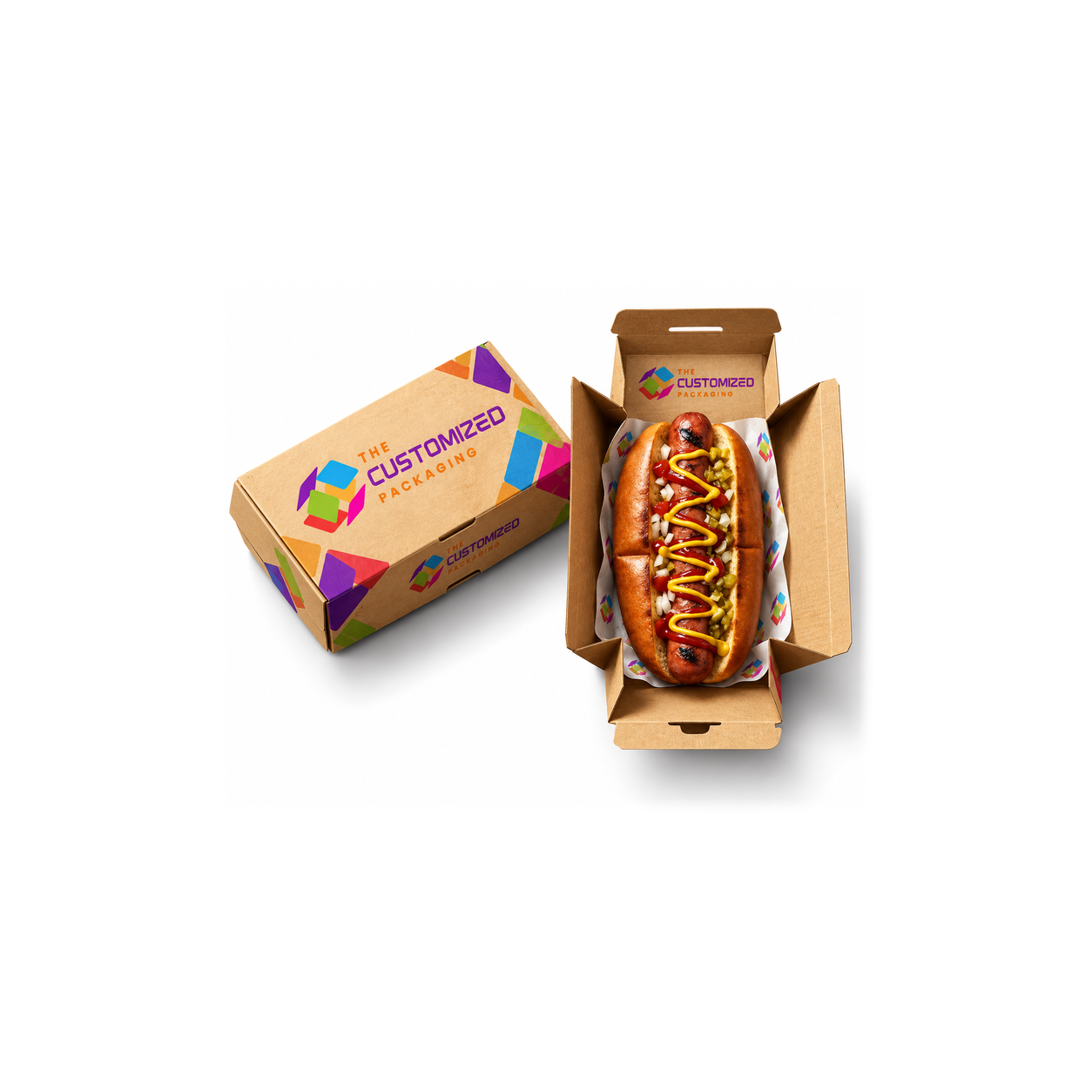
Custom Hot Dog Boxes are designed to package hot dogs in a clean, secure, and convenient format for takeaway, counter service, catering, events, and customer delivery. The dimensions, material, ventilation, closure, grease resistance, and printing can be customized according to the actual hot dog.
Hot dogs vary in bun length, sausage size, topping height, sauce quantity, and serving style. A plain hot dog may fit inside a shallow rectangular box, while a chili cheese hot dog requires additional depth, better grease resistance, and a structure that prevents toppings from touching the lid.
Proper sizing helps keep the bun supported without compressing it. It also reduces movement that may cause sauces, onions, cheese, or other toppings to shift during carrying and transportation.
What Are Custom Hot Dog Boxes?
Custom Hot Dog Boxes are paper-based food containers manufactured around the dimensions and packaging requirements of prepared hot dogs. They can be produced for standard hot dogs, footlong servings, loaded hot dogs, and other required sizes.
The box may include a hinged lid, tuck closure, locking tabs, ventilation openings, greaseproof liner, tear-away serving panel, or built-in paper support. The exterior can be printed with a restaurant logo, brand colors, promotional artwork, menu information, handling guidance, or QR code.
Unlike fixed-size stock packaging, custom dimensions allow the box to account for the bun, sausage, toppings, liner, and required removal clearance.
Choosing the Correct Hot Dog Box Size
The hot dog should be measured after the bun, sausage, sauces, and toppings have been fully assembled. Measurements should include the longest, widest, and highest parts of the serving.
The box should provide enough internal height to prevent cheese, chili, onions, relish, or other toppings from touching the lid. Excessive internal space should also be avoided because it can allow the hot dog to slide and lose its presentation.
| Hot Dog Type | Measurements to Confirm | Recommended Packaging Format |
|---|---|---|
| Standard Hot Dog | Bun length, bun width, and overall serving height | Compact rectangular box with hinged or tuck lid |
| Footlong Hot Dog | Full length, width, and topping clearance | Extended rectangular box with reinforced base |
| Chili Dog | Bun size, chili depth, and sauce movement | Deep grease-resistant box with secure corners |
| Cheese-Topped Hot Dog | Maximum topping height and heat level | Ventilated box with additional lid clearance |
| Loaded Hot Dog | Full topping width, height, and combined weight | Wide box with raised side walls and firm base |
| Hot Dog with Side Portion | Combined food dimensions and separation space | Divided box with a fitted paperboard section |
| Multiple Hot Dogs | Total arranged length, width, and weight | Reinforced box with paperboard separators |
A structural sample should be tested with the actual prepared serving because bun sizes and topping arrangements can differ even when the sausage length remains the same.
Food-Safe Materials for Custom Hot Dog Boxes
The material should provide enough strength to support the hot dog while managing heat, steam, grease, and sauce contact.
| Material | Recommended Application | Main Advantages | Important Consideration |
|---|---|---|---|
| Food-Safe SBS Paperboard | Standard hot dogs and counter service | Smooth printing surface and clean folding | May require a grease-resistant internal barrier |
| Grease-Resistant Paperboard | Chili, cheese, buttered, and saucy hot dogs | Helps reduce oil penetration and visible staining | Barrier level should match the food and holding time |
| Natural Kraft Board | Minimal and natural-looking presentation | Paper-based appearance and suitable for simple branding | Printed colors may appear muted on brown stock |
| White Kraft Board | Bright branded hot dog packaging | Cleaner background for detailed printing | Thickness should match the weight of the serving |
| E-Flute Corrugated Board | Footlong and heavily loaded hot dogs | Improved compression resistance and stronger walls | Creates a thicker finished structure |
| F-Flute Corrugated Board | Printed delivery boxes with added support | Slimmer flute and relatively smooth print surface | Sampling is recommended before production |
Food-Safe Paperboard
Food-safe paperboard is suitable for folding hot dog boxes with tuck flaps, hinged lids, auto-lock bottoms, or tear-away serving panels. It provides a printable surface for logos, patterns, product names, and promotional messages.
When the hot dog makes direct contact with the packaging, the selected board, coating, ink, and adhesive should be suitable for the intended food-contact conditions.
Grease-Resistant Board
Hot dogs containing cheese, chili, butter, mayonnaise, or oily sauces can stain untreated paperboard. Grease-resistant stock, a food-safe internal barrier, or a separate greaseproof liner can help protect the structure.
The required level of resistance depends on the temperature, sauce quantity, holding time, and amount of direct contact with the box.
Kraft Hot Dog Boxes
Natural kraft provides a simple paper appearance that works well with single-color logos, labels, minimal graphics, and bold typography. White kraft provides a brighter surface for detailed or multicolor printing.
Kraft boxes can also include ventilation openings, locking tabs, tear-away panels, and greaseproof liners.
Custom Hot Dog Box Styles
The structure should be selected according to the serving size, topping quantity, packing speed, takeaway method, and required customer experience.
| Hot Dog Box Style | Structure | Recommended Use | Available Features |
|---|---|---|---|
| Hinged-Lid Box | Lid attached to the base | Standard and loaded hot dogs | Vent holes, locking tabs, greaseproof liner |
| Tuck-Top Box | Lid closes through a front or side flap | Counter service and takeaway | Secure closure, printed panels, tear strip |
| Auto-Lock Bottom Box | Pre-glued base locks during assembly | Faster packing and heavier servings | Reinforced bottom, deep walls, ventilation |
| Footlong Hot Dog Box | Extended rectangular structure | Longer buns and sausages | Side supports, raised lid, grease-resistant base |
| Mailer-Style Box | Attached lid with folded side walls | Delivery and branded presentation | Interior printing, locking panels, vents |
| Tear-Away Serving Box | Removable or folding lid section | Eating directly from the packaging | Perforated opening, hand grip, greaseproof base |
| Sleeve and Inner Box | Printed sleeve around an internal food box | Premium branded presentation | Custom sleeve, pull opening, printed interior |
| Compartment Hot Dog Box | Internal section beside the main serving | Hot dog with separated condiment or side portion | Paper divider, sauce-cup support, reinforced base |
Hinged-Lid Hot Dog Boxes
A hinged-lid structure keeps the top and base connected, allowing quick packing and closing. Locking tabs can help prevent the lid from opening during carrying.
The internal height should be based on the complete serving rather than only the bun. Loaded toppings require enough clearance to prevent direct contact with the lid.
Footlong Hot Dog Boxes
Footlong hot dogs require an extended box with enough base strength to prevent bending. The structure can include folded side supports, locking corners, and a reinforced bottom.
The box length should include a small amount of clearance at both ends without leaving enough empty space for the hot dog to slide.
Tear-Away Hot Dog Boxes
A tear-away or perforated panel allows part of the box to be removed or folded back while eating. This can reduce direct hand contact with the hot dog and provide a convenient serving format.
The perforation should open cleanly without weakening the box during transportation. Its position should be tested with the actual hot dog and serving method.
Ventilation for Hot Hot Dogs
Freshly prepared hot dogs can release steam after packing. If the steam remains trapped, condensation may collect inside the box and soften the bun.
Small ventilation openings can be added to the lid, side walls, or rear panel. Their size and number should balance moisture release with heat retention.
A plain hot dog may need less ventilation than a hot dog containing chili, melted cheese, grilled onions, or other heated toppings. The correct vent pattern should be tested under the expected takeaway or delivery conditions.
Greaseproof Liners and Leak Control
A greaseproof liner can provide an additional barrier between the food and the box. It may be supplied as a flat sheet, folded wrap, shaped base liner, or partially raised insert.
| Interior Feature | Main Purpose | Recommended Application |
|---|---|---|
| Flat Greaseproof Liner | Reduces grease contact with the base | Standard hot dogs |
| Folded Paper Wrap | Controls sauces and loose toppings | Chili and loaded hot dogs |
| Raised Side Liner | Helps contain toppings near the bun | Cheese, onion, and relish-topped hot dogs |
| Die-Cut Base Support | Reduces sideways movement | Delivery and footlong hot dogs |
| Paperboard Divider | Separates a condiment or side section | Combined serving boxes |
| Sauce-Cup Support | Holds a small sauce container upright | Hot dogs served with a separate dip |
| End Support Tabs | Limit forward and backward movement | Footlong and delivery packaging |
The liner should not be folded so tightly that it compresses the bun or causes toppings to spill.
Custom Printing and Branding
Custom Printed Hot Dog Boxes can display artwork on the lid, base, side walls, closing flap, inner panel, or outer sleeve.
CMYK printing supports detailed multicolor designs, gradients, patterns, and food imagery. Pantone printing can be used for selected solid brand colors. Digital printing may suit samples and selected quantities, while offset printing can provide consistent reproduction for larger orders.
Printed information can include the business logo, hot dog name, ingredients, allergy guidance, promotional message, website, social media details, QR code, or reheating instructions.
Areas that may touch the food should use materials and printing specifications suitable for the intended application.
Surface and Protective Finishes
Matte coating creates a smooth, less reflective printed appearance. Gloss coating gives colors a brighter and more reflective finish. Aqueous coatings can provide surface protection for selected paper-based packaging.
Embossing, debossing, foil stamping, and spot UV can highlight exterior branding. Decorative finishes should remain away from direct food-contact areas unless specifically approved for that use.
Sustainable Hot Dog Packaging Options
Custom Hot Dog Boxes can be manufactured using recyclable paperboard, recycled-content stock, natural kraft, white kraft, FSC-certified paper, and paper-based internal supports.
Right-sized dimensions reduce unused material and unnecessary internal space. Paper liners, cardboard dividers, and locking paper closures can also reduce the need for separate plastic components.
The recyclability of the finished box depends on food residue, grease, coatings, adhesives, inks, laminations, and any additional components.
Sampling Before Full Production
A structural sample should be tested with the actual hot dog, bun, toppings, and liner. This helps confirm the internal size, lid clearance, base strength, grease resistance, ventilation, closure, and ease of eating from the box.
Separate samples may be necessary for standard, footlong, and heavily loaded hot dogs because each serving places different demands on the packaging.
Estimate the Cost of Custom Hot Dog Boxes
The price of Custom Hot Dog Boxes depends on the dimensions, material, board thickness, grease-resistant treatment, ventilation pattern, printing coverage, liner, box style, order quantity, and delivery destination.
A simple standard-size folding carton generally requires less material than a reinforced footlong box with vents, a greaseproof liner, tear-away panel, and interior printing.
Accurate quotation details should include the fully assembled hot dog dimensions, serving temperature, topping type, required quantity, preferred material, box structure, printing requirements, liner needs, and delivery location.
Build Hot Dog Packaging Around the Complete Serving
Custom Hot Dog Boxes should be designed around the bun, sausage, toppings, sauces, serving temperature, and delivery method. Correct sizing, food-safe materials, grease resistance, and ventilation can protect the bun while reducing leaks and unwanted movement.
A product-specific structure also provides a visible surface for branding and serving information while creating a cleaner takeaway or delivery experience.
Ventilation holes are useful for freshly prepared hot dogs because steam can collect inside a closed box and soften the bun. Small openings can be added to the lid or side walls to release part of the moisture while retaining reasonable heat. The vent size should be tested according to the serving temperature, toppings, and expected delivery time.
Measure the hot dog after placing the sausage, sauces, cheese, chili, onions, and other toppings inside the bun. Record its full length, widest point, and maximum height without pressing the food. Space for a greaseproof liner and easy removal should also be added to the internal dimensions.
A deeper grease-resistant box with secure corners and adequate lid clearance is suitable for chili cheese hot dogs. A folded greaseproof liner can help contain the chili, melted cheese, and oil. The box should also have enough base strength to support the additional weight without bending.
A correctly sized extended box can include folded end tabs, side supports, or a die-cut base insert. These features limit movement without pressing against the bun. The internal length should remain slightly longer than the complete serving so the hot dog can be inserted and removed easily.
A hot dog box should only be used in a microwave or another heating appliance when its material, ink, coating, adhesive, liner, and decorative components are specifically approved for that purpose. Unless the packaging is clearly specified as suitable for reheating, the hot dog should be transferred to an appropriate container first.
Related Products


Order Custom Hot Dog Boxes from The Customized Packaging
We manufacture Custom Hot Dog Boxes for businesses that need reliable product protection, accurate printing, and professional packaging for retail, ecommerce, storage, or shipping. Each box can be customized by size, material, structure, printing, coatings, finishes, inserts, and order quantity.
Share your artwork and quantity targets for Custom Hot Dog Boxes and we will recommend the most cost-effective structure for your timeline. or speak with a packaging expert. Browse custom rigid boxes, packaging inserts, and use our Custom Box Packaging Cost Calculator.