

| Specification | Available Options |
|---|---|
| Suitable Products | Personal pizzas, traditional round pizzas, deep-dish pizzas, square pizzas, flatbreads and selected pizza-style meals |
| Primary Uses | Pizzerias, restaurants, cafés, ghost kitchens, food trucks, catering, pickup and local delivery |
| Required Measurements | Finished diameter or length and width, crust height, topping height, total weight, liner and pizza-saver clearance |
| Materials | E-flute, B-flute, micro-flute, white-top corrugated board, kraft corrugated board and customer-approved food-contact liners |
| Box Styles | Standard pizza box, personal pizza box, deep-dish box, square pizza box, flatbread carton and reinforced delivery box |
| Dimensions | Fully customized around the finished pizza and required internal components |
| Pizza Sizes | Personal, small, medium, large, extra-large and fully custom dimensions |
| Box Depth | Standard, extra depth, deep-dish height and customer-specified clearance |
| Lid Support | Reinforced lid, support tabs, pizza-saver allowance, stronger flute and custom lid structure |
| Wall Construction | Single wall, rolled side wall, reinforced front wall, double side panels and customer-specified construction |
| Ventilation | Side vents, rear slots, corner openings, lid perforations, controlled folding gaps and no ventilation |
| Grease Management | Grease-resistant board where suitable, paper liner, corrugated circle, parchment-style sheet and untreated construction |
| Base Support | Standard corrugated base, reinforced base, corrugated circle, double layer and customer-specified support |
| Closures | Front tuck, side lock, corner lock, reinforced front tab and custom closure |
| Printing Methods | Flexographic, digital, offset-laminated, CMYK, Pantone, white ink and one-color printing |
| Branding Areas | Lid, front wall, side panels, rear panel, interior lid and selected base areas |
| Information Areas | Restaurant logo, menu details, QR code, promotional offer, reheating guidance, allergens and contact information |
| Pizza-and-Side Options | Sauce holder, divider, seasoning section, side compartment and separate side-package coordination |
| Food-Contact Position | Confirmed according to board, liners, coatings, inks, adhesives, temperature and contact duration |
| PFAS Position | Request documentation for grease-resistant treatments intended for current U.S. food-contact use |
| Heat Position | Performance depends on pizza temperature, box construction, ventilation, delivery time and delivery bag |
| Reheating Position | Standard printed pizza boxes are not automatically microwave-safe or oven-safe |
| Frozen Use | Frozen retail pizza requires separately specified primary and freezer packaging |
| Delivery Performance | Evaluated according to filled-box weight, stack height, handling method, delivery bag and travel time |
| Environmental Options | Right-sized boxes, kraft liners, paper pizza circles, paper liners and reduced-plastic configurations |
| Proofing | Digital proof, dieline proof, structural sample, pizza-fit test, hot-food trial, stack test and printed prototype |
| Artwork Files | Print-ready AI, EPS, PDF or PSD with outlined fonts, bleed and approved dieline placement |
| Minimum Order Quantity | Varies according to size, board grade, structure, printing, ventilation and liner requirements |
| Production Timing | Confirmed after dimensions, structure, food-use details, artwork, proofing and quantity are approved |
| Delivery | Available throughout the USA and other supported destinations |
| Pricing | Based on dimensions, corrugated grade, structure, vents, liners, printing coverage, quantity and delivery |
| Design Support | Assistance with pizza sizing, board selection, lid clearance, ventilation, stacking, dielines and artwork |
Custom Packaging for Whole Pizzas, Slices, Flatbreads, and Delivery Meals
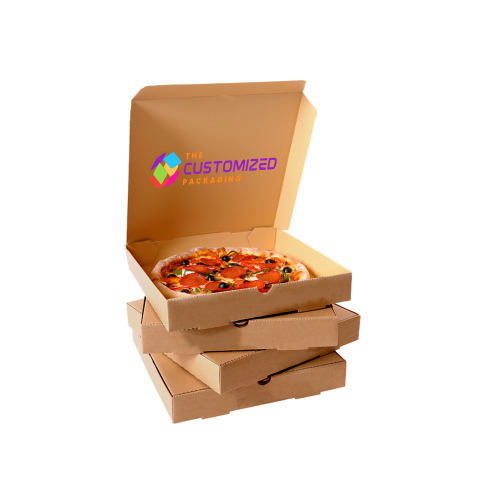
Custom Pizza Boxes help restaurants, pizzerias, cafes, food trucks, caterers, ghost kitchens, grocery retailers, event vendors, and frozen-food brands package pizzas according to their actual diameter, crust style, topping height, weight, temperature, and distribution requirements.
A thin-crust personal pizza needs a different structure from a heavily topped family pizza, deep-dish product, square Sicilian pizza, stuffed crust, flatbread, calzone, or pizza-by-the-slice order. The box should therefore be developed around the complete product rather than a general pizza-size label.
A correctly sized box can help reduce sliding, limit contact between toppings and the lid, provide room for controlled ventilation, support efficient stacking, and present the restaurant’s branding clearly. Custom features can include locking front tabs, reinforced corners, ventilation openings, grease-management components, perforated serving sections, sauce-cup areas, tamper-evident labels, order-identification panels, and coordinated delivery packaging.
The pizza should remain on a suitable liner, board, tray, pan, or other verified food-contact component. Standard decorative corrugated board should not automatically contact exposed food unless the relevant liners, inks, coatings, adhesives, and materials have been specifically selected and verified for the intended food-service application.
Suitable Pizza Products and Packaging Applications
| Pizza Product | Recommended Packaging Application |
|---|---|
| Personal Pizza | Compact corrugated carton with secure front lock |
| Small Round Pizza | Standard shallow box with ventilation |
| Medium Pizza | Reinforced folding carton for pickup and delivery |
| Large Pizza | Strong corrugated box with controlled stacking |
| Extra-Large Pizza | Heavy-duty carton with reinforced corners |
| Thin-Crust Pizza | Shallow box with limited headspace |
| Thick-Crust Pizza | Deeper box with additional topping clearance |
| Deep-Dish Pizza | Tall corrugated carton with strong base support |
| Stuffed-Crust Pizza | Increased internal height and side-wall clearance |
| Square Pizza | Square or rectangular box matched to exact dimensions |
| Sicilian Pizza | Deep rectangular carton with reinforced base |
| Flatbread Pizza | Slim rectangular box or tray-and-sleeve packaging |
| Pizza Slices | Triangular slice boxes or rectangular portion cartons |
| Mini Pizzas | Individual cartons or divided multipack boxes |
| Calzones | Compact tuck cartons or divided takeaway boxes |
| Frozen Pizza | Printed secondary carton around suitable sealed primary wrapping |
| Catering Pizza | Large reinforced boxes and organized master carriers |
| Event Pizza | Bulk-service cartons with sponsor or event branding |
What Are Custom Pizza Boxes?
Custom pizza boxes are food-service cartons designed around the width, length, diameter, height, weight, and carrying requirements of pizza products.
Most are manufactured from corrugated board because the fluted layer provides stiffness, cushioning, stacking strength, and insulation-like separation between the food and the external environment. However, a standard pizza box does not provide controlled insulation, active heating, refrigeration, or guaranteed temperature retention.
The box may use a hinged lid, front locking tabs, side flaps, rear hinge, tuck closures, ventilation holes, perforated sections, carrying grips, tamper labels, or reinforced base panels.
Pizza packaging can be manufactured for pickup, local delivery, catering, grocery retail, events, frozen products, slices, and specialty menu items.
Pizza Boxes Compared with General Food Cartons
| Feature | Custom Pizza Boxes | General Food Cartons |
|---|---|---|
| Shape | Wide and shallow | Varies by product |
| Base Support | Developed around pizza weight and diameter | May not support broad food products |
| Ventilation | Often included for steam management | May have limited ventilation |
| Topping Clearance | Customizable for crust and toppings | General dimensions may cause lid contact |
| Stacking | Designed for limited box-on-box stacking | Depends on carton style |
| Branding Area | Large top panel for logos and artwork | Smaller or divided panels |
| Delivery Use | Commonly developed for bags and insulated carriers | May focus on counter service |
| Slice Packaging | Dedicated triangular and rectangular formats available | Usually not product-specific |
| Grease Management | Can use liners and selected board systems | May require separate components |
| Opening Experience | Broad hinged lid with front locks | Tuck, clamshell, sleeve, or tray formats |
Common Pizza Box Sizes
| Pizza Size | Typical Packaging Application |
|---|---|
| 6-Inch | Mini pizzas and individual portions |
| 7-Inch | Personal pizzas and small flatbreads |
| 8-Inch | Personal and kids’ pizzas |
| 9-Inch | Compact takeaway pizzas |
| 10-Inch | Small restaurant pizzas |
| 11-Inch | Specialty small and medium pizzas |
| 12-Inch | Common medium pizza size |
| 13-Inch | Medium-to-large menu products |
| 14-Inch | Standard large pizza |
| 15-Inch | Large specialty pizza |
| 16-Inch | Family-size pizza |
| 18-Inch | Extra-large and party pizza |
| 20-Inch | Catering and group orders |
| Custom Dimensions | Square pizza, flatbread, deep dish, and brand-specific products |
The stated diameter should not be the only measurement used. Crust projection, topping height, pizza board, liner, decorative picks, pan size, and product variation should also be considered.
Measuring Pizza for Custom Packaging
Important measurements include the pizza’s widest diameter or rectangular dimensions, total height, crust thickness, topping height, packed weight, liner size, board size, and desired ventilation clearance.
Round pizzas should be measured at their widest point. Square or rectangular pizzas should be measured across the full crust and any supporting tray or board.
The lid should remain above the toppings without creating excessive unused height. Too little clearance can cause cheese and toppings to stick to the lid, while excessive clearance may allow faster heat loss and product movement.
Customers can provide physical samples, product photographs, pan dimensions, menu specifications, current box references, or technical drawings.
Right-Sized Pizza Packaging
Right-sized pizza boxes help reduce unnecessary board while improving stacking, carrying, and presentation.
A box that is too small can crush crust edges, press against toppings, bend the pizza, or prevent secure closure. A box that is too large can allow sliding, create a poor visual presentation, and use more storage and delivery space.
The structure should allow practical loading while maintaining a secure fit around the pizza, board, liner, or tray.
Corrugated Material Options
| Material | Recommended Application | Main Characteristics |
|---|---|---|
| E-Flute Corrugated | Premium printed and lightweight pizza cartons | Slim profile and clean print surface |
| B-Flute Corrugated | Standard delivery and larger pizzas | Good cushioning and puncture resistance |
| C-Flute Corrugated | Heavy pizzas and large catering cartons | Greater thickness and support |
| F-Flute Corrugated | Compact personal pizzas and detailed printing | Fine flute and precise folding |
| EB Double-Wall | Heavy family meals and demanding delivery | Combined strength with layered construction |
| BC Double-Wall | Oversized pizzas and bulk food-service cases | High compression and stacking support |
| White-Top Corrugated | Bright full-color branding | Clean outer print surface |
| Natural Kraft Corrugated | Traditional pizzeria appearance | Brown exterior and strong fibers |
| Coated Corrugated | Selected moisture- and grease-management systems | Performance depends on the applied coating |
| Specialty Food-Service Board | Selected direct-contact applications | Must be verified for intended use |
Material selection should reflect pizza diameter, product weight, delivery time, grease exposure, humidity, stacking, printing requirements, and storage conditions.
E-Flute Pizza Boxes
E-flute offers a thinner corrugated profile suitable for personal pizzas, premium retail presentation, flatbreads, bakery-style pizzas, and full-color printing.
Its smaller flutes can create cleaner folds and smoother graphics than thicker corrugated grades.
E-flute may not be sufficient for every heavy or oversized pizza. The board combination and product weight should be evaluated together.
B-Flute Pizza Boxes
B-flute is commonly selected for standard pizza delivery because it provides a balance between rigidity, cushioning, and manageable thickness.
It can support medium, large, and extra-large pizzas depending on board grade and structure.
The box should still be tested for base flexing, lid contact, grease exposure, stacking, and delivery performance.
Natural Kraft Pizza Boxes
Natural kraft corrugated boxes provide a traditional, casual pizzeria appearance.
They can use one-color printing, black graphics, red or green brand colors, white ink where technically suitable, labels, stamps, or simple patterns.
A kraft appearance does not automatically establish that the box is recyclable, compostable, biodegradable, food-safe, or environmentally preferable. Claims should consider liners, coatings, inks, adhesives, food residue, and local recycling programs.
White Pizza Boxes
White-top corrugated boxes provide a bright surface for detailed artwork, colorful logos, food illustrations, menu promotions, and franchise branding.
They are suitable for premium restaurants, grocery retail, seasonal campaigns, entertainment partnerships, and product launches.
White surfaces may show grease, sauce, dirt, and handling marks more clearly than kraft board.
Black Pizza Boxes
Black pizza boxes can support premium restaurant concepts, gourmet pizzas, events, and limited-edition campaigns.
White ink, metallic graphics, spot effects, and contrasting labels can create visual impact.
Dark printing should not reduce the readability of order information, QR codes, handling instructions, or disposal guidance.
Popular Pizza Box Styles
| Box Style | Main Features | Recommended Use |
|---|---|---|
| Standard Hinged Pizza Box | One-piece corrugated structure with front lock | Restaurant pickup and delivery |
| Tuck-Front Pizza Box | Front tab secures the lid | Standard round pizzas |
| Reinforced Pizza Box | Stronger base and corner construction | Heavy and heavily topped pizzas |
| Deep-Dish Pizza Box | Increased wall and lid height | Deep-dish and stuffed pizzas |
| Slice Pizza Box | Triangular or rectangular portion package | Pizza-by-the-slice service |
| Mini Pizza Box | Compact structure | Personal pizzas and kids’ meals |
| Square Pizza Box | Equal-length panels | Square and Detroit-style pizzas |
| Rectangular Pizza Box | Extended length | Flatbreads and rectangular pizzas |
| Window Pizza Box | Viewing panel in the lid | Retail display and premium presentation |
| Tamper-Evident Pizza Box | Seal, tear strip, or security tab | Delivery and third-party orders |
| Pizza Tray and Sleeve | Sliding or wrapped presentation | Retail, frozen, and premium applications |
| Handle Pizza Carrier | Carrying structure for multiple items | Catering and group orders |
| Frozen Pizza Carton | Printed folding carton around sealed product | Grocery retail |
| Shelf-Ready Pizza Case | Converts into freezer or retail display | Wholesale and supermarket distribution |
Standard Hinged Pizza Boxes
The standard pizza box uses a broad base, hinged rear panel, folding side walls, lid, and front locking tab.
It can be supplied flat for efficient storage and assembled during service. Side flaps and front locks help keep the structure closed without adhesive.
The design should be easy for staff to form quickly while remaining stable under the pizza’s weight.
Deep-Dish Pizza Boxes
Deep-dish pizzas require greater internal height and stronger base support.
The box should account for the baking pan or board, tall crust, cheese, toppings, and overall product weight. Increased lid height should not reduce side-wall stability.
B-flute, C-flute, reinforced bases, or double-wall structures may be considered for especially heavy products.
Square and Rectangular Pizza Boxes
Square and rectangular boxes are suitable for Sicilian pizza, Detroit-style pizza, flatbreads, sheet-pan products, and specialty bakery pizzas.
The dimensions should match the actual product rather than placing a rectangular pizza inside an oversized square carton.
Reinforced side walls may be useful for long boxes that could bow during carrying.
Mini Pizza Boxes
Mini pizza cartons can package six-inch, seven-inch, eight-inch, or other compact products.
They are suitable for personal pizzas, kids’ meals, events, samples, and grocery products.
The box can include playful artwork, product names, sauce sections, and individual customer labels.
Custom Printed Pizza Boxes
Custom printed pizza boxes can display the restaurant logo, menu items, slogans, promotional offers, QR codes, social-media information, reheating guidance, allergen messages, order checkboxes, and delivery instructions.
Available printing methods include flexographic, digital, offset-laminated, screen, CMYK, Pantone matching, white ink, and one-color printing.
Printing can appear on the top panel, side walls, front lock, interior lid, base exterior, tamper seal, label, and outer delivery packaging.
Custom Pizza Boxes with Logo
Custom pizza boxes with logo help restaurants maintain consistent branding from the kitchen to the customer’s home.
The top lid provides a large display area for the logo, while side panels can carry contact information, menu categories, QR codes, slogans, and handling guidance.
One-color logo printing is suitable for classic kraft boxes, while full-color designs support franchise systems, seasonal campaigns, product launches, and event collaborations.
Pizza Boxes with Accessory Sections
Boxes can include areas for chili flakes, grated cheese sachets, napkins, cutlery, promotional cards, or dipping sauces.
Accessories should not press against the pizza or interfere with closure and ventilation.
Non-food accessories should remain separate from exposed food.
Pizza Boxes with Windows
Windows can reveal the pizza or primary wrapped product without opening the carton.
They may be suitable for grocery retail, frozen pizza, bakery display, or premium takeaway presentation.
Transparent film can affect ventilation, condensation, strength, and recyclability. The window should not contact hot pizza unless every relevant component has been selected and verified.
Pizza Boxes for Delivery
Delivery exposes pizza boxes to stacking, vibration, tilting, temperature changes, condensation, and extended holding.
The box should fit securely inside the delivery bag and should not slide excessively. Heavy meal containers and drinks should not be stacked on top of pizza boxes.
Delivery testing should include the actual pizza, liner, number of stacked boxes, insulated carrier, route duration, and expected weather conditions.
Packaging can reduce movement and heat loss but cannot guarantee that a pizza will arrive at a specific temperature or in perfect condition under every delay or handling situation.
Insulated Delivery Bag Compatibility
Pizza boxes can be sized around standard or custom insulated delivery bags.
Boxes that are too large may bend or prevent the bag from closing. Boxes that are too small may move excessively during transport.
The number of pizzas commonly carried together should guide box height, stacking strength, and bag dimensions.
Pizza Boxes for Restaurants
Restaurants can use custom cartons for pickup, delivery, catering, events, and seasonal menu promotions.
Packaging can coordinate with burger boxes, fry cartons, food trays, napkins, bags, cup sleeves, and sauce labels.
Printed checkboxes can identify pizza size, crust, topping, customer name, order number, dietary version, or delivery platform.
Pizza Boxes for Food Trucks
Food trucks benefit from flat-packed boxes that store compactly and assemble quickly.
Mini-pizza, slice, and flatbread cartons are especially practical for mobile operations.
Boxes should remain easy to carry and open when customers are standing or eating outdoors.
Pizza Boxes for Events and Stadiums
Events, stadiums, festivals, schools, conferences, and concerts may use slice boxes, mini-pizza cartons, and sponsor-branded packaging.
Artwork can include event names, dates, sponsor logos, schedules, QR codes, and promotional messages.
High-volume packaging should be easy to store, assemble, distribute, and discard according to local systems.
Pizza Boxes for Grocery Retail
Retail pizza boxes can package fresh, chilled, prepared, take-and-bake, or frozen products inside suitable primary packaging.
The carton may require product names, ingredients, allergens, nutrition information, preparation guidance, storage instructions, net quantity, barcode, date coding, and retailer information.
The responsible food business should verify all labeling and product claims.
QR Codes and Digital Integration
QR codes can connect customers to menus, ordering pages, loyalty programs, allergen details, reheating guidance, promotions, social-media pages, or surveys.
The code should appear on a flat, high-contrast area and should be tested on the printed carton.
Placement should avoid ventilation holes, folds, grease-prone surfaces, reflective finishes, and delivery labels.
Barcodes and Retail Identification
Frozen, chilled, take-and-bake, and grocery pizzas can include UPC codes, EAN codes, SKUs, product references, size information, and retailer labels.
Barcodes should remain on clean, flat, high-contrast panels.
A finished sample should be scanned before production approval.
Wholesale Custom Pizza Boxes
Wholesale custom pizza boxes help restaurants, pizzerias, franchises, ghost kitchens, caterers, food trucks, grocery retailers, and food-service distributors maintain consistent branding across sizes and locations.
Larger production quantities can reduce average unit pricing when dimensions, board grade, artwork, and structure remain consistent.
Wholesale programs can include personal, small, medium, large, extra-large, slice, flatbread, deep-dish, frozen, and catering boxes.
Custom Pizza Box Cost Calculator
Use our Custom Box Packaging Cost Calculator to receive a preliminary estimate for your pizza-packaging project. Enter the pizza dimensions, height, packed weight, quantity, corrugated material, box style, ventilation, liner requirements, printing coverage, and finishing options.
Want to know the cost of your product’s packaging? Try our Custom Box Packaging Cost Calculator.
The calculator can help compare kraft pizza boxes, white printed cartons, slice boxes, deep-dish boxes, flatbread packaging, frozen pizza cartons, and wholesale restaurant boxes.
Final pricing is confirmed after reviewing the pizza size, product weight, flute grade, structure, food-contact requirements, printing method, quantity, packing process, and delivery destination.
Factors That Affect Pizza Box Pricing
| Cost Factor | How It Affects the Price |
|---|---|
| Pizza Dimensions | Larger pizzas require more corrugated material |
| Internal Height | Deep-dish and heavily topped pizzas need deeper boxes |
| Packed Weight | Heavy products require stronger board grades |
| Flute Type | F-flute, E-flute, B-flute, and double-wall options vary in cost |
| Board Finish | Natural kraft and white-top liners have different pricing |
| Printing Method | One-color flexographic and full-color printing have different production costs |
| Printing Coverage | Large top graphics and printed interiors increase ink and setup requirements |
| Ventilation | Custom vent holes and patterns may add tooling |
| Liners and Pads | Food-contact sheets and support pads add components |
| Windows | Die-cut openings and transparent films add materials |
| Tamper Features | Labels, paper bands, and tear strips increase cost |
| Artwork Variations | Multiple sizes, stores, promotions, and menu versions add setup |
| Order Quantity | Larger quantities generally reduce average unit pricing |
| Delivery Destination | Freight depends on flat-packed volume, weight, and location |
Why Choose The Customized Packaging?
The Customized Packaging manufactures custom pizza packaging for restaurants, pizzerias, cafes, food trucks, ghost kitchens, caterers, event vendors, grocery retailers, franchise systems, and food-service distributors.
Customers can choose custom dimensions, natural kraft and white corrugated materials, multiple flute grades, standard hinged boxes, slice cartons, deep-dish structures, windows, ventilation, tamper seals, interior printing, and full-color branding.
Whether you need custom pizza boxes with logo, kraft delivery cartons, white printed boxes, pizza-slice packaging, deep-dish boxes, flatbread cartons, frozen pizza packaging, or wholesale pizza boxes in the USA, we can manufacture boxes according to your menu and branding requirements.
Buy Custom Pizza Boxes Online
To request a quotation, provide the pizza diameter or rectangular dimensions, total product height, packed weight, liner or board size, quantity, preferred flute, box style, ventilation needs, printing coverage, artwork versions, tamper features, and delivery destination.
Our packaging specialists can help you buy custom pizza boxes online, compare low-minimum and wholesale pricing, and develop packaging for pickup, delivery, catering, events, grocery retail, frozen products, and franchise programs.
Choose The Customized Packaging for custom printed pizza boxes, corrugated food cartons with logo, kraft delivery boxes, slice packaging, deep-dish cartons, full-color restaurant boxes, and wholesale custom food packaging delivered throughout the USA.
Yes, our pizza boxes are made with food-grade materials that meet safety standards.
Yes, our durable and insulated designs help retain heat and freshness during transport.
Absolutely! We provide vibrant, full-color printing for logos, graphics, and promotions.
Yes, we offer recyclable, biodegradable, and compostable pizza box options.
Yes, we offer competitive bulk pricing and flexible order quantities.
Related Products










Order Custom Pizza Boxes from The Customized Packaging
We manufacture Custom Pizza Boxes for businesses that need reliable product protection, accurate printing, and professional packaging for retail, ecommerce, storage, or shipping. Each box can be customized by size, material, structure, printing, coatings, finishes, inserts, and order quantity.
Share your artwork and quantity targets for Custom Pizza Boxes and we will recommend the most cost-effective structure for your timeline. or speak with a packaging expert. Browse custom rigid boxes, packaging inserts, and use our Custom Box Packaging Cost Calculator.