
| Specification | Available Options |
| Product Type | Custom soft foam packaging inserts |
| Common Foam Type | Soft polyurethane or project-specific flexible foam |
| Foam Characteristic | Compressible, flexible, cushioning |
| Construction | Single-layer, multilayer, laminated, base-and-cavity |
| Cavity Shapes | Rectangular, circular, curved, contoured, stepped, divided |
| Cavity Depth | Shallow, partial-depth, deep, multilayer |
| Insert Layout | Single product, multiproduct, accessory compartments |
| Removal Features | Finger notch, side clearance, ribbon lift, pull area |
| Base Foam | Integrated layer, separate pad, bonded base |
| Lid Foam | Flat, convoluted, custom thickness, none |
| Surface Options | Plain foam, contrasting layers, selected fabric coverings |
| Foam Density | Selected according to product weight and application |
| Foam Thickness | Custom according to cavity depth and box dimensions |
| Outer Boxes | Rigid, two-piece, magnetic, sleeve-and-tray, folding carton, corrugated mailer |
| Product Applications | Cosmetics, fragrance, jewelry, glassware, collectibles, accessories, electronics |
| Outer-Box Printing | CMYK, Pantone, digital, offset |
| Outer-Box Finishes | Matte, gloss, soft-touch, foil, embossing, debossing, spot UV |
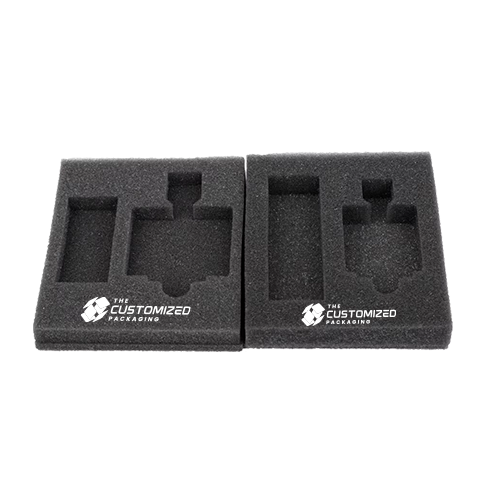
Custom soft foam inserts are developed around the actual dimensions, shape, weight, and presentation position of the products placed inside the box.
Unlike firmer EVA foam, softer foam compresses more easily and can provide gentler contact around lightweight or surface-sensitive products. The correct material, density, thickness, and cavity design should still be selected according to the specific product rather than assuming one foam specification is suitable for every application.
Key Customization Options
- Custom product-shaped cavities
- Single-layer and multilayer inserts
- Shallow and deep recesses
- Separate accessory compartments
- Finger notches and removal gaps
- Flat base foam
- Flat or convoluted lid foam
- Contrasting foam layers
- Selected fabric-covered surfaces
- Custom sizing around the outer box
- Single-product and multiproduct layouts
What Is Soft Foam Packaging?
Soft foam packaging generally uses a more flexible, compressible foam structure than rigid EPS or firmer EVA inserts.
Polyurethane foam is commonly used in flexible packaging inserts, although the exact material specification should be confirmed for each project. Density, firmness, thickness, cell structure, and surface treatment can vary according to the intended product and packaging system.
The foam can fill unused space, form fitted cavities, separate products, and provide a softer contact surface inside the outer box.
Soft Foam Compared With Other Inserts
| Insert Material | Main Characteristic | Best Suited For |
|---|---|---|
| Soft Foam | Flexible and compressible | Delicate, lightweight and presentation-sensitive products |
| EVA Foam | Firmer and more structured | Precision cavities, tools, electronics and premium presentation |
| Pluck Foam | Pre-scored and manually configurable | Equipment cases and changing product layouts |
| EPS Foam | Lightweight and relatively rigid | Structural shipping supports, end caps and heavier products |
| Paperboard Insert | Folded paper-based structure | Retail products, bottles and lightweight sets |
Custom Product Cavities
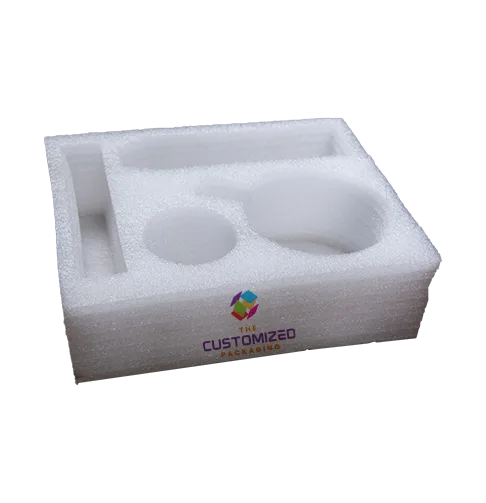
Soft foam can be shaped around individual products so each item has a designated position inside the package.
Cavity layouts can include:
- Rectangular recesses
- Circular bottle openings
- Curved product shapes
- Accessory compartments
- Long channels
- Shallow trays
- Stepped cavities
- Multiproduct arrangements
The cavity should allow enough clearance for loading and removal while limiting unnecessary movement.
Products with projecting buttons, pumps, caps, switches, handles, or decorative surfaces may require additional clearance around sensitive areas.
Foam Density and Thickness
Soft foam is available in different densities and thicknesses.
A lightweight cosmetic bottle may require a different foam specification from a glass accessory, electronic device, or multiproduct kit.
The design should consider:
- Product weight
- Product fragility
- Surface sensitivity
- Cavity depth
- Foam beneath the product
- Foam between adjacent cavities
- Outer-box dimensions
- Expected handling
Density should therefore be selected together with foam thickness and cavity geometry rather than as an isolated specification.
Single-Layer Foam Inserts
A single foam layer can work well for shallow products and straightforward layouts.
Cavities can be cut into the layer while leaving sufficient material around each product to support the insert.
A separate base pad may be placed underneath when the cavity extends through most of the upper layer.
Multilayer Soft Foam Inserts
Several foam layers can be combined when products have different heights or require deeper cavities.
A multilayer insert can include:
- Solid bottom pad
- Main cavity layer
- Secondary accessory layer
- Decorative top layer
- Contrasting foam colors
- Lid cushioning
Layered construction also allows products to sit at different presentation heights.
Finger Notches and Product Removal
Closely fitted products can be difficult to remove without an access area.
Finger notches can be positioned beside:
- Bottles
- Jars
- Small devices
- Jewelry cases
- Tools
- Glass components
- Accessories
Ribbon lifts or pull areas can also be considered where the product sits deeply inside the insert.
The removal feature should be planned before the cavity layout is finalized.
Lid Foam
Foam can also be placed inside the lid to help control vertical movement when the package is closed.
Flat Lid Foam
Flat foam creates an even cushioned surface above the products.
Convoluted Foam
Convoluted or egg-crate-style foam has a shaped surface that can accommodate products with slightly different heights.
Lid foam should not place excessive pressure on delicate switches, glass surfaces, pumps, decorative finishes, or other sensitive components.
Fabric-Covered Soft Foam
Selected projects can use a fabric or velvet-style covering over the visible foam surface.
This can create a softer presentation for:
- Jewelry
- Collectibles
- Glassware
- Awards
- Gifts
- Premium accessories
The suitability of the covering depends on the foam type, cavity shape, adhesive system, product surface, and manufacturing method.
Compatible Outer Box Styles
Soft foam inserts can be paired with several packaging structures.
| Outer Box | Typical Application |
| Magnetic Rigid Box | Premium cosmetics, gifts, fragrance and presentation sets |
| Two-Piece Rigid Box | Jewelry, glassware, collectibles and accessories |
| Sleeve-and-Tray Box | Samples, cosmetics and electronic accessories |
| Corrugated Mailer Box | Product kits and selected shipped goods |
| Folding Carton | Lightweight retail products |
| Presentation Box | Sales samples, promotional sets and gift collections |
The insert should be developed around the usable internal dimensions of the outer box rather than the exterior box dimensions.
Soft Foam for Cosmetics and Fragrance
Soft foam can create individual recesses for bottles, jars, applicators, caps, and accessories.
For fragrance packaging, the foam can support the bottle around selected areas while leaving the label or decorative front visible.
Finger notches can make tightly fitted bottles easier to remove.
Soft Foam for Jewelry and Accessories
Small compartments can separate watches, bracelets, ornaments, jewelry cases, and accessories.
A fabric-covered surface may be considered where presentation and softer visible contact are priorities.
Soft Foam for Glassware and Collectibles
Glass, decorative objects, samples, and collectibles can use shaped cavities with spacing between individual items.
The exact foam specification should be reviewed alongside the product weight and fragility because soft foam alone should not be assumed to provide sufficient shipping protection for every fragile product.
Soft Foam for Electronics Accessories
Soft foam can organize lightweight devices, cables, chargers, adapters, controls, and related accessories inside presentation boxes.
For heavier equipment or applications needing a firmer precision cavity, EVA or another material may be more appropriate.
Custom Branding and Outer-Box Printing
The main branding area is normally the outer box rather than the foam itself.
The box can include:
- Company logo
- Product name
- Instructions
- Product map
- QR code
- Barcode
- Interior message
- Accessory labels
Rigid boxes can also use foil, embossing, debossing, spot UV, printed wraps, and other decorative treatments.
Selected foam projects may support additional surface treatments or applied branding depending on the material and manufacturing method.
Designing the Right Soft Foam Insert
The strongest insert begins with accurate product measurements.
Provide the maximum length, width, and height of each item, including caps, handles, switches, cables, and other projections.
The final design should coordinate the foam density, thickness, cavity depth, product spacing, removal clearance, lid foam, and outer-box dimensions so the complete packaging system fits together correctly.
Flexible polyurethane foam is commonly used for soft cushioning inserts. The final material, firmness, density, and thickness depend on the product weight, fragility, surface finish, cavity depth, and intended application.
Soft polyurethane foam is more compressible and flexible. EVA foam is generally firmer and creates a more structured cavity. Soft foam may be preferred for delicate or lightweight products, while EVA may be more suitable for defined presentation layouts or heavier items.
Yes. The foam can be cut into circular, rectangular, curved, stepped, and irregular cavities. The achievable detail depends on the foam thickness, firmness, cavity depth, spacing, and selected cutting method.
Yes. One insert can include separate recesses for a main product, accessories, cables, bottles, samples, instruction cards, or replacement components. Adequate foam must remain between neighbouring cavities.
They can help cushion products and reduce movement inside suitable outer packaging. Shipping performance also depends on the product weight, foam specification, cavity fit, outer box, closure, and expected handling conditions.
Related Products


Order Custom Soft Foam Inserts from The Customized Packaging
We manufacture Custom Soft Foam Inserts for businesses that need reliable product protection, accurate printing, and professional packaging for retail, ecommerce, storage, or shipping. Each box can be customized by size, material, structure, printing, coatings, finishes, inserts, and order quantity.
Share your artwork and quantity targets for Custom Soft Foam Inserts and we will recommend the most cost-effective structure for your timeline. or speak with a packaging expert. Browse custom rigid boxes, packaging inserts, and use our Custom Box Packaging Cost Calculator.