
| Specification | Available Options |
|---|---|
| Product Name | Custom Pick-and-Pluck Foam Inserts |
| Foam Type | Pre-scored or pre-cubed configurable foam |
| Common Foam Material | Polyurethane and approved alternatives |
| Configuration | Customer-plucked, prepared layout or replacement insert |
| Foam Layers | Single layer, multiple layers and custom total depth |
| Grid Options | Small, medium and larger pre-scored sections |
| Base Foam | Solid pad, separate base, bonded base or custom thickness |
| Lid Foam | Flat foam, convoluted foam or no lid pad |
| Foam Density | Selected according to product weight and application |
| Cavity Depth | Shallow, partial, full-depth, stepped or multilayer |
| Removal Features | Finger clearance, side gaps, ribbon lifts and pull tabs |
| Outer Packaging | Corrugated, rigid, sleeve-and-tray, hinged or customer-supplied case |
| Printing | Exterior, interior, logo, labels, instructions and product maps |
| Premium Finishes | Foil, embossing, debossing, spot UV and lamination |
| Anti-Static Options | Verified ESD foam subject to project requirements |
| Order Quantity | Flexible minimum and wholesale quantities |
| Delivery | Available throughout the USA |
| Pricing Factors | Size, density, grid, layers, pads, layout, outer box and quantity |
Flexible Foam Protection for Boxes and Equipment Cases
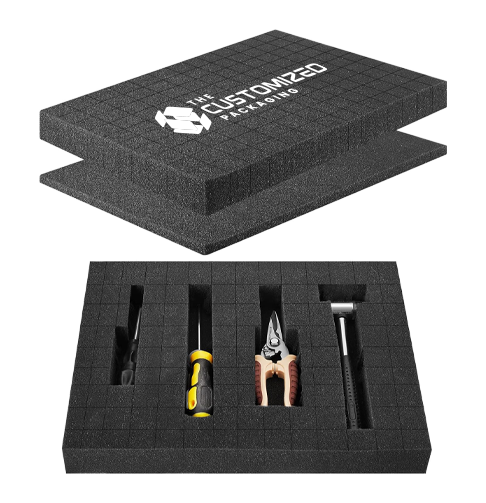
Pick and pluck foam inserts provide a flexible way to organise several products inside one box or case. Instead of cutting every cavity with specialised machinery, the foam is divided into small pre-scored sections that can be separated by hand.
The product arrangement is marked on the foam before the required sections are removed. The remaining foam forms walls around the products, while a solid layer underneath can provide bottom support. This makes pluck foam suitable for prototypes, changing equipment collections, replacement case interiors, demonstration kits, and projects where the final arrangement may not always remain the same.
How Pick-and-Pluck Foam Works
A pre-cubed foam insert contains a grid of partially separated foam sections. Individual sections are removed to create rectangular, stepped, or approximately contoured cavities.
Smaller foam sections can follow compact products and accessories more closely. Larger sections may be faster to remove and can leave wider supporting walls, although the completed cavity will have less detail.
Pluck foam should not be expected to match the exact outline created by CNC-cut EVA or polyethylene foam. It is better suited to adjustable layouts, moderate precision, changing product kits, and simpler cavity shapes.
Foam Material and Density
Pick-and-pluck inserts are commonly produced from polyurethane foam, although the exact material must be confirmed for each project. Polyurethane foam is available in different densities and may also be used for flat pads, convoluted lid liners, and fabricated cushioning components.
Foam density should be selected according to the packed product’s weight, fragility, dimensions, and expected frequency of use. Lightweight accessories may work with a softer foam, while heavier equipment may require a firmer material or an alternative precision-cut insert.
Density should not be selected independently from foam thickness. The amount of material beneath the product and between adjacent cavities also affects how the complete insert performs.
Single-Layer and Multilayer Inserts
A basic custom pluck foam insert may contain one pre-scored layer placed above a solid base pad. Deeper boxes and cases can use multiple pluck layers.
Different layers can be removed to different depths. This allows one product to sit near the top of the insert while another product rests deeper inside the case.
A solid lower pad prevents products from passing through the insert and separates them from the bottom of the outer box. The base may be supplied separately or bonded to the pluck layer depending on the required construction.
Flat and Convoluted Lid Foam
A lid pad can reduce vertical movement when the box or case is closed. Flat lid foam provides an even surface, while convoluted or egg-crate-style foam can accommodate products with slightly different heights.
The lid foam should not apply continuous pressure to fragile switches, screens, lenses, buttons, nozzles, or connectors. Product height and lid clearance should be confirmed before the complete foam depth is approved.
Customer-Configured Foam Inserts
Customer-configured inserts are supplied with the pre-scored foam sections intact. The customer positions the products, marks the intended cavities, and removes the required sections.
This option is suitable when product arrangements change, several case layouts are being tested, replacement foam is needed, or a business wants to configure equipment internally.
Adequate material should remain around the outer edges and between neighbouring cavities. Removing too much foam can weaken the remaining walls or allow products to contact one another.
Prepared Product Layouts
The foam may also be prepared according to an approved product arrangement. Product measurements, photographs, drawings, or physical samples are reviewed before the required sections are removed.
Prepared layouts can create greater consistency across repeated sales kits, employee tool cases, demonstration boxes, equipment sets, and product sample collections.
For projects requiring highly accurate outlines, narrow walls, detailed branding, or repeated industrial use, a custom-cut EVA or polyethylene insert may be more appropriate than manually plucked foam.
Measure the Box or Case Interior
Provide the usable internal length, width, and depth of the outer box or case. Measurements should include the available space inside the base and lid rather than only the exterior case dimensions.
Rounded corners, hinges, locking mechanisms, handle fittings, lid lips, and closure areas may reduce the available space. These details should be included when the foam is being produced for an existing case.
A physical case sample or an accurate internal drawing may be requested when the interior shape is irregular.
Measure Every Product
Provide the maximum length, width, depth, and complete packed weight of every item. Measurements should include handles, buttons, switches, cables, protective caps, connectors, and other projecting components.
Also identify the intended product orientation and the surfaces that need to remain visible. Closely fitted products may require finger-clearance areas or pull spaces to make removal easier.
For multiproduct kits, the complete layout should be planned before selecting the foam grid, layer depth, and outer case dimensions.
Recommended Applications
| Application | Possible foam arrangement |
|---|---|
| Tool and repair kits | Individual spaces for tools, meters, parts and accessories |
| Camera equipment | Separate cavities for camera bodies, lenses, batteries and chargers |
| Electronics | Organised spaces for devices, cables, adapters and accessories |
| Measuring instruments | Supported areas for meters, gauges and testing equipment |
| Product samples | Multiple compartments for samples, literature and demonstration items |
| Sales kits | Product cavities with printed instructions or presentation materials |
| Collectibles | Individual recesses for stored or displayed items |
| Replacement cases | Configurable foam for existing equipment or transport cases |
Tools and Heavy Equipment
Tools, measuring equipment, repair accessories, and maintenance components can be organised with pick and pluck foam for cases.
Heavy products should be distributed across the available insert area instead of concentrating the load in one small section. Sufficient foam should remain beneath the product and around the cavity walls.
Sharp edges may tear softer pluck foam along the pre-scored grid. Protective guards, wider foam separation, rigid dividers, or firmer precision-cut materials may be required for sharp or frequently used equipment.
Cameras, Electronics and Instruments
Camera bodies, lenses, batteries, chargers, and accessories can be separated into individual compartments. The layout should avoid placing pressure on lenses, screens, dials, mounting points, or connectors.
Standard black foam should not automatically be treated as anti-static. Electronics containing exposed circuit boards or electrostatic-sensitive components may require a verified anti-static, static-dissipative, or conductive foam specification.
color alone does not confirm that a foam offers suitable electrostatic protection. Required ESD properties should be defined and documented before production.
Compatible Outer Box Styles
| Outer packaging | Recommended use |
|---|---|
| Corrugated mailer box | Shipping, tools, equipment, samples and ecommerce kits |
| Rigid presentation box | Sales kits, demonstrations, premium products and samples |
| Sleeve-and-tray box | Accessories, product collections and presentation sets |
| Hinged box | Frequently accessed equipment or product kits |
| Equipment case | Tools, cameras, instruments and reusable storage |
| Customer-supplied case | Replacement or revised foam interior |
The outer packaging should be selected according to the combined product weight, presentation requirements, shipping method, and expected handling conditions.
Custom Printing and Branding
The outer box can be printed with a logo, product name, kit identification, instructions, QR code, barcode, arrangement guide, or handling information.
Corrugated boxes can use exterior or selected interior printing. Rigid presentation boxes can include printed wraps, foil stamping, embossing, debossing, spot UV, matte lamination, or other premium finishes.
Product maps or cavity labels can be added to the interior lid when users need to return tools or components to assigned positions.
Shipping and Product Protection
Foam insert boxes can help reduce movement and separate products, but their performance depends on the complete packaging system. The product, foam density, insert depth, remaining foam walls, outer box, closure, and shipping carton must work together.
Fragile, heavy, calibrated, or high-value equipment may require a prototype and shipping evaluation. Testing may include drops, vibration, compression, repeated handling, and changes in product orientation.
A manually configured foam cavity should not be represented as guaranteed protection for every parcel-shipping condition.
Moisture, Chemical and Environmental Limitations
Standard pluck foam is not automatically waterproof, moisture-barrier, solvent-resistant, sterile, food-safe, or medical-grade.
Products involving oils, fuels, cleaning solutions, solvents, or high humidity should be reviewed for material compatibility. The protective properties of an outer waterproof case do not automatically apply to the foam inside it.
Recycling and disposal options vary according to the foam material, adhesives, additives, and available local facilities. Environmental claims should be confirmed for the exact foam specification rather than applied to every insert.
Quantities and Pricing
Pricing for custom pluck foam insert boxes depends on the insert dimensions, foam material, density, grid size, number of layers, base pad, lid foam, prepared layout, outer box style, printing, finishing, quantity, and delivery destination.
Customer-configured inserts may be suitable for lower-volume or changing layouts. Prepared foam assemblies, custom outer packaging, specialty materials, and printed presentation boxes may require different minimum quantities.
Use the Custom Box Packaging Cost Calculator for a preliminary estimate of the outer box. Foam pricing is confirmed after the internal box dimensions, layer construction, product arrangement, material, and quantity have been reviewed.
Why Choose The Customized Packaging?
The Customized Packaging coordinates the foam insert and outer box as one complete packaging system. This helps ensure that the foam dimensions, layer depth, box interior, product arrangement, and printed presentation work together.
Our team can assist with internal case measurements, foam selection, layer planning, product arrangement, outer box structure, dielines, artwork, sampling, and production.
Share your case dimensions, product measurements, product weights, preferred arrangement, outer box style, quantity, and delivery location to receive a tailored quotation.
We manufacture Custom Pluck Foam Insert Boxes to your exact length, width, and depth. Send product dimensions or a sample and we will recommend a dieline with appropriate board caliper for pluck foam insert.
Yes. Custom Pluck Foam Insert Boxes support full-color exterior and interior printing, Pantone matching, and finishing upgrades such as foil, embossing, or spot UV depending on your artwork and budget.
MOQs for Custom Pluck Foam Insert Boxes depend on box style, size, and print complexity. We offer competitive minimums for startups and volume pricing for wholesale retail and ecommerce programs.
Standard lead times for Custom Pluck Foam Insert Boxes vary with quantity and finishing. After proof approval, most default runs ship within a few weeks; rush options may be available for launch deadlines.
Yes. We specify board strength, closures, and optional inserts so Custom Pluck Foam Insert Boxes protect pluck foam insert during parcel transit and arrive retail-ready for your customers.
Related Products


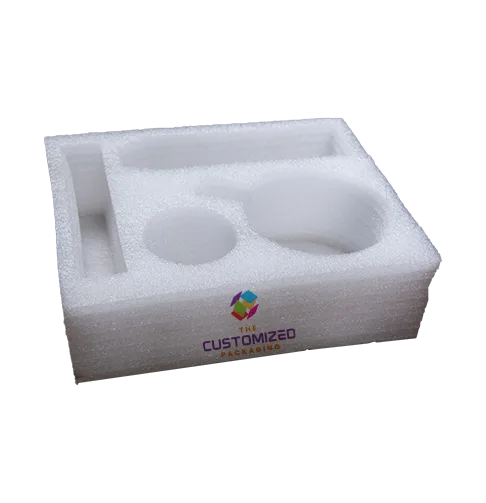
Order Custom Pluck Foam Inserts from The Customized Packaging
We manufacture Custom Pluck Foam Inserts for businesses that need reliable product protection, accurate printing, and professional packaging for retail, ecommerce, storage, or shipping. Each box can be customized by size, material, structure, printing, coatings, finishes, inserts, and order quantity.
Share your artwork and quantity targets for Custom Pluck Foam Inserts and we will recommend the most cost-effective structure for your timeline. or speak with a packaging expert. Browse custom rigid boxes, packaging inserts, and use our Custom Box Packaging Cost Calculator.