
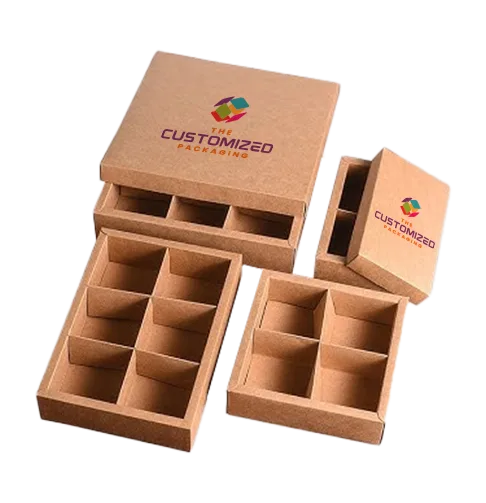

| Specification | Available options |
|---|---|
| Product name | Custom EVA Foam Insert Boxes |
| Insert material | EVA foam in selected densities and thicknesses |
| Outer box materials | Rigid board, paperboard, kraft board and corrugated board |
| Box styles | Magnetic closure, two-piece, sleeve-and-tray, folding carton, mailer and presentation box |
| Insert construction | Single-layer, multi-layer, laminated and compartmentalised |
| Cutting options | Die-cut, CNC-cut and contour-cut options according to project requirements |
| Cavity options | Product recesses, accessory compartments, channels, slots and irregular cutouts |
| Removal features | Finger notches, pull areas and raised product positions |
| Foam colors | Black, white and selected custom colors subject to availability |
| Surface options | Plain foam, contrasting layers and selected fabric-covered surfaces |
| Box printing | CMYK, Pantone, interior printing and selected digital or offset methods |
| Box finishes | Matte, gloss, soft-touch, foil, embossing, debossing and spot UV |
| Product arrangement | Single product, multiproduct kit or divided component layout |
| Sizing | customized according to product and box dimensions |
| Sampling | Digital layout and physical sample options according to project |
| Order quantity | Flexible minimum and wholesale quantities based on specifications |
| Delivery | Available throughout the USA |
| Pricing factors | Size, density, thickness, layers, cutouts, box style, printing, finishes and quantity |
Precision-Cut EVA Foam Inserts for Product Packaging
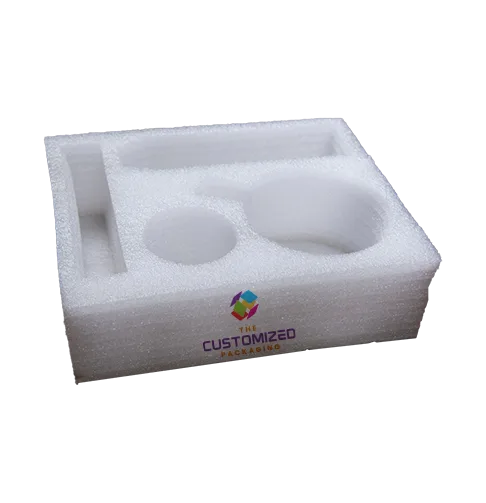
Products can become scratched, displaced, or damaged when they are placed inside packaging with too much unused space. Custom EVA foam inserts are designed around the dimensions and arrangement of the actual products, creating dedicated cavities that help limit movement inside the box.
The insert can be designed for one product or several components. Separate cutouts may be created for the main item, accessories, cables, bottles, tools, instruction booklets, sample containers, or replacement parts.
Unlike loose foam sheets or generic padding, custom-cut foam inserts allow the entire presentation to be planned before production. The cavity position, product orientation, spacing, depth, and removal method can all be adjusted according to the product.
What Is EVA Foam?
EVA stands for ethylene-vinyl acetate. In packaging applications, it is commonly used as a firm foam material that can be cut into precise shapes and layered to support products.
Its smooth appearance and structured feel make it suitable for protective packaging that also requires an organised presentation. Depending on the project, the foam can be produced in different thicknesses, densities, colors, and layered constructions.
EVA should not automatically be selected for every product. The ideal insert depends on product weight, fragility, surface sensitivity, cavity depth, shipping conditions, and the type of outer box. Softer foam, corrugated supports, molded pulp, or paperboard inserts may be more appropriate for certain applications.
Custom Cavities, Cutouts and Compartments
Every insert can be designed around the product’s length, width, height, and shape. Rectangular, circular, curved, and irregular cavities may be created depending on the available cutting method and product profile.
Finger notches can be positioned beside the product to make removal easier. Channels can accommodate cables, straps, handles, or narrow accessories. Different cavity depths can hold products at varying heights while maintaining a balanced presentation.
For packaging sets, the insert can include several compartments within one foam layer. Products that require deeper support may use several laminated foam layers rather than one thick sheet.
The clearance around the product should be carefully planned. A cavity that is too loose may allow movement, while an excessively tight opening can make the product difficult to insert or remove.
Layered EVA Foam Packaging Inserts
Layered construction allows the insert to support products with different heights, profiles, or accessories. A solid base layer may be placed beneath one or more cut layers to prevent products from falling through the insert.
A contrasting top layer can also be used to create visual separation between the foam surface and the cavities. For example, a dark top sheet may be paired with a lighter lower layer to make each opening more visible.
Layer thickness, adhesive selection, surface covering, and cavity depth are confirmed according to the design and production method.
Compatible Box Styles
Boxes with EVA foam inserts can be produced in several structures depending on the required presentation, protection, and budget.
| Box style | Recommended applications |
|---|---|
| Magnetic closure rigid box | Premium electronics, cosmetics, fragrance, presentation kits and gifts |
| Two-piece rigid box | jewelry, accessories, collectibles, glassware and luxury products |
| Sleeve-and-tray box | Cosmetics, electronics accessories, samples and promotional sets |
| Folding carton | Lightweight products requiring a compact retail presentation |
| Corrugated mailer box | Ecommerce products, equipment, tools and products requiring shipping protection |
| Presentation case | Product demonstrations, sales samples and organised component sets |
The foam insert should be designed together with the internal dimensions of the outer box. Developing the insert and box independently can create fitting problems during assembly.
EVA Foam for Rigid Boxes
Rigid packaging is one of the most common applications for EVA foam packaging inserts. The firm box walls provide presentation and structural support, while the foam insert holds the products in their intended positions.
Magnetic rigid boxes can include foam cavities for bottles, jars, devices, accessories, jewelry, promotional products, or product collections. Two-piece boxes can use a full-depth insert or a raised foam platform depending on how much of the product should remain visible.
The outer rigid box can be wrapped with printed paper and enhanced with foil stamping, embossing, debossing, spot UV, or other selected finishes.
EVA Foam Inserts for Mailer and Shipping Boxes
Custom EVA foam insert boxes can also be developed for shipping applications. In these projects, the outer corrugated structure provides transportation strength while the insert helps control product movement.
The packaging design should account for the complete packed weight, product fragility, cavity fit, foam thickness, empty space, stacking, and expected handling conditions.
EVA inserts alone do not guarantee shipping performance. The outer box material, flute type, construction, closure, and complete packed configuration should also be reviewed and tested where protection is critical.
Product Applications
These inserts can be customized for products that require both organisation and presentation.
| Application | Possible insert arrangement |
|---|---|
| Electronics | Device cavity with separate spaces for cables, chargers and accessories |
| Tools and components | Individual tool outlines, finger notches and labelled positions |
| Cosmetics | Cutouts for bottles, jars, applicators and product sets |
| Fragrances | Fitted bottle recess with support around the base and sides |
| jewelry | Cavities, slots or raised sections for individual pieces |
| Glassware | Shaped compartments with suitable spacing between products |
| Promotional kits | Multiple cavities for samples, literature and branded merchandise |
| Collectibles | Contoured openings that hold each item in a fixed display position |
Product suitability should be confirmed using the actual item dimensions, weight, surface finish, and handling requirements.
EVA Foam Compared with Other Insert Materials
| Insert material | General characteristics | Common applications |
|---|---|---|
| EVA foam | Firm, structured and suitable for precise cavities | Premium boxes, tools, electronics, cosmetics and product kits |
| Soft PU foam | More flexible and compressible | Lightweight or delicate products requiring softer contact |
| Corrugated insert | Paper-based and structurally supportive | Shipping boxes, product separation and heavier items |
| Paperboard insert | Printable and suitable for folded compartments | Cosmetics, retail cartons, bottles and lightweight products |
| molded pulp | Formed paper-fiber structure | Bottles, jars, electronics and selected sustainable packaging programmes |
The correct material should be selected according to protection requirements, product weight, branding, budget, minimum quantity, and disposal goals.
colors and Surface Presentation
Black and white are common insert colors because they work with many packaging designs, but other colors may be reviewed depending on the required foam specification and quantity.
The foam can also use a contrasting top layer or selected surface covering to create a different appearance. A soft fabric or velvet-style surface may be considered for products where the visible presentation or contact surface is important.
Availability depends on the foam type, density, thickness, color, surface treatment, quantity, and manufacturing method.
Logo and Branding Options
The most reliable branding area is normally the outer box. It can feature your logo, brand colors, product information, instructions, QR codes, barcodes, and promotional artwork.
Selected insert projects may also support a printed, engraved, embossed, or separately applied logo treatment, depending on the foam surface and production process. These options should be reviewed using the actual logo artwork before they are included in a quotation.
Exterior box finishes may include matte or gloss lamination, foil stamping, embossing, debossing, spot UV, soft-touch coating, and interior printing.
Designing the Insert Around Your Product
Accurate measurements are essential for creating custom foam inserts for boxes. Provide the maximum length, width, and height of each product, including caps, buttons, handles, cables, and other projecting parts.
You should also identify the preferred product orientation, number of items per box, accessory arrangement, required cavity depth, and whether finger notches are needed.
Product photographs can help during the initial review, but a physical sample, technical drawing, CAD file, or 3D model may be requested for irregular or high-precision products.
The final design should confirm both the insert dimensions and the internal dimensions of the box.
Foam Density and Thickness
Foam density and thickness affect how the insert supports the product. A heavier item may require a firmer specification or more material around the cavity, while a lightweight product may require less support.
The amount of foam beneath and around the product should be considered along with the cavity shape. Narrow walls between adjacent cavities may tear or distort when products are inserted, so sufficient spacing should be maintained.
Density, thickness, layer count, and cavity depth are confirmed after reviewing the product and packaging structure.
Samples and Product-Fit Testing
A prototype or production sample may be recommended before full manufacturing, particularly when the product has an irregular shape, several components, a delicate finish, or strict fitting requirements.
The sample can be used to check cavity placement, product orientation, removal clearance, box fit, presentation, and assembly. Shipping-related packaging may require additional performance testing based on the product and distribution method.
Wholesale Quantities and Pricing
Pricing for custom EVA foam inserts depends on the overall insert dimensions, foam thickness, density, number of layers, cavity complexity, cutting method, color, surface treatment, outer box style, printing, finishing, and order quantity.
Increasing the quantity can reduce the average unit price because design, tooling, setup, and manufacturing costs are distributed across more units.
Minimum quantities vary according to the insert construction and outer packaging. Simple single-layer inserts may have different requirements from multi-layer inserts with complex cavities or surface coverings.
Estimate Your Packaging Cost
Use the Custom Box Packaging Cost Calculator to receive an initial price estimate for the outer box based on its dimensions, material, style, printing, finishes, and quantity.
Because EVA inserts require product-specific cutting and fitting, the insert cost may need to be confirmed separately after the cavity layout, foam specification, number of layers, and product measurements have been reviewed.
Why Choose The Customized Packaging?
The Customized Packaging can coordinate the outer box and the EVA insert as one packaging system. This helps maintain the correct relationship between the box’s internal dimensions, foam size, cavity layout, and finished product presentation.
Our team can assist with structure selection, insert layout, dieline preparation, outer-box artwork, printing, finishing, sampling, and production planning.
Share your product measurements, photographs, required quantity, box preference, delivery destination, and packaging goals to receive a project-specific recommendation.
Provide the length, width, and height of each product, its weight, the desired product orientation, the number of items per box, accessory details, preferred box style, and required quantity. Photographs, technical drawings, CAD files, 3D models, or physical samples may be needed for complex products.
Yes. EVA foam can be cut into many rectangular, circular, curved, and contoured shapes. The achievable detail depends on the foam thickness, density, cavity depth, spacing, cutting method, and product geometry.
Insert-only orders may be reviewed when you already have a compatible box or case. You will need to provide accurate internal box dimensions and product measurements. Ordering the insert and box together helps ensure that both components fit correctly.
EVA is generally firmer and maintains a more structured cavity. Softer polyurethane foam compresses more easily and may be preferred for lightweight or surface-sensitive products. The correct option depends on the product’s weight, fragility, finish, and required presentation.
Selected branding methods may be available depending on the foam surface, artwork, quantity, and production process. The outer box provides a larger and more reliable area for full-colour logo printing, product details, foil stamping, embossing, and spot UV.
Related Products


Order Custom EVA Foam Inserts from The Customized Packaging
We manufacture Custom EVA Foam Inserts for businesses that need reliable product protection, accurate printing, and professional packaging for retail, ecommerce, storage, or shipping. Each box can be customized by size, material, structure, printing, coatings, finishes, inserts, and order quantity.
Share your artwork and quantity targets for Custom EVA Foam Inserts and we will recommend the most cost-effective structure for your timeline. or speak with a packaging expert. Browse custom rigid boxes, packaging inserts, and use our Custom Box Packaging Cost Calculator.