
| Specification | Available Options |
|---|---|
| Product Name | Custom Chocolate Display Boxes |
| Primary Use | Countertop presentation, shelf display, checkout promotion, dispensing, and display shipping |
| Product Compatibility | Wrapped chocolate bars, mini bars, truffle cartons, praline packs, pouches, and tubes |
| Size | Fully customizable according to packaged chocolate dimensions |
| Capacity | Custom unit count, row layout, and compartment arrangement |
| Paperboard | SBS, coated board, recycled paperboard, natural kraft, and white kraft |
| Corrugated Material | F-flute, E-flute, B-flute, white corrugated, and kraft corrugated |
| Display Styles | Countertop tray, bar display, gravity feed, tiered display, shelf-ready tray, and display shipper |
| Interior Options | Vertical dividers, angled channels, gravity-feed sections, tiers, and tube wells |
| Display Features | Raised header, low front lip, perforated opening, loading flap, and removable lid |
| Product Orientation | Upright, horizontal, angled, tiered, or gravity-fed |
| Printing | CMYK, Pantone, digital, offset, flexographic, and litho-laminated printing |
| Printable Areas | Header, front lip, side walls, rear panel, interior base, and dividers |
| Logo Treatments | Printed logo, foil stamping, embossing, debossing, and spot UV |
| Surface Finishes | Matte, gloss, soft-touch, aqueous coating, and selected laminations |
| Window Option | Front, side, top, or custom-shaped clear display window |
| Supply Format | Flat-packed, pre-glued, assembled, or filled display shipper |
| Sustainability Options | Recyclable board, recycled content, kraft, corrugated stock, and FSC-certified paper options |
| Sample Options | Structural prototype, digital proof, plain sample, and printed sample |
| Minimum Order Quantity | Based on dimensions, material, display structure, and printing |
| Production Time | Confirmed after structure and artwork approval |
| Delivery | Based on quantity, assembled format, destination, and shipping method |
Custom Chocolate Display Boxes for Retail Presentation
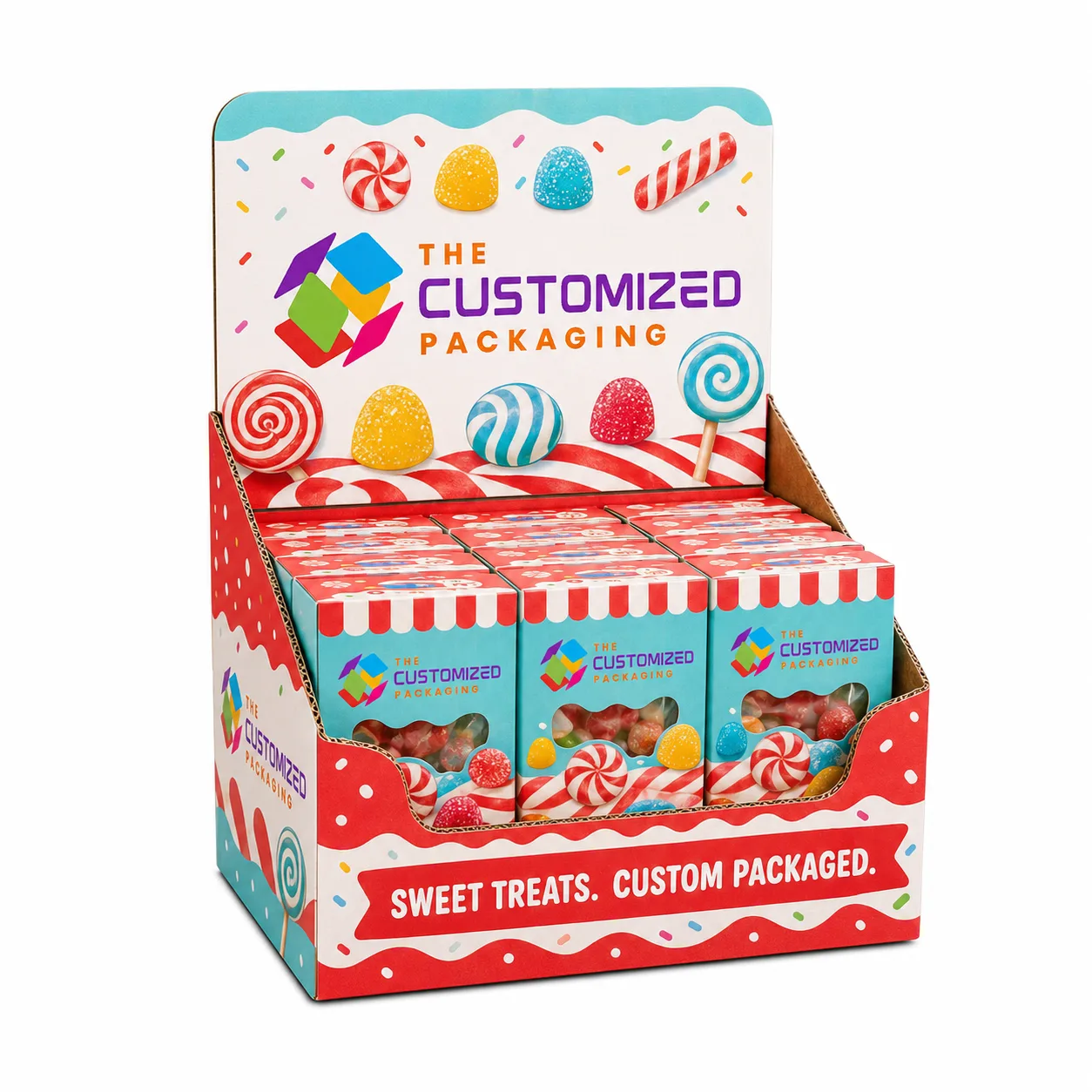
Custom Chocolate Display Boxes are designed to arrange packaged chocolate products in a visible, organized, and accessible retail format. They can be placed on checkout counters, confectionery shelves, promotional tables, café counters, reception areas, and other point-of-sale locations.
The dimensions, material, header height, front opening, product capacity, divider layout, and printing can be customized around the actual chocolate package. This prevents chocolate bars from falling backward, small cartons from becoming hidden behind high walls, and flexible packs from leaning into one another.
Unlike an individual chocolate box given to one customer, a display box holds multiple retail units and remains open for repeated product selection.
What Are Custom Chocolate Display Boxes?
Custom Chocolate Display Boxes are paper-based countertop, shelf-ready, or display-shipping structures manufactured to hold several individually packaged chocolate products.
They can be designed for wrapped chocolate bars, mini bars, truffle cartons, praline packs, chocolate pouches, cylindrical containers, and other sealed chocolate units. The individual chocolates should normally remain inside their suitable primary wrappers, trays, or cartons before being arranged in the display.
The display can include an open front, raised rear header, tiered platform, gravity-feed channel, retaining lip, or perforated conversion panel. Its surfaces provide space for logos, chocolate varieties, promotional messages, product counts, barcodes, QR codes, and approved retail information.
Choosing the Correct Chocolate Display Size
The display should be measured around the complete retail package rather than the unwrapped chocolate. A wrapped bar, truffle carton, pouch, or tube can require more space than the chocolate product alone.
The unit width, depth, height, and filled weight should be measured first. The required number of packages should then be arranged exactly as they will appear inside the display.
| Chocolate Product Format | Measurements to Confirm | Recommended Display Arrangement |
|---|---|---|
| Standard Chocolate Bars | Wrapper width, thickness, height, and unit weight | Upright rows with side dividers |
| Mini Chocolate Bars | Package dimensions, quantity, and row depth | Multi-row tray or gravity-feed channel |
| Truffle Cartons | Outer carton width, depth, height, and weight | Counter display with separate compartments |
| Praline Packs | Complete package size and product orientation | Tiered or open-front arrangement |
| Chocolate Pouches | Filled width, height, thickness, and flexibility | Angled channel with side supports |
| Chocolate Tubes | Tube diameter, cap width, and total height | Die-cut wells or divided sections |
| Assorted Chocolate Varieties | Largest unit dimensions and number of varieties | Printed partitions or labeled channels |
A structural sample should be filled with the actual packaged chocolates before the production order is approved.
Materials for Custom Chocolate Display Boxes
Material selection depends on the display size, total filled weight, retail placement, required printing quality, and whether the display must also protect the products during transportation.
| Material | Recommended Application | Main Advantages | Important Consideration |
|---|---|---|---|
| SBS Paperboard | Lightweight countertop displays | Smooth printing and precise die-cutting | Board thickness must support the total product weight |
| Recycled Paperboard | Paper-based chocolate displays | Recycled-content options and custom printing | Surface appearance varies by selected stock |
| Natural Kraft Board | Minimal and artisan chocolate presentation | Natural paper appearance and simple branding | Printed colors may appear muted |
| White Kraft Board | Bright branded display packaging | Cleaner background for detailed graphics | Filled-display strength should be tested |
| F-Flute Corrugated Board | Compact displays requiring more rigidity | Fine flute and relatively smooth print surface | Thicker than standard paperboard |
| E-Flute Corrugated Board | Counter displays and shelf-ready trays | Stronger walls and improved compression resistance | Requires additional retail space |
| B-Flute Corrugated Board | Larger display shippers and heavier quantities | Greater structural support and cushioning | Creates a bulkier display |
| Litho-Laminated Corrugated | Premium graphics on stronger displays | Detailed printed sheet mounted to corrugated board | Uses an additional laminated paper layer |
Paperboard Chocolate Displays
Paperboard is suitable for small and medium countertop units holding wrapped bars, mini cartons, truffle packs, or lightweight chocolate pouches.
It can be converted into open-top trays, raised-header displays, gravity-feed boxes, and compartment structures. Folded side walls, an auto-lock base, or a double-layer bottom can be added when greater support is required.
Paperboard displays can usually be supplied flat, reducing storage space before assembly.
Corrugated Chocolate Display Boxes
Corrugated material provides greater resistance to bending and compression. It is suitable for heavier chocolate cartons, larger retail quantities, display shippers, and structures that must pass through distribution before reaching the point of sale.
E-flute and F-flute provide relatively compact profiles for countertop and shelf displays. B-flute can be used for larger shippers or displays carrying heavier product quantities.
Custom Chocolate Display Box Styles
The structure should match the chocolate package, retail location, customer access method, and restocking process.
| Display Style | Structure | Recommended Application | Available Features |
|---|---|---|---|
| Countertop Display Tray | Open front with a raised rear panel | Chocolate bars, pouches, and mini cartons | Printed header, front lip, row dividers |
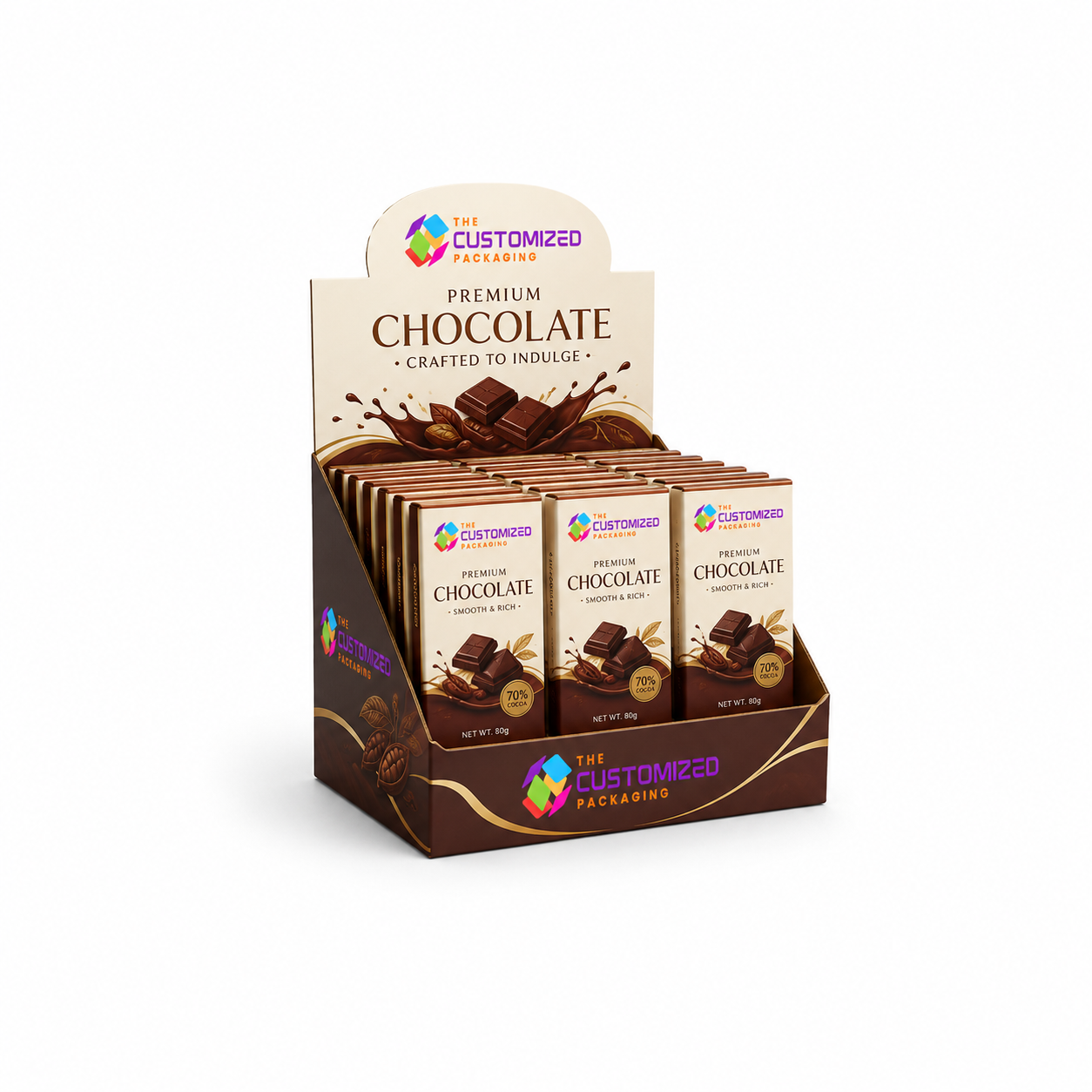
| Chocolate Bar Display | Narrow channels hold bars upright | Standard and mini chocolate bars | Side supports, branded header, angled base |
| Gravity-Feed Display | Products move toward a lower opening | Small bars and compact chocolate packs | Loading flap, dispensing opening, guide channel |
| Tiered Chocolate Display | Rear products sit above the front row | Multiple flavors and bar varieties | Raised platforms and printed sections |
| Shelf-Ready Display Tray | Low-front structure fits retail shelving | Organized rows of packaged chocolates | Side walls, retaining lip, divider channels |
| Display Shipper | Closed carton converts into an open display | Filled transportation and retail presentation | Perforated lid, removable front, printed header |
| Compartment Display | Fixed sections separate product varieties | Truffle cartons and mixed chocolate packs | Printed dividers and individual sections |
| Window Display Box | Enclosed structure with a visible product area | Protected chocolate presentation | Clear window and controlled access opening |
Countertop Chocolate Display Boxes
A countertop display commonly includes a low front retaining panel, supporting side walls, and a raised rear header. The front panel keeps products inside while allowing the package names and designs to remain visible.
The header can display the logo, chocolate collection, flavor message, or promotion. Its height and board thickness should be balanced with the display base so the unit remains stable when fully loaded and when only a few products remain.
Chocolate Bar Display Boxes
Chocolate bars are usually presented upright, angled, or horizontally stacked. Upright presentation keeps the wrapper branding visible but requires side supports or channels that stop the bars from falling backward.
The channel width should follow the wrapped bar thickness. Sufficient finger access should remain so customers can remove one bar without disturbing the rest of the display.
Gravity-Feed Chocolate Displays
A gravity-feed box allows the next packaged chocolate unit to move toward the dispensing opening after the front product has been removed.
The channel angle, width, and dispensing opening should be tested using the actual chocolate package. A narrow channel may cause wrappers to jam, while an oversized opening may release more than one product.
A top or rear loading flap can make the display easier to restock.
Tiered Displays for Chocolate Varieties
A tiered structure raises the rear rows so multiple chocolate flavors or package designs remain visible at the same time.
Each tier can include printed flavor names, color-coded sections, or individual product channels. The rear platform should support the complete product weight without bending or shifting.
Tiered arrangements are useful when similar chocolate packages need to be separated by flavor, cocoa percentage, filling, or collection.
Chocolate Display Shippers
A display shipper protects the chocolate packages during transportation and converts into a retail unit after arrival. The retailer removes or folds back a perforated lid or front panel to expose the products.
The perforation should remain intact during shipping and open cleanly without damaging the printed header. The converted display should remain stable as products are removed.
Dividers, Channels, and Product Supports
Internal supports help keep chocolate packages aligned and separate different flavors or sizes.
| Interior Feature | Main Function | Suitable Application |
|---|---|---|
| Vertical Divider | Separates chocolate rows | Wrapped bars and boxed portions |
| Angled Support | Keeps products facing forward | Bars, pouches, and slim cartons |
| Gravity-Feed Channel | Guides products toward the opening | Mini bars and compact packs |
| Tiered Platform | Raises rear products | Multiple flavors and collections |
| Die-Cut Tube Well | Holds cylindrical packs upright | Chocolate tubes and round containers |
| Front Retaining Lip | Prevents products from sliding out | Countertop and shelf-ready displays |
| Printed Partition | Separates and identifies varieties | Assorted chocolate selections |
Divider spacing should allow easy product removal without leaving enough room for packages to lean or overlap.
Chocolate Protection and Temperature Considerations
Display packaging provides organization and structural support, but it does not refrigerate chocolate or protect it from unsuitable retail temperatures.
Chocolate packages should be displayed away from excessive heat, direct sunlight, and conditions that may affect the product’s texture or appearance. Storage and display temperatures should follow the requirements established for the specific chocolate recipe and primary packaging.
The display should also be placed where it is not exposed to moisture or heat-generating equipment.
Direct Food Contact Considerations
Chocolate Display Boxes normally hold wrapped chocolate bars, sealed pouches, truffle cartons, or other primary packages.
When unwrapped chocolate will contact a paperboard tray or display surface directly, the board, liner, ink, coating, and adhesive must be selected for the intended food-contact application. A suitable primary wrapper, tray, or food-contact liner may be required.
The display box should not be described as maintaining freshness on its own unless the complete packaging structure has been tested for the required barrier performance.
Custom Printing and Branding
Custom Printed Chocolate Display Boxes can carry artwork across the header, front lip, side walls, rear panel, interior base, partitions, and removable shipping panels.
CMYK printing supports detailed multicolor graphics, illustrations, gradients, and product imagery. Pantone printing can help reproduce specific solid brand colors. Digital printing may suit prototypes and selected quantities, while offset or litho-laminated printing can provide consistent graphics for larger orders.
The printed layout can include the logo, chocolate variety, cocoa percentage, flavor, price area, promotional message, product count, barcode, QR code, website, and social media information.
Finishing Options
Matte coating creates a smooth and less reflective appearance. Gloss coating provides greater reflection and can make printed colors appear brighter. Soft-touch lamination can create a premium tactile surface on selected display structures.
Foil stamping can highlight a logo, flavor name, or decorative border. Embossing raises selected artwork, while debossing presses it into the surface. Spot UV adds glossy contrast to specific areas.
Finishes should not interfere with folds, perforations, dispensing openings, barcodes, or essential product information.
Sustainable Chocolate Display Packaging
Custom Chocolate Display Boxes can be manufactured from recyclable paperboard, recycled-content stock, kraft material, corrugated board, and selected FSC-certified paper options.
Right-sized displays reduce unused board and retail space. Integrated paperboard dividers and product channels can reduce the need for separate plastic display components.
The recyclability of the completed display depends on the board, coatings, lamination, adhesives, windows, and decorative finishes.
Sampling Before Full Production
A structural sample should be filled with the actual chocolate packages to test capacity, display stability, divider spacing, product visibility, dispensing performance, header strength, and ease of restocking.
A printed sample can be used to review logo size, color accuracy, promotional visibility, perforation placement, barcode readability, and finishing treatments.
Estimate the Cost of Custom Chocolate Display Boxes
The price depends on the dimensions, material, product capacity, display structure, header size, dividers, printing coverage, finishes, quantity, and delivery destination.
A compact paperboard bar display generally requires fewer materials than a corrugated display shipper with multiple channels, perforated conversion panels, interior printing, and a reinforced header.
Accurate pricing requires the chocolate package dimensions, individual unit weight, number of units per display, preferred arrangement, required display quantity, material, divider requirements, artwork, and delivery location.
Build Chocolate Displays Around the Retail Packages
Custom Chocolate Display Boxes should be engineered around the complete wrapped bars, pouches, tubes, or individual chocolate cartons.
Correct dimensions, stable materials, fitted dividers, visible headers, and convenient product access can keep chocolate packages organized while creating a recognizable branded presentation at the point of sale.
An upright countertop tray with fitted channels or vertical dividers is suitable for wrapped chocolate bars. The front lip should be low enough to reveal the wrapper design, while the side and rear supports keep the bars from leaning or falling backward.
A paperboard or corrugated display provides structural organization but does not refrigerate the chocolate. The display should be kept away from excessive heat, direct sunlight, and unsuitable storage conditions. Temperature control must be managed through the retail environment and the chocolate’s approved storage procedure.
Unwrapped truffles should only contact packaging components suitable for the intended food application. A food-contact-compatible tray, liner, or individual primary package may be required. Standard printed display board should not automatically be assumed suitable for direct chocolate contact.
Packaged chocolate units are loaded into a fitted channel. When the customer removes the front unit, the next package moves toward the dispensing opening. The channel angle and opening must be tested using the actual chocolate package to prevent jamming or multiple products dispensing together.
Yes. A display shipper can be packed with wrapped chocolate products before transportation. Perforated panels are removed or folded back at the retail location to convert the closed carton into an open display. The filled shipper should be tested for compression, movement, and display stability.
Related Products


Order Custom Chocolate Display Boxes from The Customized Packaging
We manufacture Custom Chocolate Display Boxes for businesses that need reliable product protection, accurate printing, and professional packaging for retail, ecommerce, storage, or shipping. Each box can be customized by size, material, structure, printing, coatings, finishes, inserts, and order quantity.
Share your artwork and quantity targets for Custom Chocolate Display Boxes and we will recommend the most cost-effective structure for your timeline. or speak with a packaging expert. Browse custom rigid boxes, packaging inserts, and use our Custom Box Packaging Cost Calculator.