
| Specification | Available Options |
|---|---|
| Product Name | Custom Soap Sleeves |
| Structure | Open-ended paperboard or kraft wrap around an existing soap bar; belly band or wider wraparound band |
| Suitable Soap Types | Handmade bars, glycerin bars, facial cleansing bars, exfoliating bars, solid shampoo or conditioner bars, hotel amenity bars, and event favors after a fit review |
| Custom Dimensions | Cut to the approved maximum length, width, and depth of the fully finished bar, including inner wrap or label build-up |
| Wrap Coverage | Narrow belly band, partial wrap, or full-width wrap around the bar as specified on the dieline |
| Open Ends | One or both ends of the bar remain visible unless a different coverage is approved on the dieline |
| Material Options | Kraft paperboard, white or print-side kraft, SBS or folding paperboard, documented recycled-content paperboard where available |
| Kraft Options | Natural kraft print face or kraft-backed wraps as specified for the order |
| Paperboard Options | SBS or folding paperboard selected by caliper, stiffness, and print surface |
| Printing Methods | Digital, CMYK, Pantone / spot, and selected one-color or limited-coverage print |
| Color Options | Board-face color plus the approved ink set for the artwork |
| Branding Areas | Outer wrap face; keep-out at the glue flap, lock tab, windows, and scuff edges |
| Die Cutting | Custom wrap outline, glue flap, lock tab, and selected openings from the approved dieline |
| Window / Opening Options | Optional die-cut window or cutout when the wrap must show more of the bar; plastic window film is listed only if specified |
| Embossing | Raised mark on a suitable board caliper, clear of the join and windows |
| Debossing | Pressed mark on a suitable board caliper, clear of the join and windows |
| Foil | Selected foil stamping where the caliper and wrap path allow; called on the quote |
| Spot UV | Local gloss on selected artwork; listed as part of the finished construction |
| Coatings | Uncoated, aqueous, varnish, or other approved surface treatments called on the quote |
| Fit Testing | Dieline review plus a wrap on the production bar; packing and storage check when those conditions matter |
| Artwork Requirements | Print-ready AI, EPS, PDF, or PSD on the sleeve dieline, fonts outlined, bleed as specified |
| Proofing | Digital proof and optional white or printed wrap sample on the actual bar |
| Moisture / Oil Position | Depends on board, coating, soap formulation, inner wrap, storage, and handling. Not stated as moisture-proof, oil-proof, or waterproof |
| Product Protection Role | Branding wrap and partial surface cover. Not a sealed carton, not a shipping case, and not equivalent to a fully enclosed soap box |
Custom Soap Sleeves Built Around the Finished Bar
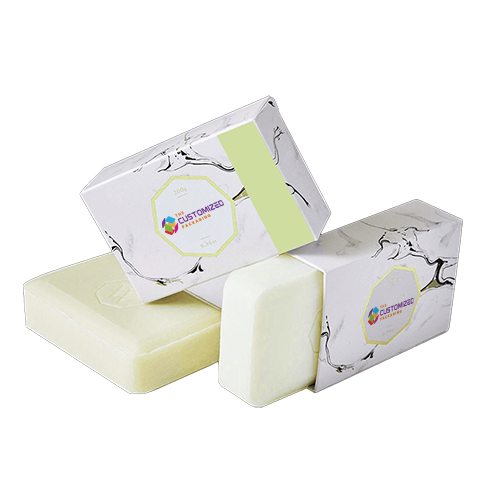
Custom Soap Sleeves are a printed paperboard or kraft wrap that goes around a soap bar already made, cured, and finished. The production quote starts with that bar: maximum length, width, depth, weight, inner wrap or label thickness, and how far the wrap should travel around the body.
The sleeve is a branding band. It is not a soap box, not a shipping carton, and not a two-piece tray-and-sleeve package. It does not seal the bar. Moisture, oil, and fragrance behavior belong first to the soap formula and to any inner wrap the maker already uses. A sleeve can only support those jobs when the board, coating, and seam are specified for the same bar.
Browse soap cartons on Soap. Two-piece sleeve-and-tray boxes stay on Sleeve and Tray. Fully enclosed cartons stay on pages such as custom kraft soap boxes or soap boxes with window. Use this page to lock wrap coverage, board, print, and a physical fit check on the actual bar.
What the Sleeve Wraps and What It Does Not Do
A soap sleeve slides or folds around a finished bar. Common bars include handmade cold-process soaps, glycerin bars, facial cleansing bars, exfoliating bars with botanicals, and solid shampoo or conditioner bars. The wrap can show a logo, fragrance name, ingredient copy supplied by the soap brand, net weight, directions, a barcode, or a QR code.
- It does not become the primary soap package in place of a closed carton
- It does not replace a shipping case or mailer
- It should not cover a required label panel, hanging hole, or inner-wrap seal unless that cutout is designed in
- It leaves one or both ends of the bar open unless a different coverage is approved
If you also need a closed carton, specify a soap box as a separate item. If you need a tray that slides into a sleeve, use the Sleeve and Tray category instead of this wraparound band.
Measuring the Finished Bar
Stated bar names are labels, not finished sizes. Two “4 oz bars” from different batches can need different sleeves because the loaf, trim, inner wrap, and raised botanicals are not the same.
Measure the soap after curing, trimming, wrapping, and labeling. Record these values from the bar you will run, or send a physical sample:
- Maximum length, width, and depth, including any paper wrap, film, or label already on the bar
- Weight of the finished bar
- Raised logos, botanicals, irregular edges, or bevels
- How far the wrap should travel: a narrow band or a wider circuit
- Whether sleeves are applied by hand, on a line, or supplied pre-glued
Handmade bars can vary slightly between batches. The wrap should include the approved dimensional tolerance. A wrap that is too open can rotate or slide off. A wrap that is too tight can crease, mark the soap, or fight the applicator.
Width, Height, and Wrap Coverage
Sleeve height is the distance the band travels along the length of the bar. Wrap coverage is how far the board travels around the girth. Those two values are independent. A short belly band and a tall wrap can both close on the same bar; they still need their own dielines.
Leave enough board around windows and lock tabs so the sleeve keeps its shape. Keep the glue flap and lock tab off the main branding face unless the artwork is built around them.
Belly Band vs Wider Wrap
Style is a coverage and packing decision, not a different product family. The same plant can produce a narrow belly band and a full-width wrap; they still need their own dielines.
| Soap type | Fit notes | Sleeve coverage often considered |
|---|---|---|
| Handmade bars | Measure after cure and trim; allow batch tolerance and any inner wrap | Belly band or mid-width wrap that leaves ends visible |
| Glycerin bars | Smooth faces can show scuff; confirm the wrap does not mark the bar | Wider wrap when more print area is required; review coating against the soap surface |
| Exfoliating bars with botanicals | Record the highest raised point; do not crush botanicals under a tight band | Open-ended wrap with height set above the raised area, or a windowed wrap if specified |
| Solid shampoo or conditioner bars | Often denser and used in wet rooms; the sleeve is still an open wrap | Full-width wrap for more copy; moisture behavior depends on board, coating, and storage |
| Hotel amenity and guest bars | Smaller footprints; confirm hanging holes or perforated openings if required | Narrow band for a logo and item name |
| Wedding and event favors | Short runs and artwork versions are common | Belly band or printed wrap sized to the favor bar, not a gift carton |
A tray-and-sleeve soap presentation is a different structure. Keep that work on Sleeve and Tray. A closed carton with a lid or window stays on a soap box page.
Board and Wrap Construction
Board is chosen after the bar and print plan are known. Naming a color is not a material specification. Recycled-content fiber is listed only when the mill documentation applies to the production lot.
| Material / construction | Usually considered when | What to confirm |
|---|---|---|
| Natural kraft paperboard | A kraft face and simpler print coverage | Caliper, stiffness, and whether the kraft side is the print surface |
| White kraft or print-side kraft | A brighter face with a kraft look on the reverse | Ink holdout and crease quality at the wrap corners |
| SBS or folding paperboard | Detailed logos, light backgrounds, or tight registration | Coating, ink set, and whether windows weaken the wrap |
| Documented recycled-content paperboard | A stated fiber mix is part of the order | Supplier percentage and the lot that will actually be used |
| Corrugated or micro-flute wrap | Only when a thicker band is required for a large bar | Bulk, crease, and whether a paperboard wrap already holds the bar |
Coatings, films, window plastics, inks, and adhesives become part of the finished construction. End-of-life depends on that finished build and on local collection rules. Do not print a disposal claim until the approved board, coating, ink, and adhesive are known.
Printing, Branding Area, and Finishes
The printable face follows the wrap path. Type, logos, barcodes, and QR codes should be built on the approved dieline, not on a flat rectangle. Keep required marks away from the glue flap, lock tab, windows, and edges that scuff in packing.
| Option | What it is used for | Production note |
|---|---|---|
| Digital printing | Short runs, fragrance versions, or campaigns | Confirm color range on the selected board face |
| CMYK process | Photographs and multi-color marks | Review a proof on the actual board family |
| Pantone / spot color | A required brand color | Call the ink and the board in the same specification |
| Embossing or debossing | A raised or pressed mark | Needs enough caliper and a keep-out from the join and windows |
| Foil stamping | A metallic or pigment mark | Confirm wrap path, caliper, and keep-out from the glue flap |
| Spot UV | A glossy mark on a selected area | Treat as an added surface; include it in the finished-construction description |
The soap brand supplies and approves ingredient lists, net-weight statements, directions, and any organic, natural, or similar wording before printing. A sleeve can carry that copy. It does not create the legal label by itself.
Moisture, Oil, and Handling Limits
An open-ended wrap is not a sealed pack. Standard paperboard sleeves are not described as moisture-proof, oil-proof, or waterproof. Those behaviors depend on the board, any coating, the soap formula, any inner wrap already on the bar, storage humidity, and how long the packed bar sits before use.
Glycerin and high-oil bars can mark an uncoated wrap. Wet-room storage can soften an uncoated band. If the bar will sit in a steamy bathroom or a high-humidity warehouse, say so in the quote so the board and coating can be reviewed. The sleeve still will not equal a closed carton or a barrier pouch.
Do not treat the wrap as a guaranteed protective package. It covers part of the bar and carries print. Scratch, dust, and handling results depend on coverage, caliper, packing method, and the inner wrap. Transit protection for a case of sleeved bars still belongs to the outer shipping carton.
Fit Testing and What to Send for a Quote
A digital dieline shows panel size and print position. A white or printed wrap on the real bar shows whether the band sits, rotates, marks the soap, or hides a label. Test under the intended packing and storage method when those conditions matter.
To quote Custom Soap Sleeves, send:
- Bar sample or maximum length, width, depth, and weight after finishing
- Inner wrap, label, and raised-botanical locations
- Preferred wrap: belly band or wider wraparound coverage
- Preferred board family: kraft paperboard or SBS / folding paperboard
- Print method, colors, and any embossing, debossing, foil, windows, or spot UV
- Artwork versions and any supplied label copy
- How sleeves are applied and the quantity required
Industry browsing stays on Soap. Closed cartons stay on soap box pages. For a planning range across styles and quantities, use the Custom Box Packaging Cost Calculator, then request a production quote from the approved bar sample and dieline.
They are printed paperboard or kraft wraps specified around an existing soap bar. They add a branding panel while leaving one or both ends open. They are not a soap box, not a shipping carton, and not a tray-and-sleeve package.
Measure the fully finished bar after curing, trimming, wrapping, and labeling. Record maximum length, width, depth, weight, and any raised botanicals or inner-wrap thickness. Note how far the wrap should travel around the bar. Send a sample or those values so the band sits without sliding off or crushing the soap.
Typical options are kraft paperboard, white or print-side kraft, SBS or folding paperboard, and documented recycled-content paperboard where the mill lot applies. The board is chosen after the finished bar sample and print coverage are known. Corrugated wraps are uncommon and used only when a thicker band is required.
Yes. Logos, fragrance names, ingredient copy supplied by the soap brand, net weight, directions, barcodes, and QR codes can be printed on the wrap face. Build the artwork on the approved die line. Keep required marks away from the glue flap and scuff edges. The soap brand supplies and approves any regulatory wording before printing.
Not as a universal claim. An open-ended wrap is not a sealed barrier. Moisture and oil behavior depend on the board, any coating, the soap formulation, inner wrap, storage, and handling. Those properties are stated only after the finished construction and the actual bar are specified.
Related Products





Configure Custom Soap Sleeves Around Your Bar
Custom Soap Sleeves are sized around the actual soap bar, including its width, height, thickness, wrap coverage, and exposed ends. Kraft and paperboard options can be selected around the required fit, printable area, branding presentation, and handling needs of the finished bar.
Share the soap bar dimensions or a physical sample, artwork, preferred material, printing requirements, and order quantity so the sleeve can be fitted and quoted for the intended product. or speak with a packaging expert. For related wraparound packaging, browse our Sleeve and Tray options, or use the Custom Box Packaging Cost Calculator for general packaging cost planning.