What Does Soap Packaging Need to Accomplish?
Custom soap packaging should protect the bar from handling, provide enough space for product information, distinguish fragrances or formulas, and support the intended retail experience. The right format depends on the soap dimensions, surface texture, curing condition, ingredients, sales channel, storage environment, and brand position.
A paper carton can protect a bar from dust, scuffing, and direct handling, but it should not automatically be described as moisture-proof, airtight, or fragrance-preserving. Those properties depend on the complete packaging system, material construction, storage conditions, and soap formulation.
Before choosing a box, define whether the product needs full enclosure, partial exposure, ventilation, a primary wrap, a protective insert, or a separate ecommerce shipping layer.
Identify How the Product Is Regulated
Packaging artwork should be planned after the product’s intended use and claims are established.
In the United States, a product generally falls under the regulatory definition of true soap when it is composed mainly of alkali salts of fatty acids, those materials provide its cleaning action, and it is marketed only as soap.
A product marketed for moisturizing, beautifying, deodorizing, or making the user smell pleasant may be regulated as a cosmetic. Claims about treating acne, eczema, infections, or other conditions may cause the product to be regulated as a drug or as both a cosmetic and a drug.
This distinction affects the claims, statements, and information that may need space on the package. Packaging suppliers can provide printable panels and structural layouts, but the soap business remains responsible for confirming its product classification and labeling obligations.
Match the Package to the Product
| Product format |
Main packaging consideration |
Suitable starting format |
| Standard bar soap |
Surface protection and information space |
Folding carton or full sleeve |
| Handmade textured bar |
Product visibility and irregular dimensions |
Open sleeve or window carton |
| Soft or oil-rich bar |
Surface contact and possible staining |
Primary wrap with outer carton |
| Premium soap set |
Product arrangement and gift presentation |
Two-piece, drawer or rigid box |
| Guest or sample soap |
Compact branding and efficient packing |
Small carton, band or wrap |
| Bath bomb |
Moisture sensitivity and breakage |
Sealed primary package with outer box |
A structural sample should be tested with production-representative products, especially when bars vary in size, have raised decorations, contain botanicals, or continue changing during storage.
Use Soap Sleeves for Partial Coverage
Soap sleeves wrap around part of the bar while leaving the top, sides, or ends visible. They suit handmade soaps with distinctive colors, layers, textures, stamps, or natural inclusions.
Sleeves use less board than a fully enclosed carton and can provide space for the logo, soap name, scent, weight, ingredients, barcode, or business information. However, they provide less protection from dust, fingerprints, abrasion, and exposure than a full box.
The sleeve must fit securely without pressing into soft surfaces or slipping off during display. Measure the bar at its widest and thickest points and account for normal production variation.
A sleeve should be chosen because partial visibility benefits the product—not simply because it uses less material.
Choose a Folding Carton for Full Enclosure
Custom soap boxes made from folding paperboard provide complete exterior panels for branding and information. They are appropriate for retail shelves, ecommerce orders, multiproduct ranges, subscription boxes, and products that should not be handled directly before purchase.
Common structures include straight-tuck, reverse-tuck, auto-bottom, crash-lock, and custom die-cut cartons. The correct closure depends on the bar weight, packing process, opening experience, and whether the package will be assembled manually or by equipment.
Small ventilation openings may be included for selected products, but they should be evaluated carefully. Openings also allow more exposure to dust, humidity, fragrance transfer, and handling.
Decide Whether a Window Adds Value
Window soap boxes reveal the bar’s color, texture, stamp, layers, or decorative surface. They are particularly useful when each soap is visually distinctive or when product appearance helps customers compare varieties.
The window should reveal an intentional feature rather than an uneven edge or blank section. Its size and position must be planned around the actual bar dimensions and expected movement inside the box.
An open die-cut window avoids adding transparent film but provides less protection. A film-covered window offers more separation from handling but adds another material to the package.
Large windows can reduce panel strength and limit space for ingredients, instructions, barcodes, and other information.
Use Luxury Packaging for Defined Product Lines
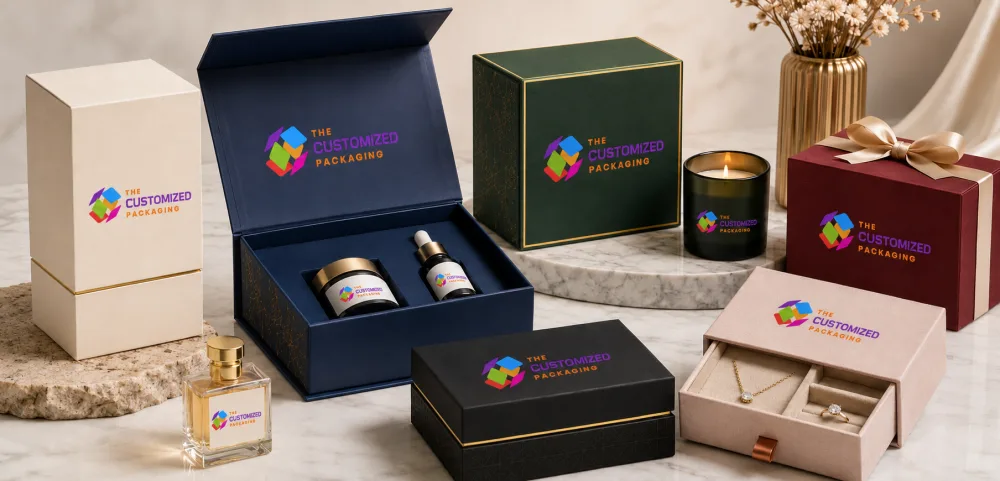
Luxury soap boxes are most useful for gift collections, hotel amenities, bridal products, premium skincare ranges, seasonal sets, and products sold at higher presentation levels.
Luxury does not require adding foil, magnets, ribbons, embossing, and soft-touch finishing to every package. It can come from accurate dimensions, clean edges, restrained typography, consistent colors, precise inserts, and an opening sequence that presents the soap neatly.
Rigid two-piece boxes, drawer boxes, magnetic structures, and premium folding cartons can all create an elevated presentation. The best option depends on the product value, set arrangement, storage limits, fulfillment process, and customer expectations.
For a collection with several fragrances, retain one structural system and change color, artwork, labels, sleeves, or interior cards. This creates recognition without requiring a separate box construction for every variety.
Understand What Kraft Packaging Communicates
Kraft soap packaging supports natural, handmade, rustic, minimalist, and ingredient-led brand identities. Brown kraft can be printed with dark ink, white ink, labels, stamps, patterns, or restrained color accents.
The kraft appearance should not be used as automatic proof that the finished package is sustainable, recyclable, biodegradable, or compostable. Coatings, laminates, windows, adhesives, foil, labels, and inserts can change the package’s material composition and disposal options.
Environmental statements should identify the specific attribute that can be supported, such as a verified percentage of recycled fiber or the absence of a particular component. Broad terms such as “green” and “eco-friendly” should be avoided unless their meaning is clearly explained and substantiated.
Treat Bath Bomb Packaging Separately
Bath bombs are not bars of soap and should not be assigned the same packaging specifications.
They can crack, crumble, lose surface decoration, or react to moisture. A paper carton can provide structure and branding, but it usually does not supply the moisture barrier by itself. The product may require a sealed primary wrap, pouch, film, or other suitable containment before being placed inside the outer box.
Bath bomb packaging can include individual cartons, multi-cavity trays, dividers, window boxes, gift sets, or corrugated ecommerce protection. Cavities should support the product without creating excessive pressure on fragile edges.
Packaging claims about preserving fragrance or preventing moisture damage should only be made when the complete system has been evaluated for the actual product and storage conditions.
The available panel space should be mapped before adding windows, patterns, foil areas, or large promotional claims.
Depending on the product classification and market, the package may need room for:
-
Product identity
-
Net quantity
-
Ingredient information
-
Business name and address
-
Directions or warnings
-
Barcode and SKU
-
Batch or production identification
-
Website and contact information
-
Fragrance or variety name
Avoid placing small text on deep textures, wrapped corners, narrow flaps, reflective foil, or low-contrast backgrounds.
The brand should also review its product descriptions, website text, social posts, and packaging together. A therapeutic claim made outside the box can still affect how the product’s intended use is understood.
Test Packaging With the Actual Soap
A dieline and digital proof confirm structure and artwork placement, but they do not fully confirm physical performance.
Test the package with finished bars to evaluate:
For online orders, test the retail package inside the complete shipping configuration. A decorative soap carton may still need a corrugated outer mailer, cushioning, or dividers.
Prepare the soap’s maximum length, width, height, and weight. Also provide the product type, whether it is fully cured, primary wrap requirements, preferred structure, window or ventilation needs, artwork, number of varieties, quantity per design, sales channel, delivery destination, and required deadline.
For soap sets, include the number of products, their arrangement, individual dimensions, accessories, and whether the items require dividers or fitted platforms.
Frequently Asked Questions
Are soap sleeves better than soap boxes?
Sleeves use less board and expose more of the product. Full boxes provide more surface protection, information space, and enclosure. The better option depends on the soap, retail environment, and presentation goal.
Do soap boxes protect bars from moisture?
Standard paperboard boxes are not automatically moisture barriers. Protection depends on the board, coatings, openings, primary wrap, storage environment, and complete package construction.
Are kraft soap boxes environmentally friendly?
Kraft can contain recycled fiber and may be recyclable in some constructions, but the complete package must be considered. Windows, coatings, adhesives, foil, labels, and inserts can affect environmental claims.
Do handmade soaps need ventilation holes?
Not always. Ventilation depends on the formulation, curing process, storage conditions, primary packaging, and intended shelf life. The soap producer should determine whether openings are suitable.
Can bath bombs use the same packaging as bar soap?
Not necessarily. Bath bombs are generally more sensitive to moisture and breakage and may require a sealed primary package and product-specific support.
Develop Packaging Around the Finished Product
The Customized Packaging LLC can produce folding soap cartons, sleeves, window boxes, kraft packaging, rigid gift boxes, bath bomb boxes, dividers, and printed packaging developed around the finished product dimensions.
For an accurate recommendation, provide the product sample or measurements, artwork, packaging format, number of designs, quantity, destination, and project deadline.


 Published April 18, 2026
Updated August 04, 2026
9 min read
Published April 18, 2026
Updated August 04, 2026
9 min read