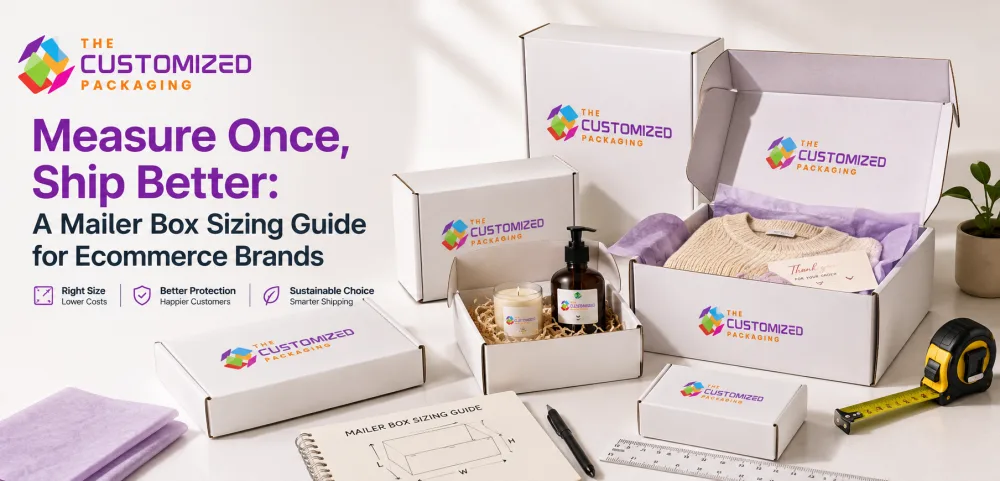
Measure Once, Ship Better: A Mailer Box Sizing Guide for Ecommerce Brands
Learn how ecommerce brands can choose the right mailer box size by measuring products, planning inserts, checking internal dimensions, reducing empty space, and improving shipping protection. This guide covers custom mailer boxes, corrugated mailer boxes, ecommerce packaging, subscription box packaging, inserts, void fill, pricing, MOQ, and bulk mailer box planning.
 Published July 14, 2026
22 min read
Published July 14, 2026
22 min read
A mailer box should fit the product, protect it during delivery, and create a clean unboxing experience without wasting space. Many ecommerce brands choose a box that looks attractive first, then later discover that it is too large, too shallow, too weak, or too expensive to ship. The better approach is simple: measure the product first, understand the packing space, then choose the right mailer box size for storage, shipping, branding, and customer experience.
For ecommerce stores, subscription brands, product sellers, boutiques, cosmetics companies, apparel brands, gift businesses, and small businesses, custom mailer boxes can improve how products arrive at the customer’s door. But the box must match the product’s dimensions, weight, fragility, and presentation style. A poorly sized mailer box can increase shipping costs, require extra filler, allow product movement, damage corners, or make the package feel less professional.
This guide explains how ecommerce brands can choose better mailer box dimensions, compare common box styles, measure products correctly, plan inserts and void fill, reduce wasted space, and prepare a practical packaging brief before production. It also covers custom shipping boxes, corrugated mailer boxes, ecommerce packaging boxes, subscription box packaging, pricing factors, MOQ, bulk quantities, and the Custom Box Packaging Cost Calculator.
Why Mailer Box Sizing Matters
Mailer box sizing affects protection, shipping cost, packing speed, storage space, and brand presentation. A box that is too small can crush the product or make packing difficult. A box that is too large can increase filler use, allow the product to move, and make shipping less efficient. Ecommerce brands choosing custom mailer boxes should focus on the right fit before selecting colors, printing, coatings, or luxury finishes.
Good sizing also improves the customer experience. When a product arrives in a box that feels made for it, the packaging looks more intentional. The customer sees the product neatly placed inside instead of buried under loose filler. This is why ecommerce packaging should be designed around the product, not around a random stock size.
Mailer boxes are often used for cosmetics, skincare, candles, apparel, accessories, electronics, gifts, books, small home products, jewelry, subscription kits, and promotional packages. Each product has different sizing needs. A fragile candle needs more protection than a folded shirt. A skincare set needs compartments. A subscription kit needs space for multiple products, inserts, cards, and printed material.
Start with Product Measurements
The first step is measuring the product accurately. Measure the length, width, and height of the product in the position it will be packed. If the product has a retail box, pouch, bottle, jar, tube, wrapper, sleeve, or protective cover, measure the final packed product, not only the item itself. This gives a more accurate starting point for mailer box dimensions.
For multiple products, arrange them the way they should appear inside the box before measuring. Ecommerce brands often make the mistake of measuring each item separately and then guessing the box size. A better method is to place all items in the desired layout, include any cards, inserts, tissue, or dividers, and then measure the full packed footprint.
If the product is fragile, leave room for cushioning. If the product is premium, leave room for presentation. If the product is light and soft, the box may fit closer to the product. Custom shipping boxes should always include enough internal space for the product and the protective material, not just the product alone.
Internal Size vs External Size
One of the most important sizing details is the difference between internal and external dimensions. Internal dimensions describe the usable space inside the box. External dimensions describe the outside size of the finished package. Ecommerce brands should usually focus on internal dimensions first because the product must fit inside the box.
For example, if a product measures 8 × 5 × 2 inches, the mailer box should have slightly larger internal dimensions so the product can be packed without pressure. The external dimensions will be larger because the corrugated board has thickness. This matters for shipping, stacking, carton packing, and storage.
When requesting custom mailer box prices, brands should clearly state whether the size is internal or external. Confusing these measurements can create production problems. A box made to the wrong dimension may look correct on paper but fail when the product is placed inside.
How Much Extra Space Should a Mailer Box Have?
The right amount of extra space depends on the product. A soft apparel item may need little clearance, while a glass bottle, candle jar, or electronics product may need more cushioning. The goal is not to make the box as tight as possible. The goal is to make the box secure, easy to pack, and safe during delivery.
For most ecommerce products, the box should allow space for a protective layer such as tissue paper, crinkle paper, corrugated inserts, molded pulp, foam, paper wrap, or a product tray. If the product touches the box walls directly, it may be more likely to get damaged during transit.
A good mailer box should prevent excessive movement. If the product slides inside the box when it is shaken gently, the box is probably too large or needs an insert. Ecommerce mailer boxes work best when the product sits in a controlled position with only the required clearance.
Mailer Box Sizing Checklist
| What to measure | Why it matters | Packaging decision |
|---|---|---|
| Product length | Determines main box footprint | Choose the correct box base size |
| Product width | Controls side clearance | Avoid tight fit or wasted space |
| Product height | Affects lid closure and product pressure | Prevent crushing or bulging |
| Product weight | Affects board strength | Select suitable corrugated thickness |
| Fragility level | Determines protection needs | Add inserts, padding, or dividers |
| Product layout | Affects presentation | Choose flat, stacked, or compartment layout |
| Extra materials | Adds internal space | Include cards, tissue, wraps, and fillers |
| Shipping method | Affects durability | Choose mailer, shipper, or outer carton |
This checklist helps ecommerce brands plan custom packaging boxes with fewer mistakes and better production details.
Choose the Right Mailer Box Style
Mailer boxes come in different structures. The most common ecommerce style is a tuck-front corrugated mailer box. It folds into shape, closes securely, and creates a clean unboxing experience. But other styles may work better depending on product weight, branding needs, and fulfillment process.
A standard corrugated mailer box is good for many ecommerce products because it provides protection and presentation in one package. A literature mailer may be better for books, documents, prints, or flat products. A subscription mailer is useful for product kits and recurring shipments. A tab-lock mailer can add extra closure security. A custom insert mailer can hold multiple products in place.
Choosing the right mailer box style is just as important as choosing the size. A product may fit inside several box types, but the best structure is the one that protects the product, packs quickly, and supports the brand experience.
Common Mailer Box Styles for Ecommerce
| Mailer box style | Best for | Main benefit | Sizing note |
|---|---|---|---|
| Standard tuck-front mailer box | Cosmetics, gifts, small products, accessories | Strong ecommerce presentation | Allow space for product and filler |
| Corrugated mailer box | Fragile or heavier ecommerce products | Better shipping protection | Match board strength with product weight |
| Subscription mailer box | Monthly kits, product bundles, sample sets | Organized unboxing experience | Plan layout before final size |
| Literature mailer | Books, prints, documents, flat items | Slim and efficient | Keep height close to product thickness |
| Apparel mailer box | Shirts, scarves, socks, fashion items | Clean folding and branding | Avoid too much empty height |
| Gift mailer box | Premium products, PR kits, branded gifts | Better presentation value | Leave room for tissue, cards, and inserts |
| Mailer box with inserts | Bottles, jars, candles, sets | Holds products in place | Measure insert and product together |
| Heavy-duty mailer box | Electronics, tools, glass, bulkier products | Stronger protection | Confirm board grade and closure strength |
This comparison helps brands select custom ecommerce packaging that fits both the product and the delivery process.
Corrugated Board and Mailer Box Strength
Most mailer boxes use corrugated board because it provides strength without becoming too heavy. The fluted layer inside the board helps protect products from pressure and movement during shipping. Corrugated mailer boxes are common for ecommerce because they balance durability, printability, and presentation.
The board strength should match the product. Lightweight products may not need a heavy board, while candles, glass jars, electronics, books, or multi-product kits may require stronger material. If the box feels weak before shipping, it may not perform well after stacking, handling, and delivery movement.
Brands should also consider the size of the box. Larger boxes may need stronger board because wider panels can bend more easily. Smaller boxes may stay firm with lighter board. When requesting custom mailer box quotes, include product weight and shipping conditions so the material can be selected properly.
Avoid Oversized Mailer Boxes
Oversized boxes create several problems. They use more material, take more storage space, require more filler, and may cost more to ship. They can also make the product look less valuable because the customer sees too much empty space.
Ecommerce brands sometimes choose a larger box because they want a dramatic unboxing experience. That can work for gift packaging, PR boxes, or influencer kits, but it should be intentional. For everyday orders, oversized shipping boxes often create unnecessary cost and waste.
The best mailer box feels comfortably fitted. It should give the product room to breathe without looking empty. A box with a simple insert can often look more premium than a large box filled with loose paper.
Avoid Undersized Mailer Boxes
A box that is too small can create even bigger problems. The product may press against the lid, corners may bulge, the closure may not lock properly, and the box may arrive damaged. Tight packaging can also slow down fulfillment because staff must force products into the box.
Undersized mailers are especially risky for fragile products. Glass bottles, jars, candles, electronics, jewelry boxes, and premium retail packaging need clearance so they are not pressed directly against the outer walls. Custom mailer boxes for ecommerce should protect the product during real shipping, not only fit it on a desk.
A properly sized box should close naturally. If the lid resists, bends, or creates pressure marks, the height or layout should be adjusted.
Product Layout Inside the Mailer Box

Product layout affects both sizing and customer experience. Items can be placed flat, stacked, side by side, nested, wrapped, or separated into compartments. Before choosing a box size, decide how the customer should see the products when the box opens.
A skincare kit may look better when bottles stand in a tray. A candle may need a center insert. A clothing item may look better folded with tissue and a thank-you card. A subscription box may need compartments for multiple products. Custom mailer boxes with inserts are useful when presentation and protection both matter.
Layout also affects shipping safety. Products placed too close together may scratch or hit each other during movement. Products placed too far apart may shift inside the box. The correct layout should keep everything organized without increasing the box size unnecessarily.
Inserts, Dividers, and Void Fill
Inserts and dividers help control movement inside the box. They are useful for bottles, jars, candles, cosmetics, electronics, jewelry, gift sets, and subscription boxes. Mailer boxes with inserts can reduce the need for loose filler and make the unboxing experience cleaner.
Common insert options include corrugated inserts, paperboard dividers, molded pulp inserts, foam inserts, die-cut trays, bottle holders, product platforms, and separator walls. The insert should be measured with the product before finalizing the mailer size.
Void fill includes tissue paper, crinkle paper, kraft paper, honeycomb paper, air pillows, and protective wraps. If a brand uses filler for presentation, the box may need slightly more space. If the filler is only used because the box is too large, the size should be corrected.
Mailer Box Sizing for Different Product Types
Different ecommerce products need different sizing logic. A soft product can compress slightly, but a glass jar cannot. A flat item should not be placed in a deep box. A premium gift set may need more display space than a single basic product.
Cosmetics and skincare products often need inserts because bottles and jars can move easily. Apparel may need a shallow box that supports neat folding. Jewelry may need a small mailer around an inner jewelry box. Candles need clearance and cushioning. Books need tight, flat mailers to avoid movement.
The best custom mailer packaging is not one-size-fits-all. It should be built around product category, weight, fragility, and brand presentation.
Mailer Box Sizing by Product Category
| Product category | Sizing priority | Useful packaging option |
|---|---|---|
| Skincare and cosmetics | Product stability and upright presentation | Mailer box with bottle insert |
| Candles and glass jars | Shock protection and side clearance | Corrugated mailer with protective insert |
| Apparel and fashion items | Shallow depth and neat folding | Apparel mailer box with tissue |
| Jewelry and accessories | Inner box protection and premium reveal | Small mailer box with branded insert |
| Books and prints | Slim profile and corner protection | Literature mailer or flat mailer |
| Subscription kits | Multi-product layout and presentation | Subscription mailer box with compartments |
| Electronics | Strong board and cushioning | Heavy-duty mailer with insert |
| Gift sets | Presentation and product separation | Gift mailer box with dividers |
This table gives ecommerce brands a simple way to match mailer box sizes with product needs.
Mailer Boxes for Subscription Brands
Subscription brands must pay extra attention to sizing because products may change every month. If the box is sized only for one product set, it may not work for future boxes. Subscription box packaging should be designed around the most common product layout and the typical number of items.
A subscription mailer should have enough flexibility to hold different combinations without looking empty. Inserts can help, but overly specific inserts may not work for changing products. Some brands use a standard box with adaptable paper filler, dividers, or printed cards.
The box should also create a consistent brand experience. Customers recognize the box before opening it, so size, print, and structure matter. A well-sized custom subscription box feels intentional every time it arrives.
Mailer Boxes for Small Businesses
Small businesses often need packaging that is affordable, branded, and easy to manage. Small business packaging should not be overly complicated at the beginning. A practical mailer box size with clean logo printing, tissue paper, and a simple insert can create a professional customer experience.
The first goal should be to choose one or two box sizes that cover the most common products. Too many sizes can make inventory difficult. Too few sizes can cause wasted space. A small brand may begin with a standard size and later move to fully custom dimensions as order volume grows.
Low MOQ options may be useful for testing packaging before committing to large quantities. Low MOQ mailer boxes can provide branding control with manageable quantity levels.
Mailer Boxes for Fragile Products
Fragile products need more than a box that fits. They need protection against impact, compression, and movement. Glass jars, candles, ceramics, electronics, premium skincare, and delicate gift items should use stronger corrugated mailer boxes with suitable inserts or cushioning.
The product should not touch the outer walls directly. Side clearance, corner protection, bottom cushioning, and lid clearance are important. The box should also be tested by gently shaking it after packing. If the product moves freely, the insert or filler should be improved.
Fragile items may also need an outer shipping carton if the inner package is decorative. For high-value products, the ecommerce packaging system may include a retail box, insert, mailer, and outer shipper.
Mailer Boxes for Lightweight Products
Lightweight products such as apparel, soft accessories, socks, fabric items, paper goods, and small gifts may not need heavy-duty packaging. The main concern is usually presentation and preventing the product from shifting. Lightweight mailer boxes should be shallow enough to avoid empty space.
For soft products, the product can be folded neatly with tissue or a branded wrap. A thank-you card or printed insert can sit on top. The box should not be so deep that the product disappears at the bottom.
Using the right size for lightweight products helps reduce filler and shipping volume. This makes the package cleaner, faster to pack, and more professional.
Mailer Box Dimensions and Shipping Costs
Shipping cost can be affected by both weight and package size. Many carriers consider the space a package takes in transit, not only how heavy it is. This is why oversized shipping boxes for ecommerce can become expensive even when the product is lightweight.
Ecommerce brands should avoid large empty boxes whenever possible. A smaller, well-fitted mailer can reduce shipping volume, storage space, and filler use. It may also improve stacking and carton packing before fulfillment.
Before finalizing a custom box, brands should compare the proposed external dimensions with their normal shipping methods. The goal is to keep the box protective and attractive without making it larger than necessary.
Storage and Fulfillment Considerations
Mailer box size also affects warehouse and packing operations. Large boxes take more shelf space. Assembled boxes take more room than flat-packed boxes. Multiple box sizes require better inventory control. Bulk mailer boxes should be planned with storage and packing workflow in mind.
Flat-packed mailer boxes save space but require folding during fulfillment. This is usually manageable for ecommerce teams, but box structure should be easy to assemble. Complicated locking tabs or inserts can slow down packing during busy periods.
A good ecommerce mailer should be easy to store, quick to fold, simple to pack, and strong enough for delivery. Packaging should support the team as well as the customer.
Custom Printing and Branding on Mailer Boxes
Once the size and structure are correct, branding can be added. Custom printed mailer boxes can include logos, brand colors, patterns, inside printing, product messages, QR codes, social media details, and seasonal artwork.
Outside printing helps the package stand out during delivery. Inside printing improves the unboxing experience. A simple logo on the outside and a message inside the lid can create a strong branded moment without overcomplicating the design.
Printing should be planned around folds, locking tabs, glue areas, inserts, and shipping labels. A beautiful design can look poor if important artwork falls on a fold or gets covered by a label. Always design on the correct dieline.
Inside Printing for Unboxing
Inside printing is especially useful for ecommerce packaging because the customer sees it when the box opens. A printed message, pattern, brand story, thank-you note, or product instruction can make the package feel more complete. Inside printed mailer boxes are popular for subscription boxes, beauty products, apparel, gifts, and direct-to-consumer brands.
The inside design should not make the box look crowded. A clean pattern, short message, or simple branded color can be enough. The product should remain the main focus.
If the brand uses inserts, cards, or tissue paper, inside printing should coordinate with those elements. A complete custom ecommerce packaging system feels consistent from outer box to product presentation.
Sustainable Mailer Box Sizing

Right-sizing is one of the most practical ways to make packaging more efficient. A smaller box uses less board, less filler, less storage space, and often less shipping volume. Eco-friendly mailer boxes should start with correct sizing before adding environmental claims.
Recyclable paper-based materials, kraft paper, water-based inks, paper inserts, and reduced plastic filler can support better packaging choices. But the box still needs to protect the product. A damaged product creates more waste than a slightly stronger package.
Sustainability should be specific. Instead of relying only on kraft color or green messaging, brands should focus on right-sized packaging, recyclable materials, minimal void fill, and reusable or recyclable inserts.
Common Mailer Box Sizing Mistakes
One common mistake is measuring the product only, then forgetting the insert, tissue, wrap, or product card. This creates a box that is too tight. Another mistake is choosing a large stock box because it is available quickly, then paying more for filler and shipping.
Some brands also ignore product height. A box may fit the length and width but crush the product when closed. This is common with candles, jars, bottles, and gift sets. Custom mailer box dimensions should always include height clearance.
Another mistake is not testing the packed box. A sample should be packed, closed, shaken gently, stacked, and handled like a real shipment. This helps confirm whether the size is correct before bulk production.
How to Test a Mailer Box Size
Testing should be practical. Pack the product exactly as a customer will receive it. Include inserts, tissue, cards, filler, labels, and any product accessories. Then close the box and check whether the lid locks naturally.
Next, check product movement. If the product slides too much, the box is too large or needs a better insert. If the lid presses against the product, the box is too shallow. If the corners bulge, the layout or box size needs adjustment.
Finally, test the visual presentation. When the customer opens the box, the product should look organized and intentional. Custom mailer box samples help confirm both protection and presentation before production.
What Affects Custom Mailer Box Prices?
Custom mailer box prices depend on size, material, board grade, printing, finish, quantity, inserts, and delivery. A larger box uses more material and may cost more to ship. A stronger board may increase production cost but improve protection. Full-color printing costs differently from simple one-color logo printing.
Inserts, dividers, inside printing, coatings, and special finishes can also affect price. For ecommerce brands, the best value often comes from the right size, strong structure, and clean branding instead of unnecessary decoration.
Mailer box wholesale prices usually improve at higher quantities, but brands should avoid ordering more boxes than they can store or use. Packaging should match real sales volume and product planning.
MOQ and Bulk Mailer Box Planning
MOQ depends on the box size, material, printing method, and customization level. Simple printed mailer boxes may support more flexible quantities, while special sizes, premium finishes, or complex inserts may require higher minimums. Low MOQ mailer boxes can help new ecommerce brands test packaging before scaling.
Bulk orders can reduce unit price, but they also require storage space. Before ordering bulk mailer boxes, brands should confirm product demand, packaging size, artwork stability, and warehouse capacity.
For growing ecommerce brands, it may be better to start with one strong custom size, then add more sizes as the product line expands. This keeps inventory simple and reduces packaging waste.
Estimate Your Mailer Box Budget
The Custom Box Packaging Cost Calculator can help ecommerce brands estimate packaging costs before finalizing every detail. Businesses planning custom mailer boxes can use it to compare approximate dimensions, board material, printing, inserts, finishes, and quantities.
Want to know the cost of your product’s packaging? Try the Custom Box Packaging Cost Calculator using your product size, mailer box dimensions, material, print style, insert needs, and quantity. This gives an early planning estimate before requesting a final quotation.
A final quote should be based on approved internal dimensions, external dimensions, corrugated board, printing, inserts, packing method, quantity, and delivery location.
How to Prepare a Mailer Box Project
Start with product details. Measure the product length, width, height, and weight. Decide whether the product needs cushioning, inserts, dividers, tissue, cards, or outer protection. Then arrange the product exactly as it should appear inside the box.
Next, choose the box style. A standard tuck-front mailer may work for many ecommerce products, while subscription kits, fragile products, apparel, or premium gifts may need a different structure. Confirm whether the box should be printed outside, inside, or both.
After the size and structure are approved, prepare artwork on the correct dieline. Logos, patterns, text, QR codes, and messages should avoid folds, tabs, and label areas. A physical sample should be tested before full production.
Why Choose The Customized Packaging?
The Customized Packaging helps ecommerce brands, small businesses, subscription companies, beauty brands, apparel sellers, gift brands, candle brands, jewelry sellers, and product businesses create custom mailer boxes that fit their products properly.
Available options include corrugated mailer boxes, printed mailer boxes, subscription boxes, apparel mailer boxes, gift mailer boxes, mailer boxes with inserts, kraft mailer boxes, white mailer boxes, black mailer boxes, and ecommerce shipping boxes.
Printing options can include logo printing, full-color printing, inside printing, outside printing, QR codes, branded patterns, product instructions, seasonal designs, and custom artwork. Custom printed mailer boxes can be designed for product protection, brand presentation, and customer unboxing.
Packaging can be planned around product size, shipping method, storage, fulfillment speed, and budget. With the right measurements and structure, custom ecommerce boxes can reduce wasted space, improve delivery performance, and make the brand feel more professional.
Final Thoughts
A better mailer box starts with better measurements. Ecommerce brands should measure the product, plan the layout, include inserts and filler, check internal dimensions, and test the packed box before production. Mailer box sizing affects shipping cost, product protection, customer experience, storage, and brand presentation.
The best custom mailer boxes are not always the largest or most decorative. They are the boxes that fit properly, protect the product, pack efficiently, and create a clean unboxing experience.
Measure once, ship better. When ecommerce brands choose the right mailer box dimensions, they reduce wasted space, improve packaging performance, and deliver products in a more professional way.