
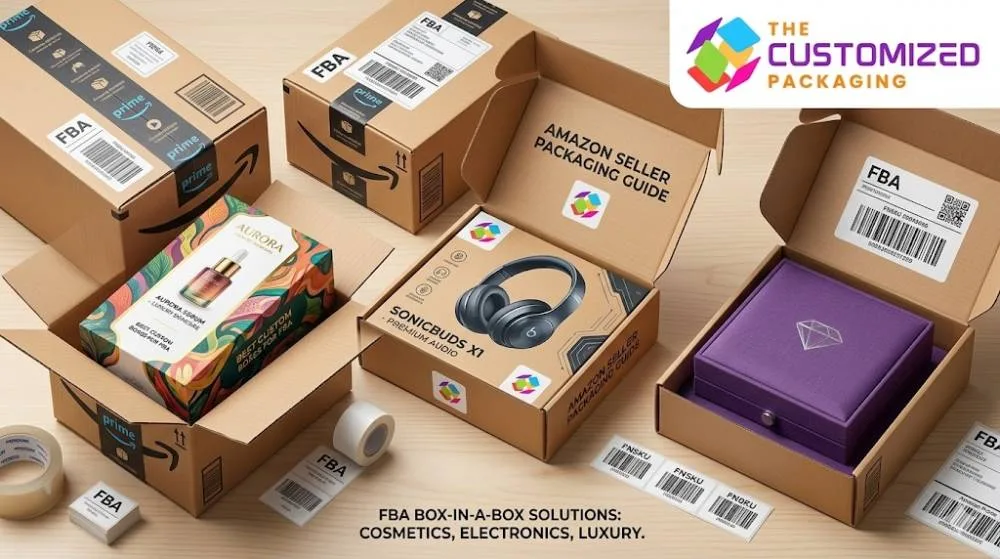
Custom Packaging for Amazon FBA Sellers: A Practical Box Selection Guide
Selling on Amazon is highly competitive, but the right packaging can elevate your brand above the rest. This comprehensive guide breaks down the best custom boxes for FBA businesses, navigating compliance, and using packaging to drive off-Amazon brand loyalty.
 Published May 15, 2026
Updated July 22, 2026
17 min read
Published May 15, 2026
Updated July 22, 2026
17 min read
Selling through Fulfillment by Amazon can simplify storage, order processing, shipping, returns, and customer service, but it does not remove the seller’s responsibility for preparing products correctly. Before inventory reaches a fulfillment center, every sellable unit needs packaging that protects the product, supports identification, and remains suitable for the way Amazon will receive, store, pick, and deliver it.
That makes custom packaging for Amazon FBA sellers a structural and operational decision rather than a purely visual one. A beautiful box that crushes during handling is unsuccessful. A strong box that wastes space can increase material and fulfillment costs. A compact package with no suitable barcode area may create labeling problems. The right solution balances protection, dimensions, identification, production cost, and brand presentation.
This guide explains how to evaluate custom boxes for Amazon sellers, where branding fits into the fulfillment process, and what information a packaging manufacturer needs before producing an FBA packaging order.
Understand the Three Layers of Amazon FBA Packaging
Amazon packaging decisions become clearer when sellers separate the customer-facing unit box from the inbound shipping carton. These layers perform different jobs and should not automatically use the same structure.
The individual unit package is the packaging surrounding one sellable product. It may be a folding carton for a skincare bottle, a printed corrugated box for an electronic device, or a mailer containing a clothing item. This package normally carries the product identifier, brand artwork, instructions, warnings, and customer-facing information.
The inbound shipping carton holds multiple prepared units while inventory travels to an Amazon fulfillment center. It is primarily a transportation container. Its strength, sealing, shipping labels, weight, and contents must be suitable for the inbound shipment rather than retail presentation.
The third possibility is Ships in Product Packaging, commonly called SIPP. Eligible and certified products can be delivered in their own product packaging without Amazon adding another shipping package. Amazon states that the program can reduce added packaging, lower waste, and provide fulfillment-cost benefits for qualifying products. Eligibility, packaging preparation, testing, and certification must be reviewed through the seller’s current Amazon account.
| Packaging Layer | Main Purpose | Typical Packaging | Main Design Priority |
|---|---|---|---|
| Individual unit package | Protect and identify one sellable item | Folding carton, mailer, product box, sealed bag or rigid presentation box | Product fit, barcode access, required information and branding |
| Inbound shipping carton | Move multiple prepared units to a fulfillment center | Regular slotted corrugated carton | Compression strength, sealing, handling and shipment labels |
| SIPP-ready product package | Protect the product through customer delivery without an added Amazon box | Tested corrugated mailer or enclosed shipping-ready package | Transit performance, secure closure, testing and customer presentation |
A premium product box should therefore not be treated as an inbound carton unless it is designed for that purpose. In the same way, a plain shipping carton is not a replacement for attractive individual packaging when the product relies on retail presentation.
Start With Current Amazon FBA Packaging Requirements
Amazon requirements can vary by product category, packaging type, barcode setting, destination, and fulfillment program. Sellers should confirm the latest requirements inside Seller Central before approving a production run.
At a minimum, the finished package should keep the sellable unit contained, prevent loose components from separating, and provide access to the product identifier Amazon expects for that unit. Unrelated or competing barcodes may need to be covered so automated scanning does not identify the wrong code.
A barcode panel should be designed before decoration, not squeezed into the artwork after printing. Reserve a smooth, flat area that remains readable after the box is folded, filled, sealed, and handled. Avoid positioning the main inventory barcode across a fold, corner, opening, textured finish, or closure seam.
Poly bags require separate attention. Amazon’s current guidance says that bags with openings of five inches or larger, measured flat, require a suffocation warning. Bags must also meet the applicable sealing, transparency, labeling, and product-preparation requirements.
Products sold as sets must remain together as one sellable unit. Fragile, sharp, liquid, powdered, apparel, baby, adult, and expiration-dated products can have additional preparation rules. The box manufacturer can engineer the physical package, but the seller remains responsible for confirming category-specific Amazon and regulatory requirements.
Build the Package Around the Actual Product
Generic box dimensions often create unnecessary empty space. Begin with the product rather than selecting a popular box style first.
Measure the product at its widest, longest, and tallest points. Include caps, pumps, cables, handles, accessories, manuals, applicators, and any parts that extend beyond the main body. Record the product’s packed weight and identify surfaces that can scratch, leak, bend, or break.
Next, decide how much internal clearance the product needs. A simple folding carton may require only enough room for loading and closing. A glass bottle may require a fitted insert, impact clearance, and space around the neck or pump. A bundle may need separate compartments so the components do not collide.
Excessive clearance allows movement and may require more filler. Insufficient clearance can create pressure against the product or prevent the box from closing correctly. The dieline should be built from the packed product dimensions, not only from measurements taken from a catalog or supplier listing.
The most expensive package is not always the strongest one; it is often the package that uses space badly. Right-sizing can reduce board consumption, internal movement, storage volume, and the amount of secondary protection needed.
Choose the Best Custom Box Style for the Product
No single box structure is best for every FBA business. Product weight, fragility, customer presentation, assembly time, order quantity, and the intended fulfillment path should determine the structure.
| Box Style | Suitable Products | Main Advantages | Important Limitation |
|---|---|---|---|
| Folding carton | Cosmetics, supplements, soap, small accessories and lightweight retail products | Lightweight, printable, compact and cost-efficient | Often needs an outer carton or additional protection for demanding shipping conditions |
| Corrugated mailer box | Ecommerce kits, apparel, beauty sets, accessories and small electronics | Strong walls, secure presentation and internal printing options | Board grade and closure must match product weight and handling |
| Regular slotted corrugated carton | Inbound FBA shipments and multipacks | Efficient, stackable and widely used for transportation | Usually provides limited customer-facing presentation |
| Corrugated product box with insert | Glass containers, candles, devices and bundled products | Combines structure with controlled product movement | Poorly designed inserts can add unnecessary material and labor |
| Sleeve-and-tray box | Gift sets, cosmetics, accessories and product variations | Premium opening and flexible branding | May need a protective outer shipping package |
| Rigid presentation box | Jewelry, premium electronics, luxury beauty and high-value gifts | Strong presentation and high perceived value | Weight, cost, and transport protection must be evaluated carefully |
| Printed sleeve over a standard box | Seasonal products, scents, flavors and multiple variations | Allows one base structure to support several designs | The base box must still provide the required strength and identification space |
Folding Cartons for Lightweight Private-Label Products
Paperboard folding cartons are suitable for compact products that already have a strong primary container. They are frequently used for cosmetic bottles, skincare tubes, soap, small electronics accessories, vitamins, and personal-care products.
Straight tuck, reverse tuck, auto-bottom, and seal-end configurations provide different levels of assembly speed and bottom strength. An auto-bottom carton can be useful where faster packing is important, while a basic tuck-end structure may suit lighter products and smaller trial runs.
The carton should include enough space for the product identifier, consumer information, legal text, and batch or expiration details where applicable. Decorative finishes should not make these functional areas difficult to print or scan.
Corrugated Mailer Boxes for Protection and Presentation
Custom corrugated mailer boxes combine stronger walls with a controlled opening experience. They can work well for apparel, subscription kits, beauty bundles, small home products, electronics accessories, and direct-to-consumer items.
The flute profile, liner combination, box dimensions, closure tabs, and insert design should be chosen according to the packed weight and shipping environment. A mailer that looks strong in a rendering may still fail if the board is too light, the front tabs release, or the product places pressure on an unsupported panel.
Interior printing can carry instructions or brand messaging without crowding the exterior label area. This is particularly useful when the outside needs to remain simple for fulfillment and shipping.
Corrugated Shipping Boxes for Inbound Inventory
Inbound cartons should prioritize stackability, edge protection, sealing, and accurate labeling. They should not contain old carrier labels or unrelated barcodes that could cause confusion.
Carton dimensions should reflect the number of prepared units placed inside, the orientation of those units, and the amount of void fill needed. Packing too loosely creates movement. Packing too tightly can crush individual product boxes and damage corners before the inventory is received.
Rigid Boxes for Premium Products
Rigid boxes can create a high-end customer experience, but they are not automatically shipping-ready. A luxury shoulder-neck or magnetic-closure box may still require a corrugated overbox to withstand parcel delivery.
Use rigid packaging where the product value and presentation justify the added material, assembly, and shipping weight. For FBA, the complete packaging system should be evaluated rather than judging the rigid box alone.
Compare Materials Before Choosing the Finish
Material selection should happen before foil, lamination, embossing, or other decorative treatments. The substrate determines structural performance, print behavior, weight, and much of the final cost.
| Material | Best Use | Protection Level | Printing and Branding |
|---|---|---|---|
| SBS or coated paperboard | Folding cartons for lightweight products | Low to moderate | Smooth surface for detailed color printing |
| Natural kraft paperboard | Natural-looking cartons and lightweight goods | Low to moderate | Best for restrained artwork and earthy branding |
| E-flute corrugated board | Compact mailers and printed ecommerce boxes | Moderate to high | Good balance of printability and strength |
| B-flute corrugated board | Shipping cartons and heavier products | High | More visible flute profile but stronger cushioning |
| Double-wall corrugated board | Heavy or demanding shipment applications | Very high | Primarily selected for structural performance |
| Rigid chipboard with printed wrap | Luxury and presentation boxes | High presentation strength | Supports premium wraps, foil and textured finishes |
| Molded pulp insert | Bottles, jars, devices and sustainability-focused projects | Product-specific | Natural appearance with limited direct-print detail |
| Paperboard or corrugated insert | Lightweight products, kits and compartments | Product-specific | Can be printed and produced with the outer box |
| Foam insert | Delicate devices, glass and high-value items | High cushioning | Precise fit, but environmental and disposal considerations apply |
For many ecommerce products, corrugated material provides the most practical balance between weight and protection. Folding cartons remain useful for individual retail units, but they often depend on an outer shipping layer. Rigid board is valuable for presentation, not necessarily for reducing fulfillment volume.
Engineer Inserts to Control Movement
An insert should solve a specific packaging problem. Its purpose may be to center the product, isolate two components, protect a pump, prevent glass-to-glass contact, or create a consistent presentation.
Start by identifying the direction in which the product is most likely to move. A bottle may require support at the base and shoulder rather than uniform foam around every surface. A cable kit may need compartments that keep accessories from covering the main product. A candle jar may need corner or circular support that transfers force away from the glass.
Paperboard and corrugated inserts are appropriate for many lightweight products and are easier to print or recycle within paper-based packaging systems. Molded pulp can provide shaped support with a natural appearance. Foam can offer precise cushioning for delicate products, although material recovery and disposal should be considered.
Overengineering the insert can increase board usage, packing time, shipping weight, and production cost. The best insert holds the product securely while remaining simple to assemble.
Reserve Functional Space in the Artwork
Packaging artwork should be organized around operational information. Establish a quiet label area before adding background patterns, foil, windows, promotional badges, or decorative textures.
The front panel should communicate the brand and product clearly. Secondary panels can carry instructions, warnings, ingredients, manufacturer information, quantities, or regulatory text. The inventory barcode should remain separate from decorative QR codes and other machine-readable graphics so the intended code is easy to identify and scan.
Expiration dates, lot numbers, and variable information may need a dedicated uncoated or printable zone. If this information will be applied after production, confirm that the coating and finish accept the intended ink, stamp, or label.
A highly reflective foil area, deep embossing, curved panel, or soft-touch coating may not be suitable beneath a barcode label. Functional testing should be completed on the finished material, not only on a digital proof.
Match Packaging to the Product Category
Different product categories create different failure risks. A visually consistent brand can still use different internal structures across its product range.
| Product Category | Main Packaging Risk | Practical Packaging Direction |
|---|---|---|
| Cosmetics and skincare | Leakage, scratched containers and crowded compliance text | Folding carton or mailer with neck support, dividers, and clear information panels |
| Candles and glass jars | Impact, vibration and glass breakage | Corrugated box with fitted pulp, corrugated, or foam support |
| Apparel and textiles | Dust, moisture and poor presentation | Sealed protective layer with a right-sized mailer or folding box |
| Supplements and packaged food | Expiration details, tampering and required product information | Secure unit packaging with dedicated variable-data and label zones |
| Electronics accessories | Scratches, loose components and connector damage | Corrugated or paperboard box with compartments and cable control |
| Beauty sets and bundles | Products separating or colliding | Compartmented insert with the complete set identified as one sellable unit |
| Premium gifts | Presentation damage and excessive shipping weight | Rigid or sleeve-and-tray presentation box inside a protective shipping system |
Packaging should also reflect the consequences of failure. A small scratch may be unacceptable on a premium electronic accessory, while a leaking cosmetic bottle can damage the entire package and nearby inventory. Material and insert decisions should be based on the most serious realistic failure mode.
Prepare Packaging for SIPP Evaluation
Amazon’s Ships in Product Packaging program is relevant when sellers want eligible products delivered in their own branded package without an added Amazon box. The program is not simply permission to print a logo on a normal retail carton.
The finished package must be appropriate for the fulfillment and delivery journey. Amazon instructs sellers to review product eligibility, update packaging where necessary, group similar products for certification, test representative products, and submit the required documentation. Depending on the product, testing may be performed through the available self-test process or an appropriate testing provider.
SIPP planning should begin before artwork is finalized. A decorative handle, exposed opening, protruding feature, weak closure, or unprotected corner may affect shipping performance. A package that will ship without an overbox should also consider customer privacy, tamper evidence, weather exposure, and whether shipping labels can be applied without hiding essential product information.
Do not describe packaging as SIPP-certified or guaranteed to qualify until the relevant Amazon process has been completed.
Control Packaging Cost Without Weakening the Box
Packaging price is influenced by dimensions, material, printing method, quantity, inserts, finishing, assembly, freight, and production setup. Reducing cost requires reviewing the complete specification rather than simply asking for thinner material.
Digital printing can be useful for prototypes, shorter runs, and artwork testing. Offset printing can become more economical for larger quantities and can provide consistent results across repeat production. The most suitable method depends on box dimensions, color requirements, quantity, finish, and supplier capabilities.
Standardizing a base box across several product variations can reduce structural setup costs. Printed sleeves, labels, or controlled artwork changes can then distinguish scents, colors, flavors, or bundle versions.
Premium finishes should be concentrated where they create visible value. Foiling every panel or applying multiple coatings may add cost without improving product protection or customer understanding. A well-positioned logo, controlled color palette, clean typography, and strong structure often produce a more professional result than excessive decoration.
Estimate Your Packaging Budget Before Requesting Production
An early cost estimate helps sellers compare structures before investing in final artwork. Enter the intended dimensions, material, printing, quantity, coating, and finishing choices into the Custom Box Packaging Cost Calculator to develop an initial budget range.
Use the estimate to compare practical alternatives. For example, compare a printed folding carton inside a standard shipping package with a fully printed corrugated mailer. Evaluate whether a molded insert is necessary or whether a folded corrugated insert can provide adequate support. Compare the cost of a premium finish against the expected selling price and product margin.
The estimator should be treated as a planning tool rather than a final production quotation. Final pricing depends on confirmed dimensions, material specifications, artwork coverage, quantity, delivery destination, and the physical packaging requirements of the product.
Test Samples Before Approving a Bulk Order
Treat the first production run as a packaging validation run, not simply a purchasing decision. Begin with a structural sample or blank prototype to check product fit, loading direction, closure, insert assembly, and internal movement.
A printed sample can then be used to review color, text size, barcode placement, coating behavior, finish alignment, and the appearance of variable information areas. Scan every barcode after the package has been folded and filled.
Basic testing should reflect the actual supply chain. Review corner impact, compression, vibration, accidental opening, abrasion, and the effect of repeated handling. Liquids should be checked for leakage in the expected orientation. Fragile products should be tested with the complete insert and shipping system, not only the empty box.
Record the results and revise the dieline before approving a large quantity. Correcting a structural issue before production is usually less expensive than relabeling, repacking, or replacing finished inventory.
Information to Send a Custom Packaging Manufacturer
A useful packaging quotation requires more than a general product name. Provide the exact product dimensions and packed weight, photographs from several angles, fragility information, the number of components, intended order quantity, fulfillment method, delivery location, and desired production schedule.
Explain whether the box is an individual retail package, an inbound shipping carton, a presentation package that will use an overbox, or a candidate for SIPP evaluation. Include the required barcode type, approximate label area, variable information, warnings, and any product-specific regulatory content.
Artwork files should be supplied in an editable professional format where possible. Brand colors, fonts, finish locations, image resolution, and print expectations should be documented. Where artwork is not ready, request the structural dieline first so the design is created around the actual folds, bleed, glue areas, barcode panel, and closure.
Common Amazon Seller Packaging Mistakes
One frequent mistake is designing the artwork before confirming the structure. This can place important text across folds or leave no reliable space for the required product label.
Another mistake is using the product’s retail box as though it were automatically suitable for parcel delivery. Folding cartons and rigid presentation boxes can still require a corrugated outer package.
Oversized boxes create another avoidable problem. They consume more material, allow movement, require additional filler, and occupy more storage and shipping space. A smaller box is not automatically better, but the dimensions should be justified by the product and protection system.
Some sellers approve bulk packaging without testing a physical product inside the sample. Measurements alone may not reveal a flexible cable, raised pump, curved jar, accessory bag, or loading difficulty.
Sellers should also avoid printing claims such as “Amazon approved,” “FBA certified,” or “SIPP certified” unless those claims accurately reflect the applicable approval or certification.
Why Work With The Customized Packaging?
The Customized Packaging develops custom folding cartons, corrugated shipping boxes, branded mailers, rigid presentation packaging, sleeves, trays, and fitted inserts for ecommerce and private-label products.
Our packaging team can review product dimensions, packed weight, structural risks, quantity, branding goals, and fulfillment plans before recommending a material or box style. This helps prevent sellers from paying for decorative features while overlooking product fit, barcode space, insert performance, or shipping protection.
Projects can include custom dielines, logo printing, internal artwork, corrugated and paperboard materials, product inserts, coatings, foil stamping, embossing, debossing, and other finishing options. Sellers can also use the Custom Box Packaging Cost Calculator to explore an initial budget before requesting a production quotation.
Packaging recommendations are based on the information provided by the customer. Amazon rules, regulatory labeling, category requirements, and program eligibility should always be confirmed through the seller’s current Amazon account and appropriate compliance advisers.