
| Specification | Available Options |
|---|---|
| Suitable Products | Multidose eye drops, single-dose vials, lubricating drops, allergy drops, contact-lens rewetting drops, prescription ophthalmic products, and veterinary eye-care products |
| Packaging Uses | Pharmacies, hospitals, clinics, optical retailers, veterinary practices, ecommerce, contract packing, institutional supply, and wholesale distribution |
| Primary Packaging | Dropper bottle, multidose bottle, single-dose vial, vial strip, pouch, tray, blister, sealed container, or other validated primary package |
| Materials | SBS paperboard, white kraft, folding boxboard, recycled secondary board, clay-coated board, natural kraft, micro-flute, E-flute, rigid board, molded pulp, and specialty paperboard |
| Box Styles | Straight-tuck carton, reverse-tuck carton, auto-lock box, snap-lock box, bottle-holder carton, sleeve-and-tray box, hanging carton, multipack box, display box, and corrugated master case |
| Dimensions | Fully customizable according to bottle height, width, depth, cap diameter, vial-strip size, leaflet dimensions, product count, and insert requirements |
| Product Capacity | One bottle, two bottles, multipack bottles, vial strip, single-dose assortment, eye-care kit, clinical quantity, or custom capacity |
| Board Thickness | Selected according to carton dimensions, bottle weight, insert design, hang-tab requirements, coding method, and distribution conditions |
| Flute Options | Micro-flute, E-flute, B-flute, and suitable double-wall combinations for larger kits and master cases |
| Product Orientation | Upright, horizontal, bottle-centered, divided, vial-stacked, tray-mounted, kit-style arrangement, or fully customized |
| Printing Methods | Offset, digital, flexographic, screen, CMYK, Pantone, white ink, metallic ink, and one-color printing |
| Printing Areas | Front, back, sidewalls, top, bottom, interior, sleeve, tray, insert, leaflet pocket, label zone, and security seal |
| Logo Options | One-color logo, full-color logo, embossed logo on suitable areas, debossed logo, spot UV logo, metallic logo, repeating pattern, or branded label |
| Closure Options | Straight tuck, reverse tuck, auto-lock base, snap-lock base, adhesive seal, locking tab, sleeve, tear strip, security label, or custom closure |
| Opening Options | Top opening, bottom opening, drawer pull, sleeve removal, tear strip, perforated flap, coordinated child-resistant action where developed, or custom feature |
| Bottle Holder Options | Folded paperboard cradle, side supports, base platform, molded-pulp cavity, neck support, divider, or custom insert |
| Vial Holder Options | Row divider, vial-strip support, layered tray, paperboard grid, molded insert, pouch compartment, or custom arrangement |
| Leaflet Options | Side compartment, top pocket, under-product section, folded-leaflet space, lid pocket, sleeve, or custom information area |
| Hang-Tab Options | Euro slot, round hole, sombrero slot, reinforced header panel, attached tab, or no hanging feature |
| Display Options | Counter display, shelf-ready tray, gravity-feed carton, hanging retail box, unit-carton case, or custom merchandising format |
| Multipack Options | Two-pack, three-pack, four-pack, six-pack, vial assortment, treatment pack, pharmacy bundle, or custom quantity |
| Single-Dose Options | Vial strips, individual vials, sealed pouches, tray packs, count guide, dose sections, or custom layout |
| Multidose Options | Single bottle, paired bottles, refill pack, bottle-and-leaflet format, holder insert, or custom arrangement |
| Contact-Lens Product Options | Compact bottle carton, hanging box, lens-use guidance panel, travel pack, accessory kit, or custom format |
| Veterinary Options | Animal-use identification, species information supplied by brand, dosage panel, clinic branding, color coding, or custom carton |
| Primary Package Protection | Bottle, vial, nozzle, cap, seal, pouch, and label supported according to the selected secondary structure |
| Sterility Considerations | Outer carton used as secondary packaging unless the complete sterile-barrier system is specifically developed and validated |
| Light-Protection Options | Opaque board, printed coverage, primary amber or opaque container, overwrap, or evaluated complete package |
| Moisture Protection | Primary bottle, pouch, liner, coating, barrier component, corrugated outer case, or validated complete packaging system |
| Nozzle Protection | Lid clearance, bottle holder, cap support, side restraint, top pad, or custom product-protection feature |
| Tamper-Evident Options | Adhesive seal, locking label, tear strip, perforated flap, serialized sticker, security band, or custom feature |
| Child-Resistant Options | Specialized tested opening mechanism, squeeze-and-pull design, push-and-slide format, locking tabs, or custom validated structure |
| Product Information | Product name, active ingredient information, dosage form, bottle volume, directions, warnings, storage guidance, batch details, barcode, and business information |
| Ingredient Panel | Front panel, side panel, rear panel, extended-content label, leaflet, QR-linked information, or custom layout |
| Dosage Information | Printed carton, leaflet, label, insert card, QR-linked guide, or custom manufacturer-approved instructions |
| Warning Information | Dedicated side panel, rear panel, leaflet, peel-back label, high-contrast section, or custom warning area |
| Storage Guidance | Brand-supplied temperature range, light precautions, cap guidance, disposal information, or custom approved text |
| Batch Coding | Lot number, batch code, production reference, manufacturing date, facility code, or custom traceability field |
| Expiry Information | Printed field, inkjet area, laser-compatible panel where appropriate, embossed code, label zone, or custom date area |
| Serialization Options | Unique serial number, data matrix, human-readable code, tamper label, aggregation code, or custom traceability system |
| Barcode Options | UPC, EAN, GTIN, SKU, pharmacy label, product code, case code, batch reference, or custom scannable information |
| QR Code Options | Instructions, product information, multilingual content, patient support, demonstration video, authenticity record, refill page, or customer service |
| Data Matrix Options | Product identifier, serialization, batch data, expiry data, unique code, or custom machine-readable information |
| Braille Options | Product name, strength, dosage form, market-required text, custom tactile information, or no braille where not required |
| Tactile Features | Embossed symbols, raised identification, tactile markers, braille-ready panels, or custom accessibility feature |
| Multilingual Options | Multiple printed panels, folded leaflet, peel-back label, extended-content label, sleeve, QR-linked content, or custom language layout |
| Color-Coding Options | Formulation, strength, bottle size, preservative-free format, prescription line, product family, or custom brand system |
| Pharmacy Label Area | Blank panel, lightly printed panel, coated label zone, side panel, rear panel, or custom application area |
| Clinical Features | Large product identification, batch and expiry visibility, end-panel coding, quick-access design, and institutional labeling |
| Retail Features | Product name, formulation, bottle volume, barcode, price-label area, hang tab, tamper seal, and shelf-facing branding |
| Ecommerce Features | Corrugated mailer, protective insert, bottle restraint, shipping-label area, tamper seal, and transit protection |
| Shelf-Ready Options | Corrugated tray, tear-away cover, front-facing unit cartons, product-count label, retailer code, and display-ready front rail |
| Master-Carton Options | Retail-unit quantity, product code, batch reference, expiry information where applicable, orientation marks, packed weight, and pallet-ready construction |
| Surface Finishes | Uncoated board, aqueous coating, matte varnish, gloss varnish, soft-touch coating on suitable areas, spot UV, and specialty retail finishes |
| Decorative Options | Full-color artwork, metallic ink, foil accents, embossing, debossing, sleeves, labels, and branded security seals |
| Interior Printing | Instructions, product guide, brand message, refill information, warning reminder, QR code, or custom educational content |
| Eco-Friendly Options | Recycled-content secondary board, responsibly sourced paperboard, paper inserts, molded pulp, reduced ink coverage, and right-sized dimensions |
| Reusable Options | Refillable organizer carton, durable kit box, removable divider, reclosable drawer, or return-program outer case |
| Color Options | White, natural kraft, blue, green, red, purple, pharmacy colors, clinical graphics, CMYK, Pantone matching, and custom artwork |
| Minimum Quantity | Low-minimum options may be available for selected digitally printed cartons, product launches, labels, sleeves, and simple paperboard inserts |
| Wholesale Orders | Available for pharmaceutical brands, eye-care companies, pharmacies, hospitals, clinics, optical retailers, veterinary suppliers, and distributors |
| Bulk Pricing | Unit pricing may decrease as quantity increases, depending on dimensions, material, inserts, leaflet space, tamper features, variable data, printing, and order volume |
| Artwork Files | AI, EPS, PDF, PSD, or high-resolution print-ready artwork with outlined fonts, approved dieline placement, and suitable bleed |
| Product Information Required | Primary bottle or vial dimensions, cap diameter, product count, packed weight, carton style, insert needs, leaflet dimensions, coding requirements, artwork, and samples where available |
| Proofing Options | Digital proof, 3D mockup, material sample, white structural prototype, bottle-fit sample, vial-fit sample, insert sample, printed sample, or finished carton |
| Testing Options | Bottle-fit review, nozzle-clearance assessment, insert-retention test, closure review, hang-tab test, barcode scan, data-matrix scan, compression test, and transit evaluation |
| Assembly Options | Supplied flat, pre-glued, auto-bottom, snap-lock, partially assembled, inserts fitted, leaflets inserted, labels applied, variable data printed, or custom fulfillment |
| Assembly Guidance | Printed instructions, numbered panels, sample carton, packing diagram, QR-linked guide, or custom production documentation |
| Storage | Clean, dry storage away from excessive humidity, direct moisture, heat, strong odors, dust, contamination, pests, and crushing loads |
| Turnaround Time | Determined by quantity, dimensions, material, inserts, leaflet requirements, coding, tamper features, proof approval, assembly, and delivery method |
| Delivery | Shipping available throughout the USA and other supported locations |
| Cost Estimate | Available through the Custom Box Packaging Cost Calculator or a personalized quotation |
| Design Support | Assistance with primary-pack measurements, carton sizing, bottle holders, vial dividers, leaflet placement, coding panels, tamper features, and printing |
| Ordering Options | Request a custom quote, buy custom eye drop boxes online, or order bulk and wholesale pharmacy, clinical, veterinary, and ophthalmic packaging |
Structured Secondary Packaging for Ophthalmic Products
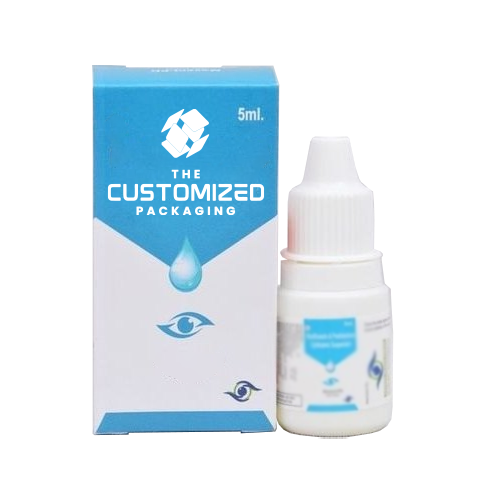
Custom Eye Drop Boxes provide organized secondary packaging for lubricating eye drops, redness-relief products, allergy drops, prescription ophthalmic solutions, contact-lens rewetting drops, preservative-free vials, veterinary eye-care products, and related accessories.
The correct structure depends on the primary bottle dimensions, cap diameter, dropper profile, fill volume, vial count, leaflet size, storage conditions, retail environment, and distribution method. Box length, width, height, board thickness, closure, bottle holder, leaflet compartment, hang tab, tamper-evident feature, printing, and coding areas can all be customized.
A properly designed carton helps keep the primary package positioned while providing clear space for product identification, active ingredient information supplied by the brand, dosage form, bottle volume, directions, warnings, contraindications, storage instructions, batch codes, expiry dates, barcodes, QR codes, and company information.
Custom ophthalmic packaging is suitable for pharmaceutical manufacturers, eye-care brands, pharmacies, clinics, hospitals, optical retailers, veterinary suppliers, contract packers, distributors, and ecommerce businesses.
Suitable Eye-Care Products and Packaging Applications
| Product or Application | Recommended Packaging Format |
|---|---|
| Multidose Eye Drop Bottles | Tuck carton with bottle holder and leaflet space |
| Single-Dose Vials | Multipack carton with tray or divider |
| Lubricating Eye Drops | Retail tuck carton with color-coded branding |
| Allergy Eye Drops | Folding carton with dosage and warning panels |
| Contact-Lens Rewetting Drops | Compact bottle carton or hanging retail box |
| Preservative-Free Drops | Single-dose multipack or specialized bottle carton |
| Prescription Ophthalmic Products | Printed carton with traceability and coding areas |
| Veterinary Eye Drops | Clearly identified carton with animal-use labeling |
| Travel-Size Eye Drops | Small tuck carton or blister-and-carton combination |
| Eye-Care Kits | Compartment box for bottle, leaflet, wipes, or accessories |
| Pharmacy Multipacks | Divided carton or retail bundle sleeve |
| Wholesale Distribution | Corrugated master case with case-level labeling |
Material Options for Eye Drop Packaging
The selected material affects print clarity, folding accuracy, product support, coding performance, and retail presentation.
| Material | Best For | Main Benefits |
|---|---|---|
| SBS Paperboard | Pharmaceutical and pharmacy retail cartons | Smooth surface and detailed printing |
| White Kraft Paperboard | Clinical branding and color-coded product ranges | Bright print contrast |
| Folding Boxboard | Lightweight bottles and high-volume production | Efficient folding and flat storage |
| Recycled Paperboard | Selected secondary-packaging applications | Recycled content and printability |
| Clay-Coated Board | High-resolution graphics and small text | Smooth coated surface |
| Natural Kraft Board | Veterinary, wellness, and selected natural-style lines | Brown kraft appearance |
| Micro-Flute Cardboard | Larger eye-care kits and multipacks | Added rigidity |
| E-Flute Corrugated Board | Institutional packs and protective outer cartons | Improved strength |
| Rigid Board | Premium diagnostic or specialty eye-care kits | Strong presentation structure |
| Molded Pulp | Selected bottle and vial supports | Shaped paper-based positioning |
| Paperboard Insert Stock | Bottle holders, vial dividers, and leaflet supports | Lightweight customizable organization |
| Specialty Barrier Board | Application-specific secondary packaging | Performance selected for storage and distribution needs |
The printed outer carton does not automatically provide sterility, microbial protection, light protection, moisture control, or product preservation. Those functions depend primarily on the validated primary container and complete packaging system.
Popular Custom Eye Drop Box Styles
| Box Style | Main Features | Recommended Use |
|---|---|---|
| Straight-Tuck Eye Drop Box | Top and bottom flaps close in the same direction | Standard bottle packaging |
| Reverse-Tuck Eye Drop Box | Opposing tuck flaps support efficient production | High-volume pharmacy cartons |
| Auto-Lock Eye Drop Box | Pre-glued base supports faster packing | Heavier bottles and kits |
| Snap-Lock Eye Drop Box | Interlocking base adds support | Multipacks and accessory sets |
| Bottle-Holder Carton | Internal support keeps bottle upright | Multidose dropper bottles |
| Sleeve-and-Tray Box | Outer sleeve surrounds inner tray | Premium kits and organized multipacks |
| Hanging Eye Drop Box | Euro slot or hang tab supports peg display | Optical and pharmacy retail |
| Multipack Eye Drop Box | Dividers organize several bottles or vials | Pharmacy bundles and treatment packs |
| Single-Dose Vial Carton | Holds vial strips, trays, or pouches | Preservative-free products |
| Display Eye Drop Box | Converts into a counter or shelf display | Retail and clinic dispensing |
| Child-Resistant Secondary Box | Specialized opening sequence where developed | Selected regulated applications |
| Corrugated Master Case | Holds multiple retail cartons | Wholesale and institutional distribution |
Custom Dimensions and Primary-Pack Fit
Custom eye drop boxes can be manufactured around the bottle height, width, depth, cap diameter, dropper profile, vial-strip dimensions, leaflet thickness, and product count.
Small cartons can hold travel-size or low-volume bottles. Standard cartons can package common multidose droppers with folded instructions. Larger structures can hold several bottles, single-dose vials, eye-care kits, applicators, wipes, or related accessories.
The internal dimensions should account for bottle labels, tamper bands, overcaps, nozzle protection, leaflet folds, separators, and any required clearance. A carton that is too tight can damage the bottle label or make removal difficult, while an oversized carton can allow unnecessary movement.
Physical primary-package samples, technical drawings, photographs, and approved label dimensions can help determine the correct structure.
Multidose Eye Drop Bottle Boxes
Multidose bottles commonly use narrow folding cartons with top and bottom tuck closures.
A paperboard insert or folded internal platform can help keep the bottle upright. The carton can also include a leaflet pocket or enough internal clearance for folded instructions.
Bottle dimensions should be measured with the final cap, overcap, tamper band, and label applied.
Single-Dose Vial Boxes
Single-dose eye drops may be packed as vial strips, individual units, pouches, or trays.
Custom cartons can hold several doses in rows, stacks, or divided sections. The structure should protect vial tips, seals, and connecting tabs from unnecessary pressure.
A printed dose-count guide can help customers understand the package arrangement.
Preservative-Free Eye Drop Boxes
Preservative-free products may use single-dose vials or specialized multidose bottles.
The carton can distinguish the format through color coding, illustrations, icons, and clearly organized text supplied by the product company.
Packaging should not make unsupported claims about tolerability, sterility, or clinical performance.
Lubricating Eye Drop Boxes
Lubricating eye drops can use compact retail cartons with clear product identification, bottle volume, directions, warnings, and storage guidance.
Different formulations can use coordinated color systems while maintaining consistent brand architecture.
The outer carton should protect the bottle label and leaflet during retail handling.
Allergy Eye Drop Boxes
Allergy-related products may require prominent dosage, age, warning, and active-ingredient panels supplied by the responsible brand.
The carton can use a clear information hierarchy and high-contrast typography. Multiple strengths or package sizes can be differentiated through color and variable printing.
Claims about symptom relief or duration should only use approved product wording.
Contact-Lens Rewetting Drop Boxes
Contact-lens rewetting products can use compact cartons sized around small multidose bottles.
The package can provide room for lens-use guidance, warnings, storage instructions, bottle volume, and compatibility information supplied by the manufacturer.
The carton should not imply universal contact-lens compatibility unless supported and approved.
Prescription Eye Drop Boxes
Prescription ophthalmic cartons may require extensive information, coding, traceability fields, and market-specific labeling.
The structure can include areas for batch numbers, expiry dates, serialization, pharmacy labels, braille where applicable, and tamper-evident features.
The pharmaceutical company remains responsible for regulatory review and approval of all text, claims, symbols, and coding requirements.
Over-the-Counter Eye Drop Boxes
Consumer eye-care packaging can focus on clear front-panel identification while reserving side and back panels for directions, warnings, active ingredients, inactive ingredients, and storage information supplied by the brand.
Retail features may include hang tabs, security seals, barcodes, and shelf-ready cases.
Different formulations should remain easy to distinguish without relying only on color.
Veterinary Eye Drop Boxes
Veterinary eye drop cartons can package products intended for pets, livestock, or clinical animal care.
The box can include clear animal-use identification, species information supplied by the manufacturer, dosage guidance, warnings, storage instructions, and veterinary branding.
Human-use and animal-use products should remain clearly differentiated.
Eye Drop Multipack Boxes
Multipack cartons can hold two, three, four, six, or custom quantities of bottles or vial groups.
Paperboard dividers can keep units separated and organized. The outer carton can display total quantity and individual bottle volume.
The layout should support easy counting and reduce bottle-to-bottle contact.
Eye-Care Kit Boxes
Eye-care kits can combine drops with wipes, compresses, applicators, instructions, storage pouches, or related accessories.
Compartments can separate liquid products from paper components. The box can include a product inventory, step-by-step guidance supplied by the brand, and refill information.
Each item should remain inside its appropriate primary packaging.
Eye Drop Boxes with Bottle Inserts
Bottle inserts can hold the primary container upright and centered.
Available options include folded paperboard cradles, side supports, base platforms, molded pulp, and custom cavities. The insert should support the bottle without pressing on the label or cap.
The holder should allow the customer to remove the bottle without excessive force.
Eye Drop Boxes with Leaflet Compartments
Instruction leaflets can be positioned beside the bottle, above the bottle, beneath an internal platform, or inside a dedicated sleeve.
The compartment should keep the document flat while preventing it from interfering with the bottle cap or tamper band.
The leaflet fold pattern should be reviewed together with the carton dimensions.
Eye Drop Boxes with Dividers
Dividers can separate multiple bottles, vial strips, accessories, and instruction materials.
Available layouts include two-section, four-section, grid, layered, removable, and custom configurations.
The divider should not rub against or puncture the primary package.
Straight-Tuck Eye Drop Cartons
Straight-tuck cartons use top and bottom flaps that close in the same direction.
They provide broad front and back panels for pharmaceutical branding and detailed information. This style is suitable for lightweight bottles and standard retail applications.
Flap dimensions should remain compatible with automated or manual packing equipment.
Reverse-Tuck Eye Drop Cartons
Reverse-tuck cartons use top and bottom flaps that close in opposite directions.
They are common for compact retail products and can support efficient paperboard use. The structure can include dust flaps, locking tabs, security seals, and leaflet space.
The opening direction should remain clear to the packing team.
Auto-Lock Eye Drop Boxes
Auto-lock cartons use a pre-glued bottom that forms when the carton is opened.
They can support heavier bottles, multipacks, and eye-care kits. Faster setup may benefit high-volume packing operations.
The base should still be tested with the final product weight and insert system.
Sleeve-and-Tray Eye Drop Boxes
Sleeve-and-tray packaging creates a controlled opening and organized product presentation.
The tray can hold one or more bottles, vials, leaflets, and accessories. A thumb notch, paper pull, or ribbon can support opening.
This format is suitable for premium products, treatment kits, and subscription-style eye-care programs.
Drawer-Style Eye Drop Boxes
Drawer cartons use a sliding tray inside an outer sleeve.
Dividers can organize bottles, doses, and accessories. The drawer should remain closed during normal retail handling and transportation.
Security labels or paper bands can indicate prior opening.
Hanging Eye Drop Boxes
Hanging cartons can include euro slots, round holes, sombrero slots, or reinforced header panels.
They are useful for optical stores, pharmacies, convenience retail, and travel-size products. The hang tab should be aligned with the final packed weight.
Required text should not be crowded by the hanging feature.
Display Eye Drop Boxes
Retail display boxes can hold several bottles, unit cartons, or vial packs.
The top or front panel can fold back to create a branded counter display. The remaining tray should support products when full, partially sold, and nearly empty.
Display packaging can also support clinic counters and sample distribution.
Shelf-Ready Eye Drop Packaging
Shelf-ready cases can transport retail cartons and convert into display trays.
Perforated panels should remove cleanly without damaging visible branding or labels. Unit cartons should remain front-facing after opening.
The full case should be evaluated for compression, stacking, and distribution.
Tamper-Evident Eye Drop Boxes
Tamper-evident options include adhesive seals, tear strips, perforated flaps, locking tabs, serialized labels, security stickers, and shrink bands where appropriate.
These features can indicate prior opening but do not make the package completely tamper-proof.
The selected seal should remain visible and should not cover important instructions, expiry details, or barcodes.
Child-Resistant Secondary Packaging
Selected products may require or benefit from a specialized child-resistant secondary package.
Possible structures can use squeeze-and-pull, push-and-slide, locking tabs, coordinated opening actions, or other tested mechanisms. A standard folding carton should not be described as child-resistant without suitable development and validation.
The responsible product company should confirm whether such packaging is required and which performance standards apply.
Sterility and Primary Container Considerations
Eye drops commonly rely on the bottle, vial, seal, nozzle, cap, pouch, or tray as the primary product-protection system.
The printed outer carton generally provides organization, information, retail presentation, and secondary protection. It should not be described as sterile or as maintaining sterility unless the complete packaging system has been specifically validated for that function.
The carton should protect the primary container from unnecessary crushing, scuffing, and handling damage.
Light-Protection Considerations
Some ophthalmic products may require protection from light.
Light protection is usually achieved through the primary container, label, overwrap, carton material, or complete tested system. A printed paperboard box should not automatically be described as light-resistant or UV-protective.
Claims should reflect the actual package specification and validated performance.
Moisture and Barrier Considerations
Paperboard cartons do not automatically provide a moisture, oxygen, vapor, or microbial barrier.
Products requiring barrier protection should remain inside suitable primary containers or pouches. Coatings and laminations may improve surface resistance but do not automatically create a validated barrier.
Storage testing should reflect the product’s intended environment.
Dropper and Nozzle Protection
The carton should provide enough clearance for the dropper tip, nozzle, cap, and tamper band.
Inserts can keep the bottle from shifting so the nozzle does not strike the box walls. The primary seal should remain undisturbed during packing and removal.
The box should not apply continuous pressure to the cap.
Product Information and Labeling
Eye drop cartons can provide space for the product name, active ingredient information, dosage form, bottle volume, directions, warnings, contraindications, storage guidance, batch details, expiry information, barcode, QR code, and company information.
Required text should remain readable and should not cross folds, perforations, closures, or heavily textured finishes.
Pharmaceutical and healthcare companies remain responsible for reviewing and approving all claims, symbols, translations, and regulatory information.
Active Ingredient and Formulation Information
Ingredient information can appear on front, side, and back panels according to the brand’s approved layout.
Multiple formulations can use different color bands, icons, or naming systems. Color should support rather than replace written identification.
All ingredient and strength information should come from the responsible product company.
Dosage and Administration Information
Usage directions can appear on the carton, leaflet, label, or QR-linked guide.
Instructions should be supplied and approved by the manufacturer or responsible healthcare company. The packaging should not add unverified medical guidance.
Diagrams may support understanding but should not replace required written information.
Warning and Precaution Panels
Dedicated areas can be reserved for warnings, age limitations, contraindications, contamination precautions, contact-lens guidance, and other approved information.
High-contrast text and clear spacing improve readability. Important warnings should not be hidden beneath pharmacy labels or tamper seals.
The final wording should be reviewed by the responsible company.
Storage Instructions
The box can display storage temperature, light precautions, closure guidance, disposal information, and other brand-supplied instructions.
The carton itself does not create controlled storage conditions. The complete product should be stored and distributed according to the approved requirements.
Temperature-sensitive products may require additional distribution systems beyond the retail carton.
Batch, Lot, and Expiry Coding
Flat panels can be reserved for lot numbers, batch codes, manufacturing dates, expiry dates, serial numbers, and facility references.
Coding may be preprinted, inkjet applied, laser marked where compatible, embossed, or added through labels.
The coding area should remain accessible during production and inspection.
Serialization and Traceability Areas
Custom cartons can include zones for serialized barcodes, unique identifiers, data matrices, human-readable codes, and tamper-evident labels.
The carton material, coating, and finish should support reliable printing and scanning.
Variable-data requirements should be confirmed before artwork and dieline approval.
Barcode Placement
UPC barcodes, EAN codes, GTINs, product codes, pharmacy labels, and case codes can be printed or applied.
Barcodes should appear on a flat, high-contrast panel away from folds, perforations, foil, embossing, and security seals.
A completed sample should be scanned before production approval.
QR Codes and Digital Integration
QR codes can link customers to instructions, product information, multilingual content, demonstration videos, patient support, refill pages, authenticity records, or company contact details.
The code should appear on a flat panel with sufficient contrast and should be tested on the final printed carton.
Placement should avoid folds, tamper seals, textured finishes, and reflective coatings.
Data Matrix and Machine-Readable Codes
Pharmaceutical packaging may require compact machine-readable codes.
The panel should provide enough quiet space and print contrast for reliable scanning. Coatings, varnishes, and textured materials can affect code quality.
Production samples should be checked with the intended scanning system.
Braille and Tactile Information
Selected markets or products may require braille or tactile information on the carton.
Panel size, board thickness, embossing depth, text placement, and structural folds should be considered early in development.
Braille should not be added without confirming the applicable market requirements and approved wording.
Multilingual Eye Drop Packaging
Custom cartons can include several languages through printed panels, fold-out leaflets, peel-back labels, extended-content labels, sleeves, or QR-linked information.
The layout should provide enough space for readable text without crowding key warnings or product identification.
The responsible company should verify translation accuracy and market-specific requirements.
Color-Coded Eye Drop Packaging
Color coding can help distinguish lubricating drops, allergy products, prescription lines, preservative-free formats, bottle volumes, or different strengths.
Colors may appear as bands, side panels, top flaps, symbols, or full carton backgrounds. The system should remain consistent across the range.
Written names and strengths should remain prominent because color alone may not be sufficient.
Pharmacy Label Areas
A dedicated blank or lightly printed area can support pharmacy-applied labels.
The panel should remain smooth, flat, and large enough for the intended label format. Important manufacturer information should not be covered.
Label adhesion should be tested on the selected coating.
Clinical and Hospital Packaging
Institutional cartons can prioritize clear product identification, batch details, expiry information, storage guidance, and quick access.
Larger fonts, color-coded tops, and end-panel labels can help staff identify products inside storage drawers.
Bulk inner cartons and master cases can organize several retail or clinical units.
Optical Retail Packaging
Optical retailers can use hanging cartons, compact tuck boxes, display trays, and eye-care kits.
The packaging can coordinate with contact-lens products, cleaning supplies, cases, and accessories.
Branding should remain clear while preserving sufficient room for approved directions and warnings.
Veterinary Eye-Care Packaging
Veterinary cartons can include animal-use statements, species information, dosage guidance, warnings, storage instructions, and clinic details supplied by the manufacturer.
Color coding and animal imagery can help differentiate veterinary products from human products.
The package should avoid unsupported treatment or efficacy claims.
Sample and Trial-Size Eye Drop Boxes
Sample cartons can hold small bottles, limited vial quantities, or trial-size products.
The box can include product information, instructions, warnings, and promotional details while remaining compact.
Sample packaging should still provide the required information for the intended market and distribution method.
Ecommerce Eye Drop Packaging
Retail eye drop cartons may require protective corrugated mailers for parcel shipping.
The outer shipping package can protect tuck flaps, seals, labels, bottle corners, and printed surfaces. Void fill or fitted inserts can prevent movement.
The small retail carton should not always be treated as the complete shipping package.
Subscription and Refill Packaging
Eye-care subscription services can package several approved products, refills, accessories, and educational materials inside a larger mailer.
Compartments can separate bottles from wipes, lens cases, or documents. Each product should remain inside its appropriate primary and secondary packaging.
The outer subscription box does not replace product-specific storage requirements.
Corrugated Master Cartons
Master cases can hold multiple retail eye drop cartons for pharmacies, hospitals, distributors, and wholesalers.
The case can display unit quantity, product code, batch information, expiry details where applicable, orientation marks, packed weight, and destination labels.
Corrugated grade should reflect total weight, stacking height, palletization, and distribution conditions.
Premium Finishes
Custom eye drop boxes can use matte or gloss varnish, aqueous coatings, soft-touch finishes on suitable consumer-health cartons, spot UV, metallic ink, embossing, debossing, and foil accents.
Decorative finishes should not reduce readability, interfere with coding, cover warnings, or affect barcode and data-matrix scanning.
Healthcare packaging usually benefits from clear information hierarchy over excessive decoration.
Minimalist Eye Drop Packaging
Minimalist cartons can use white paperboard, limited colors, simple typography, and clear product icons.
This style suits modern ophthalmic brands, wellness-oriented eye-care products, optical retailers, and direct-to-consumer companies.
A clean design should still provide enough room for approved instructions, warnings, batch details, expiry information, and machine-readable codes.
Eco-Friendly Eye Drop Boxes
Possible options include recycled-content secondary board, responsibly sourced paperboard, reduced ink coverage, paper inserts, molded pulp, right-sized dimensions, and removable mixed-material components.
Primary bottles, caps, seals, pouches, labels, coatings, tamper features, and local recycling systems can affect end-of-life options.
An eye drop box should not automatically be described as recyclable, biodegradable, compostable, plastic-free, or sustainable without considering the complete packaging system.
Flat-Pack Storage and Assembly
Folding eye drop cartons, sleeves, dividers, display boxes, and corrugated cases can usually be supplied flat.
Assembly may involve forming the base, inserting a bottle holder, placing the primary pack and leaflet, closing the flaps, applying tamper seals, and adding variable data.
Auto-lock and pre-glued structures can reduce packing time for higher-volume production.
Wholesale and Bulk Custom Eye Drop Boxes
Ordering wholesale custom eye drop boxes can reduce the average unit price and help brands maintain consistent packaging across formulations, bottle sizes, strengths, languages, retailers, and markets.
Bulk ophthalmic packaging is suitable for pharmaceutical companies, eye-care manufacturers, pharmacies, hospitals, clinics, optical retailers, veterinary suppliers, contract packers, and distributors.
Pricing depends on dimensions, paperboard grade, box style, inserts, leaflet space, hang tabs, tamper features, braille, variable data, printing coverage, quantity, assembly, and delivery destination.
Low-minimum options may be available for selected digitally printed folding cartons and product launches. Multiple language versions, serialized printing, specialized security features, and regulated structures may require different production quantities.
Custom Eye Drop Box Cost Calculator
Use our Custom Box Packaging Cost Calculator to receive a preliminary estimate for your eye drop packaging project. Enter the carton dimensions, required quantity, material, primary bottle size, insert needs, leaflet requirements, printing coverage, coding areas, and finishing options.
Want to know the cost of your product’s packaging? Try our Custom Box Packaging Cost Calculator.
The calculator can help compare single-bottle cartons, vial multipacks, hanging pharmacy boxes, sleeve-and-tray kits, display packaging, and wholesale corrugated cases.
Final pricing is confirmed after reviewing the primary package dimensions, structural requirements, artwork, variable data, quantity, assembly needs, and delivery destination.
Factors That Affect Eye Drop Box Pricing
| Cost Factor | How It Affects the Price |
|---|---|
| Carton Dimensions | Larger bottles, leaflets, and multipacks require more material |
| Primary Package Type | Bottles, vial strips, trays, and pouches require different structures |
| Material Grade | SBS, coated board, kraft, and corrugated materials vary in cost |
| Insert Design | Bottle holders, vial dividers, and molded supports add components |
| Leaflet Space | Larger or more complex leaflets may increase carton dimensions |
| Tamper Features | Tear strips, labels, and security seals add production steps |
| Hang Tab | Reinforced retail hanging features increase complexity |
| Braille or Embossing | Specialized tooling and quality control may be required |
| Variable Data | Batch, expiry, serialization, and multilingual versions can add setup |
| Printing Coverage | Full-color and interior printing affect cost |
| Premium Finishes | Foil, spot UV, and specialty coatings increase production cost |
| Order Quantity | Larger production quantities generally reduce the average unit price |
Why Choose The Customized Packaging?
The Customized Packaging manufactures eye drop packaging for pharmaceutical brands, eye-care companies, pharmacies, clinics, hospitals, optical retailers, veterinary suppliers, contract packers, distributors, and ecommerce businesses.
Customers can choose custom dimensions, white or kraft paperboard, tuck cartons, bottle holders, vial dividers, leaflet compartments, hang tabs, tamper-evident features, variable-data areas, custom printing, and wholesale quantities.
Whether you need custom eye drop boxes with logo, ophthalmic bottle cartons, single-dose vial packaging, pharmacy display boxes, veterinary eye-care cartons, or wholesale pharmaceutical packaging in the USA, we can manufacture boxes around your validated primary packages and approved branding requirements.
Buy Custom Eye Drop Boxes Online
To request a quotation, provide the bottle or vial dimensions, primary package type, product count, packed weight, required quantity, preferred material, box style, insert needs, leaflet dimensions, tamper features, artwork, labeling requirements, and delivery destination.
Our packaging specialists can help you buy custom eye drop boxes online, compare low-minimum and wholesale pricing, and develop packaging that supports product organization, pharmacy display, clinical distribution, ecommerce fulfillment, traceability, and brand recognition.
Choose The Customized Packaging for custom printed eye drop boxes, pharmaceutical folding cartons, vial multipacks, hanging retail packaging, bottle-holder cartons, and wholesale custom healthcare packaging delivered throughout the USA.
Provide the completed primary package’s height, width and depth, along with the cap diameter, nozzle or dropper profile, overcap, tamper band, label thickness and packed weight. For single-dose products, provide the vial-strip, pouch or tray dimensions and the required number of doses per carton.
Yes. The carton can include enough clearance beside, above or below the bottle for a folded leaflet. A dedicated paperboard compartment or internal platform can help prevent the leaflet from interfering with the cap, nozzle or tamper band.
A folded paperboard collar, base platform, side supports or molded-pulp insert can help keep the bottle centered and upright. The holder should support stable areas of the primary container without pressing against the label, cap, nozzle or seal.
Yes. Cartons can be developed for vial strips, individual units, sealed pouches or trays. The layout may include rows, divided sections, layered trays or printed dose-count guides according to the final primary packaging.
A standard printed outer carton should not be described as sterile or as maintaining sterility. Sterility and contamination protection normally depend on the validated bottle, vial, pouch, tray, seal and complete packaging system.
Related Products



Order Custom Eye Drop Boxes from The Customized Packaging
We manufacture Custom Eye Drop Boxes for businesses that need reliable product protection, accurate printing, and professional packaging for retail, ecommerce, storage, or shipping. Each box can be customized by size, material, structure, printing, coatings, finishes, inserts, and order quantity.
Share your artwork and quantity targets for Custom Eye Drop Boxes and we will recommend the most cost-effective structure for your timeline. or speak with a packaging expert. Browse custom rigid boxes, packaging inserts, and use our Custom Box Packaging Cost Calculator.