
Top Ecommerce Packaging Trends in the USA for 2026
Explore the top ecommerce packaging trends for 2026, including right-sized boxes, sustainable materials, smart packaging, return-ready designs, personalized printing and simpler unboxing experiences for USA brands.
 Published May 15, 2026
Updated August 04, 2026
17 min read
Published May 15, 2026
Updated August 04, 2026
17 min read
The role of ecommerce packaging is changing quickly across the United States. A shipping box is no longer evaluated only by whether it reaches the customer without breaking. It is also judged by how efficiently it moves through fulfillment, how much space it occupies, how easy it is to open or return, whether its environmental claims are credible and how well it represents the brand after an online purchase.
That matters because online retail continues to expand. According to the U.S. Census Bureau, ecommerce represented approximately 16.8% of total US retail sales during the first quarter of 2026, while ecommerce sales increased faster than overall retail sales compared with the same quarter in 2025.
The most important ecommerce packaging trends 2026 are therefore not limited to visual design. They include right-sized packaging, shipping-ready product boxes, paper-based materials, verified sustainability claims, efficient fulfillment structures, return-ready closures, connected packaging and more disciplined unboxing experiences.
This guide examines the trends shaping ecommerce packaging trends USA and explains how Shopify stores, Amazon sellers, subscription businesses and direct-to-consumer brands can apply them without increasing unnecessary packaging, shipping volume or inventory.
What Are the Biggest Ecommerce Packaging Trends in 2026?
The defining change in 2026 is the movement from “more packaging” to better packaging systems. Online brands are looking for packaging that uses the correct amount of material, protects the product through parcel delivery, assembles quickly, communicates clearly and gives customers an uncomplicated opening and return experience.
The strongest custom ecommerce packaging strategies balance five requirements: product protection, fulfillment efficiency, shipping dimensions, environmental credibility and brand presentation. A design that looks impressive but is slow to assemble, difficult to recycle or oversized for the product is unlikely to remain cost-effective as order volume increases.
1. Right-Sized Packaging Is Becoming a Business Requirement
Right-sized packaging is packaging designed around the actual dimensions, weight, fragility and arrangement of the product rather than around a standard box that happens to be available.
Oversized boxes require more paper, void fill and storage space. They also allow products to move during transit unless additional cushioning is added. A properly sized box can reduce unnecessary material while creating a cleaner presentation when the customer opens the order.
Right-sizing does not mean making every package as small as physically possible. Fragile glass, electronics, candles and liquid products still need enough clearance for protective inserts and cushioning. The objective is to remove unused space without removing the protection required for realistic carrier handling.
For growing brands, the best approach is to create a small packaging-size system. One size may serve small orders, another may serve common product combinations and a third may accommodate larger bundles. This is usually more practical than using one oversized box for every order or producing a separate structure for every SKU.
2. More Products Are Being Designed to Ship in Their Own Packaging
A major development in 2026 is the growth of packaging designed to function as both product packaging and shipping packaging. Instead of placing a retail box inside a second corrugated carton, brands are developing structures that can withstand distribution while still presenting the product professionally.
Amazon’s Ships in Product Packaging program reflects this direction by certifying eligible products that can travel through fulfillment without additional Amazon packaging. Amazon reports that millions of products have been certified for the program and that it continues to invest in packaging reduction and made-to-fit systems.
Shipping-ready ecommerce packaging boxes can reduce secondary packaging, filler and packing steps. However, they must be designed carefully. The box may need stronger corners, secure closures, suitable board strength, label placement space and enough print resistance to remain presentable after shipping.
Brands should also consider privacy and theft risk. A highly recognizable exterior may be appropriate for apparel, subscriptions or promotional kits, while electronics, luxury goods and sensitive products may benefit from a more discreet outside surface and a branded interior.
3. Environmental Claims Must Be Specific and Verifiable
The direction of sustainable ecommerce packaging is moving away from broad statements such as “100% green” and toward specific, supportable information.
Brands should identify what makes the package more sustainable. Useful statements may include the percentage of recycled content, the material used, whether components should be separated before recycling or how the new package uses less material than the previous version.
The FTC Green Guides warn marketers against broad, unqualified environmental claims. They also explain that recyclable and compostable claims may require qualifications depending on whether appropriate facilities are widely available.
This means the wording printed on recyclable packaging matters. A kraft appearance does not automatically make an entire package recyclable. Plastic windows, magnetic closures, laminated films, metallic foils, foam inserts and mixed adhesives may affect how customers should dispose of the package.
State-level extended producer responsibility programs are also making packaging data more important for businesses selling across the United States. Requirements vary by state, but brands may increasingly need accurate records describing packaging material types, weights and quantities placed into the market.
For ecommerce businesses, material transparency is becoming both a compliance issue and a trust signal.
4. Paper-Based and Easier-to-Separate Packaging Continues to Grow
Paper and paperboard remain important materials for ecommerce because they are familiar to consumers, printable and supported by established recovery systems. EPA data identifies paper and paperboard as a major part of the US material stream and reports historically high recovery rates for corrugated containers.
This does not mean every product should immediately replace plastic with paper. Moisture resistance, grease resistance, barrier protection, product weight and the full lifecycle of the package must still be considered.
The stronger trend is toward simpler material combinations. A corrugated box with a fitted corrugated insert is generally easier for customers to understand than a box containing several unidentified plastics, laminated foams and permanently attached decorative parts.
Brands developing corrugated mailer boxes can also evaluate water-based coatings, reduced ink coverage, removable labels and paper-based cushioning. The most appropriate specification will depend on the product and shipping environment rather than on appearance alone.
5. Return-Ready Packaging Is Becoming Part of Ecommerce Design
Returns are a normal part of online retail, especially in apparel, footwear, accessories and subscription commerce. Packaging that cannot be reused for a return creates inconvenience for customers and may require another package.
Return-ready packaging may include a second adhesive strip, a reusable tuck closure, a tear strip positioned away from the return seal or clear instructions explaining how to close the box again.
The closure should be intuitive. Customers should not need excessive tape, tools or complicated folding steps to prepare a return. At the same time, the first closure must be strong enough to prevent accidental opening during delivery.
Brands should test both journeys: the outbound shipment and the return shipment. A box that survives the first delivery may not perform equally well after the tear strip has been removed or the original adhesive has been used.
For products with frequent returns, return functionality should be considered during structural design rather than added after the artwork is complete.
6. Faster-to-Assemble Boxes Are Improving Fulfillment Efficiency
A packaging structure may appear inexpensive until the labor required to assemble, fill and close it is calculated.
In 2026, online businesses are paying more attention to the number of folds, locking steps, adhesive applications and separate components involved in each order. Faster assembly becomes especially important during product launches, holidays and promotional periods.
Self-locking custom mailer boxes, crash-lock bottoms and simplified corrugated structures can reduce repetitive pack-out steps. Clearly designed inserts can also help warehouse teams position products consistently without guessing how each item should fit.
The right structure depends on the packing environment. A manually packed startup may need a different solution than a high-volume fulfillment center using conveyors, label applicators or automated packing equipment.
Before bulk production, the packaging should be tested by the people who will actually assemble and pack it. Their feedback can identify tabs that are difficult to lock, panels that bend incorrectly or inserts that slow down product loading.
7. QR Codes Are Becoming More Useful and Less Decorative
The value of smart packaging is not the presence of technology by itself. It is the useful action the technology allows the customer to take.
A visible, properly tested QR code may connect customers to setup instructions, care information, product registration, authenticity verification, reorder pages, recycling guidance or a loyalty program.
Effective QR code packaging gives the customer a clear reason to scan. “Scan for assembly instructions” is more useful than an unexplained code. The destination page should also be mobile-friendly, fast and maintained for as long as the packaging remains in circulation.
QR codes can reduce the amount of temporary information printed directly on the box. However, critical safety instructions, required product information and essential usage directions should not be hidden exclusively behind a digital link.
NFC tags and more advanced connected features may be useful for high-value products, authentication or controlled experiences, but many small and mid-sized ecommerce brands can accomplish their immediate goals with a well-implemented QR code.
8. Personalization Is Moving Toward Shorter, Smarter Print Runs
Personalized packaging does not have to mean printing a different customer name on every shipment. It can involve producing controlled variations for customer groups, regions, subscription months, seasonal collections, product launches or loyalty tiers.
Modern digital printing makes shorter runs and multiple artwork versions more practical because conventional printing plates may not be required for every design. This can help brands test packaging concepts without holding excessive quantities of one design.
The important consideration is operational control. Too many packaging versions can create inventory confusion, inconsistent packing and unused stock. Personalization should therefore be connected to a clear business purpose.
A subscription company might change the inside message each month while keeping the outer structure consistent. A cosmetics brand might use one approved box size with different sleeves for product launches. An apparel brand might create seasonal artwork without changing the box dimensions or packing process.
The trend is not unlimited customization. It is controlled variation built around a repeatable packaging system.
9. Premium Packaging Is Becoming Simpler and More Intentional
Premium ecommerce presentation is moving away from adding as many finishes and components as possible.
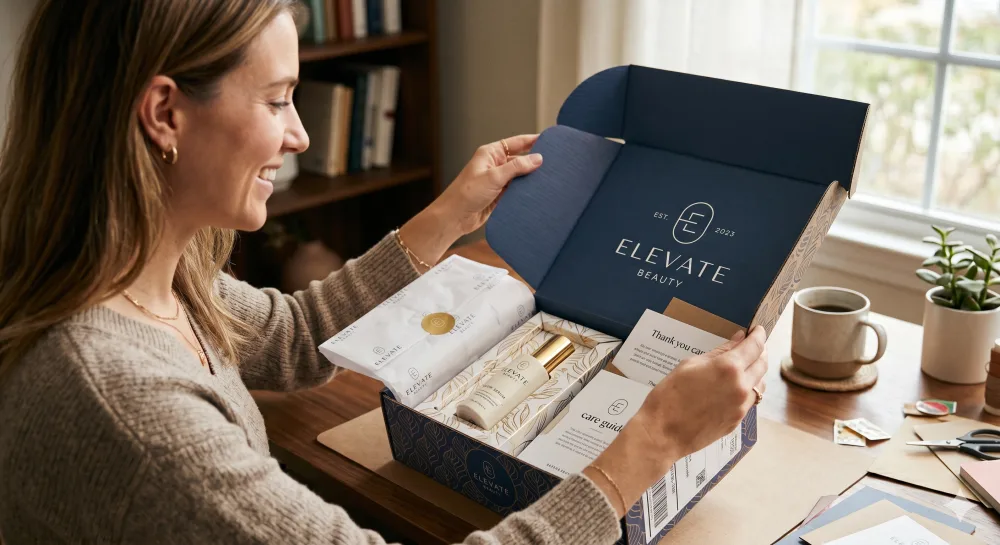
A strong unboxing experience can be created through accurate fit, a controlled opening sequence, clean printing, a clear interior message and an insert that presents the product immediately. It does not always require ribbons, several layers of tissue, magnetic closures and plastic decorations.
Minimal exterior graphics can also protect customer privacy while allowing the interior to carry the more expressive part of the brand story. This approach works particularly well for skincare, fashion, jewelry, candles, corporate kits and subscription products.
Premium simplicity also supports consistency. It is easier for fulfillment teams to reproduce the intended presentation when the packaging system has a limited number of clearly defined components.
Finishes such as foil stamping, embossing, debossing, spot UV and soft-touch coatings should be used where they improve hierarchy or tactile quality—not simply because they are available.
10. Product Protection Is Becoming More Product-Specific
Using a stronger box does not automatically solve every shipping problem. Damage often occurs because the product can move, because weight is distributed incorrectly or because the package was not designed for the product’s most vulnerable areas.
Packaging inserts are increasingly being engineered around the product rather than selected from generic filler materials. Corrugated partitions, paperboard platforms, molded pulp and suitable foam structures can hold products away from the outer walls and prevent contact between multiple items.
The insert and outer box should be developed as one system. An insert that is too tight may damage labels or finishes, while an insert that is too loose will not control movement.
Brands shipping glass jars, candles, electronics, bottles or product sets should test the packed configuration rather than evaluating an empty box. Packed weight, center of gravity, surface sensitivity and expected delivery journey all affect performance.
Tamper-evident seals and security features are also becoming more important for cosmetics, wellness products, food, electronics and high-value goods. These features should be easy for customers to understand and difficult to replace without visible evidence.
Which Ecommerce Packaging Material Fits Each Product?
| Packaging material or structure | Best suited to | Main 2026 advantage | Important consideration |
|---|---|---|---|
| Folding cardboard cartons | Lightweight products, cosmetics, small retail goods and product boxes | Strong print quality with relatively low material weight | Usually needs an outer shipper for parcel delivery |
| Kraft paperboard | Natural, handmade, food, soap and sustainability-positioned products | Recognizable natural appearance and reduced surface treatment options | Printed colors may appear more muted |
| E-flute corrugated board | Apparel, subscriptions, candles, cosmetics and general ecommerce shipping | Combines protection, printing space and compact flute thickness | Board grade must match packed weight and shipping conditions |
| B-flute corrugated board | Larger, heavier or more vulnerable shipments | Greater cushioning and stacking strength | Thicker profile can increase package dimensions |
| Rigid board | Luxury gifts, jewelry, premium beauty and presentation kits | High perceived value and reusable construction | Often requires protective transit packaging |
| Molded pulp or corrugated inserts | Bottles, jars, sets and shaped products | Product-specific support with paper-based options | Tooling and minimum quantities may apply |
| Flexible mailers | Apparel, soft goods and lightweight accessories | Low material and shipping volume | Limited crush protection and recycling access varies by material |
How Packaging Trends Differ by Ecommerce Industry
Apparel brands usually benefit most from lightweight mailers, return-ready closures, tissue reduction and packaging sizes designed around common order combinations. Premium clothing collections may use printed interiors or reusable boxes, while everyday products may perform better in a simplified mailer.
Beauty and skincare companies require careful fit, leakage control, product separation and readable instructions. Their branded shipping boxes may use inserts to present bottles or jars immediately while keeping components from colliding during delivery.
Candle and fragrance brands need packaging designed around glass protection, heat exposure, product weight and surface sensitivity. Corrugated inserts, corner clearance and accurate internal dimensions are usually more important than decorative filler.
Electronics sellers should prioritize impact protection, accessory organization, tamper evidence and discreet exterior branding. QR codes may provide setup instructions, troubleshooting and warranty registration.
Subscription businesses need repeatability. Their packaging must create a recognizable experience while remaining economical to assemble every month. Controlled artwork changes are generally easier to manage than repeated structural changes.
Food and bakery brands need materials, coatings and inks appropriate for the packaged product and its contact requirements. A sustainability claim should never replace food-safety, barrier or shelf-life considerations.
Ecommerce Packaging for Small Businesses
The most practical ecommerce packaging for small business is usually a flexible system rather than the most elaborate design available.
A growing brand can begin with one or two well-fitted sizes, one consistent structural style and controlled branding. Exterior logo printing, a printed interior message and one fitted insert may create a more professional result than several decorative components that increase packing time.
Businesses ordering smaller quantities should prioritize dimensions and structure first. Artwork can be adjusted more easily than an incorrect dieline or box size.
Digital proofs are useful for checking graphics, but they do not demonstrate board strength, assembly difficulty or actual product fit. A physical prototype becomes especially important when the package contains glass, several components, inserts, unusual closures or premium finishes.
What Affects the Cost of Custom Ecommerce Packaging?
The cost of custom shipping boxes is influenced by dimensions, material, board grade, printing method, ink coverage, quantity, inserts, closures, finishing, tooling and delivery location.
Reducing the box dimensions may lower material usage, but the package must still provide enough room for product loading and protection. Removing an unnecessary finish may save more than reducing a small amount of board. Increasing order quantity can lower the unit cost but may create storage and obsolete-inventory risk.
The minimum order quantity for many TCP custom packaging projects generally begins at 100 units. Higher minimums may apply to complex rigid structures, specialty materials, custom inserts, multiple artwork versions or certain finishes.
Before approving wholesale custom packaging, brands should compare the total packaging system rather than only the box price. Assembly labor, filler, storage, damage, returns and shipping volume can all affect the real cost per successful delivery.
How Should a Brand Plan Its 2026 Packaging Update?
Begin with the product and shipping journey, not the artwork. Record the product dimensions, packed weight, fragile points, common order combinations, fulfillment method, return requirements and delivery destinations.
Next, decide whether the package is primary packaging, secondary presentation packaging, transit packaging or a structure expected to perform more than one role.
Select the material and structure according to product protection and operational needs. Then determine how much branding is appropriate on the exterior and interior.
After the structural direction is established, prepare the artwork, environmental wording, QR destination and required instructions. Produce a prototype and test it with the actual product.
The final sample should be assembled, packed, labeled, handled, opened and returned where applicable. Only after these steps should the complete production quantity be approved.
Frequently Asked Questions About Ecommerce Packaging Trends
What is the most important ecommerce packaging trend in 2026?
The most important trend is the move toward right-sized, operationally efficient packaging. Brands are reducing unused space and unnecessary components while improving product protection, assembly speed, return functionality and material transparency.
Are custom mailer boxes still popular for ecommerce?
Yes. Custom mailer boxes remain widely used because they combine a connected lid, locking structure, printable surfaces and shipping protection. The material and flute should be selected according to the product’s weight and delivery requirements.
Is kraft packaging always more sustainable?
No. Kraft packaging may use fewer surface treatments and has a recognizable natural appearance, but sustainability depends on the complete structure, material sourcing, weight, coatings, inserts, shipping performance and end-of-life options.
Should ecommerce boxes be printed inside and outside?
Not necessarily. Exterior printing improves recognition, while interior printing creates a branded reveal and may provide privacy during delivery. The best approach depends on budget, product category, theft risk and customer experience.
What information should a QR code on packaging provide?
A QR code should lead to a useful mobile page such as product instructions, registration, care information, recycling guidance, reorder options, authenticity verification or loyalty enrollment.
How can ecommerce brands reduce packaging waste?
Brands can reduce waste by improving box sizing, eliminating unnecessary layers, using fitted inserts, simplifying mixed materials, selecting appropriate board strength and testing whether product packaging can also perform as shipping packaging.
What is the best packaging for Shopify stores?
Many Shopify stores use corrugated mailers because they provide shipping strength and extensive branding space. Lightweight products may use flexible mailers, while luxury or fragile products may require rigid presentation boxes, protective shippers or custom inserts.
What should Amazon sellers consider when choosing packaging?
Amazon sellers should consider fulfillment requirements, labeling space, product protection, packaging dimensions and whether their product may qualify to ship in its own packaging. Requirements should be verified against the current Amazon seller guidance for the relevant product and fulfillment method.
Why Choose The Customized Packaging?
The Customized Packaging develops custom ecommerce packaging around the product, shipping journey, fulfillment process, branding requirements and order quantity.
Available options include cardboard cartons, kraft boxes, corrugated mailers, rigid presentation boxes, custom inserts, printed interiors, tear strips, adhesive closures, return-ready features, digital printing, full-color printing, foil stamping, embossing and other finishing options.
Brands can request custom dimensions, artwork support, digital proofs, physical samples and packaging recommendations for apparel, cosmetics, candles, electronics, subscriptions, food gifts, jewelry, retail products and other ecommerce categories.
Final Takeaway
The leading ecommerce packaging trends 2026 are practical rather than purely decorative. Right-sized boxes, shipping-ready product packaging, credible environmental information, easier returns, faster fulfillment, useful QR codes and product-specific protection are shaping how US brands package online orders.
The strongest packaging strategy does not add every available feature. It selects the material, structure, printing and customer experience that solve the most important problems for the product and the business.
When packaging is designed as a complete system—from warehouse assembly to doorstep delivery and possible return—it can reduce friction, support brand consistency and create a more useful experience for both the business and the customer.