
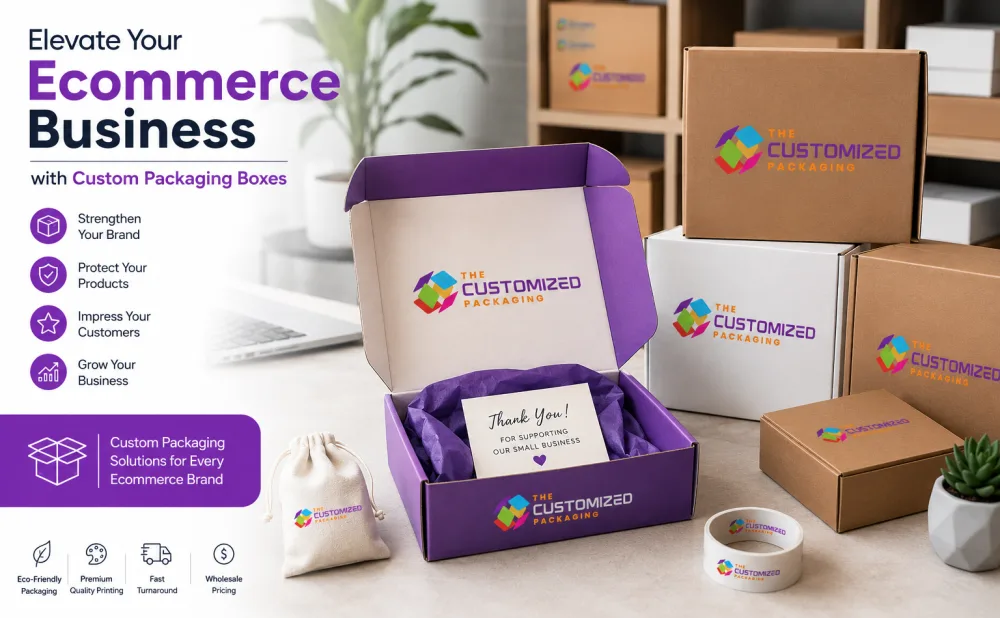
How Ecommerce Brands in the USA Can Grow Faster with Custom Packaging Boxes
A practical guide to selecting, testing and scaling ecommerce packaging around product protection, shipping costs, branding, fulfillment and customer experience.
 Published May 15, 2026
Updated August 05, 2026
14 min read
Published May 15, 2026
Updated August 05, 2026
14 min read
Selling online removes many of the physical interactions that normally happen inside a store. Customers cannot hold the product, speak to a salesperson or inspect the packaging before placing an order.
The delivery is often the first time the product, brand and customer meet in the same physical space.
That makes custom ecommerce packaging boxes important—but not because printing a logo automatically creates loyalty or increases revenue. Packaging supports growth when it protects the order, fits the fulfillment process, controls shipping volume and presents the product consistently.
For USA ecommerce brands, the right system must work across several stages: storage, picking, packing, transportation, delivery, opening and possible return.
This guide explains how to plan those stages as one connected packaging strategy.
What Does Ecommerce Packaging Include?
Ecommerce packaging is more than the outer box delivered by a courier.
A complete system may contain several layers:
| Packaging layer | Examples | Main function |
|---|---|---|
| Primary packaging | Bottle, pouch, tube, jar or product wrap | Directly contains or protects the product |
| Retail packaging | Folding carton, sleeve or presentation box | Product identity and customer presentation |
| Transit packaging | Corrugated mailer, shipping carton or envelope | Protects the order during delivery |
| Internal protection | Divider, insert, tissue or cushioning | Controls product movement |
| Communication material | Care card, return instructions or QR code | Helps the customer use or reorder the product |
Some products need all five layers. Others can use one carefully engineered structure for more than one purpose.
A shoe box may serve as both retail presentation and a shipping container when designed for transit. A glass candle may need a fitted retail carton inside a stronger corrugated shipper. Apparel may only require a mailer when the garment itself does not need impact protection.
The best system is the simplest one that performs every required function.
Define the Packaging Problem Before Choosing a Box
Starting with a box style often leads to unnecessary expense.
A brand may select a magnetic rigid box because it looks premium, only to discover that it occupies too much warehouse space and requires a second carton for shipping. Another brand may choose a lightweight mailer without testing whether it can protect a fragile product.
Begin by defining the actual problem:
-
What normally becomes damaged?
-
How many products are packed in one order?
-
Does the customer need a retail presentation box?
-
Will the packaging be assembled manually or automatically?
-
Is privacy important?
-
Must the package support returns?
-
Which order combinations occur most frequently?
-
What storage space is available?
-
Which parts of the experience need branding?
The answers determine whether the business needs a folding carton, mailer, shipping case, rigid presentation box, pouch or combination of formats.
Choose Packaging Around the Product Category
Different products create different transit risks.
| Product category | Common requirement | Practical direction |
|---|---|---|
| Apparel | Compact shipping and privacy | Corrugated mailer, folding carton or shipping bag |
| Cosmetics | Leakage control and product separation | Retail cartons inside a divided mailer |
| Jewelry | Small-product organization and presentation | Jewelry box inside an outer shipper |
| Candles | Glass protection and vessel support | Fitted carton with corrugated transit packaging |
| Electronics | Component separation and impact control | Engineered insert with durable outer carton |
| Food products | Product-appropriate containment and labeling | Primary food packaging inside a shipping system |
| Subscription products | Repeatable arrangement and fast packing | Mailer with modular compartments |
| Home accessories | Variable shapes and weights | Right-sized corrugated carton with supports |
These are starting points, not fixed rules.
The filled product weight, fragility, dimensions, storage requirements and delivery method should determine the final construction.
Build a Small Range of Box Sizes
Using one oversized shipping box for every order may simplify purchasing, but it often creates other problems.
Products move more inside large cartons. Staff add more filler, packaging occupies additional warehouse space and shipping dimensions increase.
Most ecommerce brands benefit from a controlled range built around common order profiles:
-
Small single-product order
-
Standard one- or two-product order
-
Multiproduct purchase
-
Fragile or high-value shipment
-
Gift-ready order
-
Oversized product
Each size should cover a meaningful percentage of orders without leaving excessive empty space.
Review order data before selecting dimensions. The most attractive box size is not necessarily the one that fits the largest number of real customer orders.
Measure the Complete Packed Order
Box measurements should include everything placed inside the package—not only the product.
Account for:
-
Primary product container
-
Retail carton
-
Insert or divider
-
Instructions and accessories
-
Tissue or protective wrap
-
Required cushioning clearance
-
Sealing area
-
Product weight
Carriers require accurate package dimensions and weight when creating a shipment. UPS, for example, instructs shippers to measure the length, width and height of the completed package and retain those measurements when purchasing the shipment.
Measure a fully packed sample rather than calculating dimensions from separate components. Inserts, folding panels and several products placed together can change the final external size.
Separate DTC Packaging from Amazon Requirements
A brand shipping from its own warehouse controls most of the delivery experience. It can select the outer carton, printed interior, packing method and included communication.
Amazon fulfillment works differently.
For Fulfillment by Amazon, the seller must prepare each sellable unit according to Amazon’s applicable packaging, barcode, set, expiration-date and product-specific requirements. Amazon guidance states that units must be properly contained and carry accessible, scannable identification, while fragile and other product types can require additional preparation.
This means an Amazon seller should distinguish between:
-
Product packaging: the branded carton or container around the sellable item
-
Preparation packaging: protection required for the unit to enter fulfillment
-
Inbound shipping cases: cartons used to send inventory to Amazon
-
Customer delivery packaging: which may be controlled by Amazon
A box developed for a direct-to-consumer Shopify order should not automatically be used for an FBA unit without reviewing the current requirements for that product.
The branding opportunity on Amazon may therefore concentrate more heavily on the sellable product package than on the final courier carton.
Product Protection Comes Before Decoration
Shipping damage can generate refunds, replacements, support tickets and negative customer experiences.
Common causes include:
-
Empty space around the product
-
Weak corners or panels
-
Heavy products resting on lighter items
-
Glass vessels touching each other
-
Caps and pumps carrying impact
-
Loose accessories scratching the product
-
Unprotected retail boxes
-
Closures opening during transit
The solution is not always more cushioning.
A smaller carton may reduce movement. A divider can separate products. A paperboard platform may support a jar, while a stronger corrugated grade may prevent wall compression.
Every protective component should address a specific risk.
Select Inserts According to Function
Product inserts can improve protection, presentation and packing consistency, but they should not be treated as a compulsory premium feature.
| Insert type | Appropriate use |
|---|---|
| Folded paperboard | Lightweight products and organized retail presentation |
| Corrugated support | Heavy items and ecommerce transit |
| Molded pulp | Shaped protection and product positioning |
| Foam or EVA | Fragile, technical or high-value products |
| Dividers | Several products in one shipment |
| Wrapped rigid platform | Luxury presentation boxes |
Before adding an insert, determine whether right-sizing the package could solve the same problem with less material and assembly.
The customer must also be able to remove the product comfortably. A cavity that holds the item too tightly can damage labels, caps, straps or decorative surfaces.
Treat Branding as a Consistent System
Branded ecommerce packaging should connect the physical delivery to the store the customer remembers.
Consistency may come from:
-
Logo position
-
Typography
-
Brand colors
-
Illustration style
-
Product-information hierarchy
-
Opening message
-
Interior print
-
Packing cards
The logo does not need to cover every surface.
Exterior branding may be reduced for privacy, security or theft concerns. In that case, the inner surface, retail carton, tissue, label or card can carry the stronger visual experience.
A one-color printed mailer can feel more intentional than an expensive structure using several unrelated finishes.
Design the Opening Around Customer Needs
An unboxing experience should make the order easier to understand and use.
Useful details include:
-
A visible opening point
-
Products arranged in a logical sequence
-
Instructions placed before they are needed
-
Accessories separated from the main item
-
Clear return information
-
A concise care guide
-
A relevant QR code
-
Minimal unnecessary layers
The number of components does not determine the quality of the experience.
A package containing tissue, stickers, several cards, filler and a gift may look busy while making the actual product harder to find. Every element should have a clear role.
Use Packaging to Continue the Customer Journey
A printed box cannot guarantee another purchase, but it can create a useful path toward the next interaction.
Depending on the product, packaging may direct customers to:
-
Setup instructions
-
Care guidance
-
Refill ordering
-
Replacement parts
-
Product registration
-
Compatible items
-
Loyalty programs
-
Referral offers
-
Customer support
Tracked QR codes or campaign-specific landing pages can show whether customers interact with this content.
The message should remain relevant to the product. A customer who has just purchased skincare may value routine guidance more than a generic social-media request.
For a more detailed discussion of repeat purchases, damage rates and packaging ROI, link to the supporting article about measuring the commercial value of premium ecommerce packaging.
Plan Sustainability from the Specification
A brown carton or paper-based mailer should not automatically be described as eco-friendly, recyclable, biodegradable or sustainable.
Windows, coatings, laminations, labels, adhesives, tape, cushioning and mixed-material inserts can change the finished package.
The FTC advises businesses to qualify environmental claims appropriately and substantiate claims about recyclable materials, recycled content and broader environmental benefits.
More useful packaging statements identify a specific verified choice:
-
Percentage of recycled content
-
Certified fiber used for the order
-
Removal of a plastic window
-
Reduction in box dimensions
-
Paperboard replacing a previous foam insert
-
Reusable return strip
-
Disposal instructions for separate components
Right-sizing and reducing unnecessary layers may be more meaningful than printing a generic leaf icon on an oversized carton.
Make Returns Part of the Packaging Plan
Returns are common in categories such as apparel, footwear and accessories.
A package intended for return use may include:
-
A second adhesive strip
-
A tear-open section
-
Clear resealing instructions
-
Space for a return label
-
A structure that remains intact after opening
-
Enough strength for a second journey
This functionality should be designed into the structure rather than added after production.
The brand should also decide whether the product presentation box must be returned or whether only the outer shipping package needs to remain reusable.
Design for the Fulfillment Team
Packaging should be evaluated from the packer’s perspective as well as the customer’s.
A visually impressive box may create operational problems when it requires complicated folding, several loose components or precise manual alignment.
During a packing trial, record:
-
Assembly time
-
Number of packing steps
-
Required tape or adhesive
-
Product-loading order
-
Common packing errors
-
Space required at the station
-
Completed packages per hour
-
Waste from damaged packaging
A modest structural improvement can sometimes produce more value than an additional decorative finish.
Fast, repeatable packing becomes increasingly important as daily order volume grows.
Test Before Committing to a Large Order
A digital rendering can show artwork placement, but it cannot confirm shipping performance or fulfillment speed.
Test the physical package with the actual product and all components.
Review:
-
Product fit
-
Movement after shaking
-
Closure security
-
Corner and edge strength
-
Insert performance
-
Ease of packing
-
Customer opening
-
Barcode and QR-code scanning
-
Surface condition after transit
-
Return usability where required
A limited pilot run can be useful before applying a new structure to every ecommerce order.
Document failures and revise the structure rather than adding random cushioning to compensate.
Scale Packaging Without Creating Excess Inventory
Wholesale purchasing can lower the manufacturing cost per unit, but a larger order also creates storage, cash-flow and artwork risks.
Before ordering wholesale ecommerce packaging, calculate:
-
Average monthly use by size
-
Seasonal demand
-
Existing stock
-
Production and delivery lead time
-
Storage capacity
-
Artwork-change risk
-
Number of designs
-
Expected product discontinuations
-
Reserve quantity
A universal branded structure can sometimes support several products through labels, sleeves or interchangeable inserts.
However, using one oversized package for unrelated products is not true standardization. A small family of tested structures is usually more efficient.
Measure Whether the Packaging Is Working
Packaging should be linked to observable outcomes.
Useful measures include:
| Metric | Packaging question |
|---|---|
| Damage rate | Is the product adequately protected? |
| Packing time | Is the structure efficient to assemble? |
| Shipping cost | Are external dimensions controlled? |
| Customer complaints | Are opening, waste or damage issues recurring? |
| Return condition | Does the package survive a second shipment? |
| QR-code activity | Are customers using printed guidance? |
| Review language | Do customers mention delivery condition or presentation? |
| Reorder rate | Did customer behavior change after the update? |
Packaging should not receive full credit for every improvement in sales or retention. Product quality, pricing, advertising, delivery and customer service also affect these results.
Evaluate related metrics together and compare packaging versions where practical.
Information Needed for a Custom Quote
Provide the packaging manufacturer with:
-
Product dimensions and weight
-
Common order combinations
-
Retail and shipping layers
-
Sales channels
-
Existing damage issues
-
Preferred structures
-
Insert or divider needs
-
Exterior and interior artwork
-
Required box sizes
-
Quantity per size
-
Fulfillment method
-
Delivery destination
-
Required date
Most custom box styles begin at 100 units. Several box sizes, structures or artwork versions should be listed separately so pricing reflects the actual production plan.
Why Choose The Customized Packaging?
The Customized Packaging develops custom packaging for ecommerce around the product, shipping method, brand presentation and fulfillment workflow.
Available structures include corrugated mailers, shipping cartons, folding product boxes, rigid presentation packaging, sleeves, dividers and fitted inserts.
Projects can be planned for Shopify stores, direct-to-consumer brands, subscription businesses, marketplace sellers and established online retailers.
Standard production generally takes 8–12 business days after structural and artwork approval. Rush service is available for eligible projects, and most custom styles begin at 100 units.
The objective is to create a repeatable packaging system that protects the order and supports growth—not simply place branding on a standard shipping carton.
Frequently Asked Questions
Which packaging is best for an ecommerce business?
The best option depends on the product, weight, fragility, order combinations and sales channel. Corrugated mailers suit many direct-to-consumer orders, while fragile products may need a fitted retail box inside a stronger shipping carton.
Are custom mailer boxes suitable for every product?
No. They work well for many apparel, subscription, cosmetic and accessory orders, but heavy, fragile or unusually shaped products may require reinforced shipping cartons and engineered supports.
Should Shopify and Amazon sellers use the same packaging?
Not automatically. Direct-to-consumer brands control more of the delivery experience, while Amazon sellers must consider applicable unit preparation, identification and fulfillment requirements.
How many ecommerce box sizes should a brand use?
A brand should develop enough sizes to cover its common order combinations without maintaining unnecessary inventory. A small, data-based range is usually better than one oversized box or dozens of rarely used sizes.
Does custom packaging increase ecommerce sales?
Packaging may support product presentation, delivery satisfaction, brand recall and repeat buying, but it does not guarantee sales. Its effect should be evaluated alongside other commercial and operational factors.
What details are required for accurate pricing?
Provide the packed dimensions, weight, required box styles, inserts, artwork, quantities for each version, shipping destination and delivery schedule.
Build a System That Can Grow with the Store
Ecommerce packaging should work when the brand ships its first hundred orders and remain manageable when that number becomes several thousand.
That requires more than an attractive design.
The structure must fit the product, the shipping dimensions must support order economics, the fulfillment process must remain repeatable and the branding must stay recognizable across products and channels.
When those decisions are planned together, custom ecommerce packaging boxes become part of a scalable operating system rather than an isolated marketing expense.