
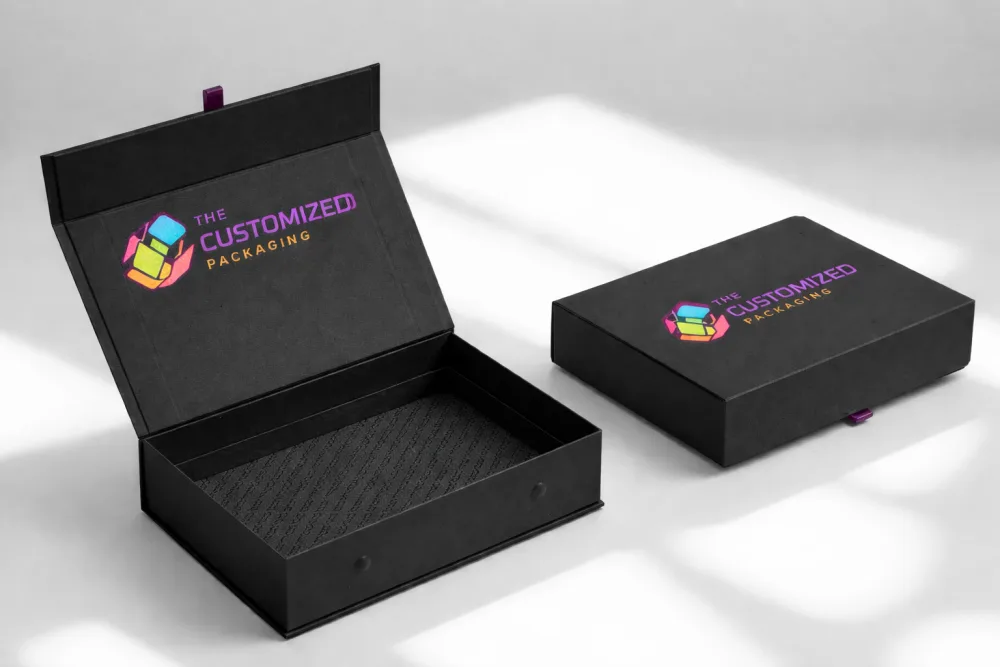
Custom Magnetic Closure Rigid Boxes: How to Test the Closure Before Production
A magnetic rigid box can look perfect and still feel wrong if the lid sits unevenly, the magnets pull too hard or the insert pushes against the closure. Learn what to check on a physical sample before approving production.
 Published April 08, 2026
Updated September 01, 2026
17 min read
Published April 08, 2026
Updated September 01, 2026
17 min read
A magnetic rigid box is often judged by its appearance first.
But one of the most important quality checks happens when the lid closes.
A box can have clean printing, premium paper and an attractive logo while still feeling poorly made if one side of the flap closes before the other, the lid sits crooked, the magnets feel excessively strong or the product prevents the box from closing completely.
That is why custom magnetic closure rigid boxes should be evaluated as moving structures rather than static presentation boxes.
Before approving production, check how the lid opens, where the magnets meet, how the front flap sits against the box wall and whether the closure still works correctly after the actual product and insert are loaded.
The closing action should feel controlled and repeatable—not simply strong.
What Actually Creates the Magnetic Closure?
A magnetic closure rigid box usually combines several structural components:
-
Rigid-board base
-
Attached hinged lid
-
Front closing flap
-
Concealed magnetic components
-
Wrapped exterior
-
Interior lining
-
Product insert where required
The magnets are only one part of the closing system.
The final result also depends on:
lid alignment + hinge movement + flap position + magnet position + internal product height
If any one of those elements is incorrect, the box may not close properly.
This is why specifying “strong magnets” alone does not guarantee a better magnetic box.
Stronger Magnets Are Not Automatically Better
The magnetic pull should be strong enough to bring the flap into its intended closed position.
But excessive force can create a different problem.
If the customer needs to pull aggressively every time the box is opened, the closure can feel awkward rather than refined.
Very strong attraction can also place additional stress on:
-
Front flap
-
Hinge area
-
Paper wrap
-
Wrapped edges
The correct closure should balance retention with comfortable opening.
There is no universal magnetic strength that is correct for every box.
The appropriate configuration depends on the dimensions, lid size, flap geometry, construction and intended use.
Test How the Lid Finds the Closing Position
A well-developed closure should naturally guide the lid toward the intended position.
Close the sample several times without carefully steering the flap into place.
Watch whether it returns to approximately the same alignment each time.
If the lid consistently needs to be pushed sideways before the magnets connect, the problem may involve:
-
Magnet placement
-
Lid alignment
-
Hinge geometry
-
Flap construction
-
Wrapped-board tolerance
A premium box should not require the customer to manually correct the lid every time it closes.
Check Whether Both Sides Close Together
For wider custom magnetic closure rigid boxes, uneven closing becomes particularly noticeable.
One side may connect before the other.
That can leave:
-
Visible gap
-
Twisted front edge
-
Raised corner
-
Uneven lid line
Look at the closed box directly from the front.
The upper and lower edges should appear visually balanced.
Then view it from each side.
A problem that is difficult to notice from above may become obvious from a lower viewing angle.
Magnet Placement Matters More Than Maximum Pull
Concealed magnets need to meet correctly when the lid closes.
If corresponding magnetic components do not align properly, the closure can feel weak even when relatively strong magnets are being used.
Possible symptoms include:
-
Stronger pull on one side
-
Flap shifting after closure
-
Lid closing only when pressed
-
Visible front gap
-
Closure that feels inconsistent
Do not assume every weak-feeling sample simply needs stronger magnets.
Alignment should be investigated first.
Check the Entire Front Flap
The front flap should sit naturally against the receiving wall.
Do not inspect only the points directly above the magnets.
Look across the complete front edge.
Ask:
-
Does the center sit flat?
-
Do both corners meet evenly?
-
Is one side raised?
-
Does the flap bow outward?
-
Is the flap excessively long?
-
Is part of the front wall exposed unexpectedly?
The magnetic components may function perfectly while incorrect flap geometry still makes the finished package look poorly aligned.
The Flap Length Affects the Closing Experience
A front flap that is too short can reduce the visual overlap and change where the magnetic components meet.
An unnecessarily long flap can create different handling or alignment issues.
The correct dimension depends on the box structure.
The flap should provide enough area for a clean magnetic connection while remaining proportional to the overall design.
Its length should be reviewed on the assembled sample rather than judged only from a dieline.
Test the Hinge Independently From the Magnets
Open the lid slowly and pay attention to the hinge.
It should move smoothly through the intended opening range.
Warning signs can include:
-
Unusually stiff movement
-
Lid pulling the base upward
-
Wrap material becoming strained
-
Visible buckling around the hinge
-
Lid refusing to remain in the intended position
-
Uneven movement from side to side
A magnetic closure may feel wrong because of hinge tension even when the magnets themselves are correctly positioned.
The opening and closing system should therefore be evaluated as one connected structure.
Do Not Let the Hinge Fight the Magnets
If the hinge naturally pushes the lid away from the base, the magnets have to overcome that force every time the box closes.
This can create the impression of weak magnets.
Increasing magnetic pull may not solve the underlying issue.
The better solution may involve adjusting the hinge, lid geometry or another structural detail.
A properly balanced box should allow the hinge and magnetic closure to work together.
Check the Closed Lid From Every Corner
Place the finished box on a flat surface and close it normally.
Inspect the four corners.
Look for:
-
One corner sitting higher
-
Lid appearing twisted
-
Uneven front gap
-
Side edges no longer parallel
-
Flap pulling more strongly toward one side
Small alignment differences become particularly noticeable on rigid packaging because the straight edges make inconsistencies easier to see.
This matters even more when the exterior uses:
-
Solid dark colors
-
Metallic foil
-
Border artwork
-
Geometric patterns
-
Edge-aligned graphics
The printed design can make structural misalignment more visible.
Load the Actual Product Before Approving the Closure
Never approve the magnetic closing action based only on an empty box.
The product changes the system.
A loaded insert can sit slightly higher than expected.
A bottle may project above its cavity.
An accessory may contact the inside lid.
A card may rest on top of the product.
Any of these can prevent the lid from reaching its intended closing position.
The correct test is:
box + final insert + actual product + accessories + printed materials
Then close the package.
Insert Height Can Make Good Magnets Look Weak
An insert that sits too high can push against the lid.
The magnets may then struggle to bring the flap fully into contact with the box wall.
This creates a misleading diagnosis.
The problem is not necessarily weak magnets.
It may be insufficient internal clearance.
Before modifying the closure, check whether:
-
Insert projects above the intended level
-
Product extends too far upward
-
Product cap touches the lid
-
Accessory overlaps the closing area
-
Printed card adds unexpected thickness
A small internal interference can affect the entire magnetic action.
Check the Tallest Product, Not Only the Main Product
Multi-product gift boxes can create additional problems.
The main item may fit perfectly, while a smaller accessory has a taller cap or raised component.
Measure the highest loaded point inside the complete arrangement.
That determines the minimum usable lid clearance.
The magnetic closure should be tested with the exact layout intended for production.
Product Weight and Closure Strength Are Different Issues
The magnets close the lid.
They should not be treated as the primary mechanism preventing a heavy product from moving inside the box.
Product movement should be controlled through:
-
Correct dimensions
-
Fitted insert
-
Dividers
-
Product supports
-
Appropriate internal structure
A heavier product may influence the overall box design, but stronger magnets are not a substitute for a properly engineered interior.
Magnetic Closure Does Not Automatically Make the Box a Shipping Carton
A magnetic rigid presentation box may remain closed during normal handling, but that does not automatically make it suitable as the only package for courier transportation.
Parcel distribution can expose packaging to:
-
Abrasion
-
Corner impact
-
Compression
-
Conveyors
-
Stacking
-
Labels
-
Weather exposure
Decorative wraps and premium finishes can also become damaged.
Depending on the product and delivery conditions, the magnetic rigid box may need an appropriately sized outer shipping carton or corrugated mailer.
The magnetic flap is a presentation closure—not a universal replacement for transport packaging.
Test the Opening Resistance
Ask several people to open the sample naturally.
Do not explain the mechanism first.
Watch how they interact with it.
A suitable opening should not require:
-
Excessive pulling
-
Bending the flap
-
Holding the base with unusual force
-
Searching for a hidden opening point
At the same time, the lid should not fall open from very light handling.
The desired resistance depends on the product and intended experience, but the action should feel deliberate.
Consider Finger Access
The closing flap may sit tightly against the base.
Customers still need a natural place to grip it.
That may come from:
-
Flap projection
-
Thumb access
-
Small edge allowance
-
Structure-specific opening point
Do not sacrifice usability simply to create perfectly flush surfaces.
The opening method should be obvious when the customer holds the package.
Repeated Opening Is More Useful Than One Perfect Close
A sample may work perfectly once.
Open and close it repeatedly.
You are looking for consistency.
After repeated operation, check whether:
-
Lid alignment changes
-
Hinge becomes noticeably different
-
Flap starts to lift
-
Wrapped crease shows stress
-
Magnetic connection feels different
-
Corners remain square
The purpose is not to simulate years of use during approval.
It is to reveal immediate weaknesses that may not appear during the first opening.
Inspect the Wrap Around the Hinge
Magnetic rigid boxes normally use decorative paper wrapped over the rigid-board structure.
The hinge is a movement area.
Check whether the surface around it:
-
Creases naturally
-
Shows cracking
-
Wrinkles
-
Pulls away
-
Develops visible stress
Some specialty wraps and finishes behave differently around movement areas.
The final material should therefore be reviewed on the functional box, not only as a flat swatch.
Detailed board and paper-wrap selection can be considered separately from the closure test, but the approved materials still need to work with the hinge.
Keep Foil and Other Finishes Clear of High-Stress Areas
A logo or decorative finish positioned directly across the hinge or tight flap fold may experience repeated movement.
Where possible, keep important decorative elements away from areas that continually flex.
This can help preserve:
-
Foil definition
-
Embossed details
-
Printed registration
-
Surface appearance
Artwork should follow the mechanical structure.
It should not make the mechanical structure work around the artwork.
Test Front-Flap Artwork in the Closed Position
The front flap itself can be branded.
But its graphics should be reviewed with the box completely closed.
Check whether:
-
Logo appears level
-
Text aligns with adjoining surfaces
-
Pattern transitions correctly
-
Border spacing remains even
-
Artwork is visually centered after wrapping
A dieline may show technically centered artwork while the finished wrapped structure creates a different visual result.
Always approve the assembled presentation.
Long Front Edges Need Even Closure
Larger magnetic boxes may use more than one magnetic connection across the front.
The objective is not simply adding more magnets.
The entire edge needs to close evenly.
Check whether the center:
-
Bows outward
-
Sits farther from the base
-
Requires hand pressure
-
Looks visually different from the corners
If several magnetic points are used, their positions should work together rather than pulling different parts of the flap unevenly.
The Closure Should Still Work After the Insert Is Glued In
If the sample uses a temporary insert and production will use a permanently installed one, repeat the final closing check after the complete interior construction is assembled.
Adhesive layers, wrapped trays and additional components can slightly change available depth.
Do not approve closure geometry and insert construction as completely separate systems.
The box should be tested in its final packed form.
Check Opening Angle if the Lid Is Part of the Presentation
Some magnetic rigid boxes open completely flat.
Others are designed to stop at a particular angle.
The correct option depends on the structure and presentation.
For a cosmetic or jewelry set, a controlled lid position may keep interior artwork visible behind the product.
For another product, fully opening the lid may be more practical.
If ribbons or another lid support are used, check:
-
Both sides carry the lid evenly
-
Lid does not twist
-
Support does not interfere with products
-
Closing remains smooth
The lid should not rely on the magnets to control the opening angle.
Pre-Assembled and Collapsible Magnetic Boxes Should Not Be Judged the Same Way
Traditional setup magnetic rigid boxes are normally supplied in their formed shape.
Collapsible magnetic boxes fold flatter before assembly.
Their storage and assembly behavior is different.
If the project uses a collapsible structure, additional checks are needed for:
-
Assembly sequence
-
Corner formation
-
Wall alignment
-
Adhesive panels
-
Closing performance after setup
For this reason, do not approve a collapsible magnetic box based on expectations developed from a permanently assembled setup box.
Use a White Sample for Structure, Then a Printed Sample for Final Feel
Different approval stages answer different questions.
A structural sample can help verify:
-
Dimensions
-
Lid movement
-
Flap geometry
-
Magnet position
-
Product fit
-
Insert height
A finished printed sample adds:
-
Final wrap
-
Lamination
-
Foil or other finishing
-
Interior lining
-
Production-style artwork
The final closure should be reviewed again after those additional layers are present.
Something that works in a basic structural sample may feel slightly different after the final wrapping system is applied.
What Should You Check on a Magnetic Rigid Box Sample?
Before approving custom magnetic closure rigid boxes, review the following:
| Check | What You Want to See |
|---|---|
| Lid alignment | Lid returns to the same position consistently |
| Magnet contact | Both sides engage evenly |
| Front flap | Sits flat without visible bowing |
| Opening force | Secure but comfortable to open |
| Hinge movement | Smooth without excessive resistance |
| Closed edge | Even visual gap and alignment |
| Product clearance | Nothing pushes against the lid |
| Insert height | Does not interfere with closure |
| Product orientation | Remains correct after closing |
| Wrap at hinge | No obvious cracking or lifting |
| Artwork alignment | Looks correct on the assembled box |
| Repeated use | Closing action remains consistent |
| Shipping plan | Presentation box protected where required |
The sample should be judged functionally as well as visually.
Common Magnetic Closure Problems and What They May Indicate
| What You Notice | Possible Area to Check |
|---|---|
| One side closes first | Magnet or lid alignment |
| Flap stays slightly open | Insert/product clearance or magnet contact |
| Lid requires sideways adjustment | Hinge or structural alignment |
| Closure feels excessively hard | Magnet configuration or opening access |
| Closure feels weak | Alignment, gap or magnetic configuration |
| Front edge bows | Flap geometry or multi-point closure |
| Lid sits unevenly | Board construction, hinge or alignment |
| Surface cracks near hinge | Wrap/finish behavior |
| Box closes empty but not loaded | Product or insert height |
| Product moves despite secure lid | Interior fit, not magnetic closure |
These symptoms should be investigated before changing one component blindly.
For example, increasing magnetic strength will not solve an insert that prevents the lid from reaching the closing position.
Questions to Ask Before Approving Production
A useful approval conversation should answer:
Does the lid close naturally without being guided?
Do both sides engage consistently?
Is the opening force appropriate for the product?
Does the box still close with everything packed inside?
Is the product clear of the lid?
Does the hinge move smoothly?
Does the front flap remain visually flat?
Does the finished artwork align after closure?
Has the box been opened and closed repeatedly?
Will a protective outer shipper be used where the delivery method requires one?
If those questions cannot yet be answered, the magnetic box is not ready for final approval.
Frequently Asked Questions About Custom Magnetic Closure Rigid Boxes
How do custom magnetic closure rigid boxes work?
They use concealed magnetic components within a rigid hinged-lid structure. When the front flap reaches the closed position, the corresponding magnetic areas attract and help hold the lid against the box body.
Are stronger magnets always better for rigid boxes?
No. The closure needs enough attraction to remain properly seated while still opening comfortably. Magnet position, flap design, lid weight, hinge behavior and internal clearance all influence the result.
Why does one side of a magnetic box close before the other?
Possible causes include uneven magnet positioning, lid alignment, hinge geometry or flap construction. A physical sample should be inspected before assuming that magnet strength alone is responsible.
Why does my magnetic box close when empty but not with the product inside?
The product or insert may be sitting too high and contacting the lid. Check the tallest loaded point, insert height and available top clearance.
Should the magnets hold products in place inside the box?
No. Product movement should be controlled primarily by correct box dimensions and suitable inserts or supports. The magnetic closure is designed to close the lid.
Can magnetic closure rigid boxes be used for shipping?
They can be part of an ecommerce packaging system, but decorative rigid presentation boxes should not automatically be treated as standalone courier cartons. Depending on the product and shipping conditions, an outer corrugated shipper may be appropriate.
Should I test a magnetic rigid box before bulk production?
Yes. A physical sample allows you to evaluate lid alignment, magnet engagement, opening resistance, hinge movement, product clearance, insert height and the finished opening experience.
What should I look for when closing a magnetic box sample?
Check whether the lid returns to the same position, both sides engage evenly, the flap sits flat, the product does not interfere with the lid and the opening force feels appropriate.
Can the insert affect the magnetic closure?
Yes. If the insert or product projects too high, it can push against the lid and prevent the magnetic areas from meeting correctly.
Does the final printed sample need another closure check?
Yes. Final wraps, lining, lamination and other finishing components can affect how the completed structure behaves. Review the finished sample again before approving production.
Approve the Closing Action, Not Just the Appearance
The quality of custom magnetic closure rigid boxes is not determined only by board thickness, logo printing or premium finishes.
The closing action matters.
The lid should move smoothly. The magnets should meet consistently. The front flap should sit evenly. The product and insert should remain below the required clearance, and the package should open without unnecessary force.
These details are difficult to evaluate from a flat dieline or digital rendering.
That is why the final magnetic closure should be tested with the complete product-loaded sample.
When the structure, hinge, flap, magnets and interior work together, the box feels deliberately engineered rather than simply decorated.
The Customized Packaging develops custom magnetic closure rigid boxes around your product dimensions, opening requirements, inserts and presentation goals. Share your product size, packed weight, box dimensions and preferred structure to develop and sample the closing system before production.