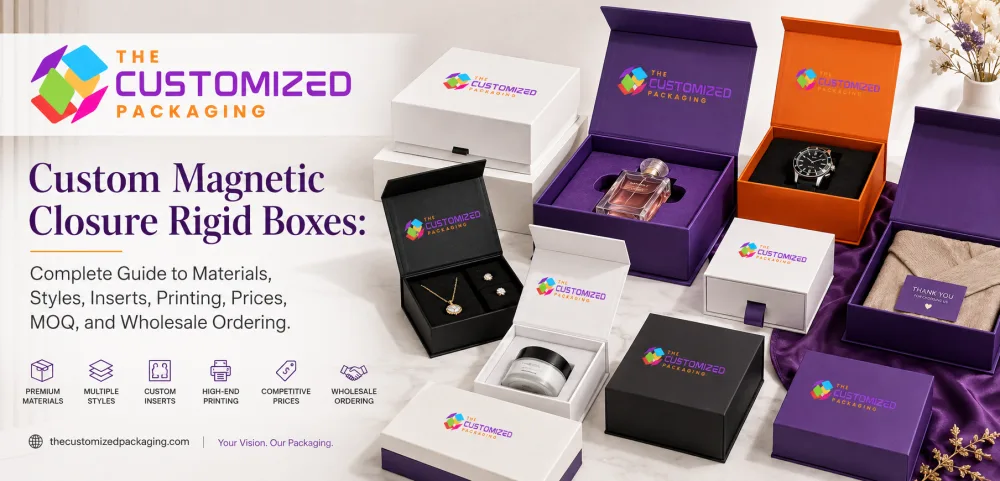

How to Design Magnetic Rigid Boxes with Foam Inserts for Jewelry, Watches and Cosmetics
Jewelry, watches and cosmetics need different support inside a magnetic rigid box. Learn how foam cavity depth, density, finger access, lid clearance and product orientation should change according to the product.
 Published June 25, 2026
Updated September 01, 2026
15 min read
A magnetic rigid box can use the same basic hinged structure for jewelry, watches and cosmetics, but the foam insert inside should not be designed the same way for every product.
A ring needs controlled positioning without burying the setting. A watch needs support around the case and strap while remaining easy to lift. A perfume bottle or cosmetic jar may need a deeper cavity that keeps the container upright without rubbing against labels or decorative surfaces.
Well-designed magnetic rigid boxes with foam inserts bring these product-specific requirements together with the hinged lid and magnetic closure.
The box, foam and product should be developed as one system rather than as separate components.
Why Foam and Magnetic Rigid Boxes Work Together
A magnetic closure rigid box provides a firm outer structure with an attached lid and concealed magnetic closure.
The foam insert controls what happens inside that structure.
Its job can include:
-
Keeping the product centered
-
Reducing unnecessary movement
-
Separating several components
-
Supporting delicate or high-value items
-
Creating an organized presentation
-
Providing a consistent product position
-
Protecting surfaces from contact with the outer box
-
Making accessories easier to arrange
The combination works best when the foam does not simply fill empty space.
Every cavity should have a reason.
Start With the Finished Product
Foam cavities should be developed around the final product rather than only around nominal manufacturer dimensions.
Measure the item at its widest and tallest points and include features such as:
-
Ring settings
-
Watch crowns
-
Watch straps and clasps
-
Bottle caps
-
Pumps
-
Cosmetic jar lids
-
Raised logos
-
Product labels
-
Decorative sleeves
-
Protective caps
Weight matters too.
A small metal watch can place more pressure on the foam than a larger but lightweight cosmetic palette.
The insert should therefore be developed around both shape and weight.
The Same Foam Cavity Does Not Suit Every Product
Jewelry, watches and cosmetics behave differently during handling.
| Product | Main Foam Function | Critical Design Detail |
|---|---|---|
| Ring | Maintain upright display | Setting height and slot control |
| Earrings | Keep pair aligned | Consistent cavity spacing |
| Pendant | Center main feature | Chain or accessory management |
| Watch | Support case and strap | Cushion shape and removal access |
| Perfume bottle | Keep bottle upright | Base support and label clearance |
| Cosmetic jar | Control round container | Side clearance and finger access |
| Serum bottle | Maintain vertical orientation | Pump or dropper clearance |
| Makeup tool | Hold elongated item | Cavity length and end clearance |
The insert should follow the way the product needs to be presented, not just its outline.
Foam Density Affects How the Product Feels
Foam is available in different levels of firmness.
A softer foam can compress around a product, while a firmer material creates more defined support and sharper cavity edges.
The appropriate density depends on:
-
Product weight
-
Fragility
-
Cavity size
-
Required compression
-
Desired appearance
-
Removal method
A heavy watch placed into foam that is too soft may sink or tilt.
A small cosmetic bottle placed into overly firm foam may become difficult to remove if the cavity is designed too tightly.
The objective is controlled support rather than maximum firmness.
Cavity Depth Determines More Than Protection
The depth of the cut affects how much of the product remains visible.
A deep cavity can hold an item securely, but it can also make the product difficult to reach or visually bury important features.
A shallow cavity makes more of the product visible but may provide less side support.
The correct depth depends on how the product should appear when the hinged lid opens.
For premium presentation, customers should be able to recognize the product immediately without having to remove it first.
Leave Enough Foam Around the Cavity
Foam needs enough material around each opening to maintain its shape.
If several cavities are placed too close together, the narrow sections between them can deform or tear.
This becomes especially important for multi-product cosmetic kits where bottles, jars, brushes and accessories may all require separate positions.
Spacing should account for:
-
Product weight
-
Foam density
-
Cavity depth
-
Distance from the outer edge
-
Distance between neighboring cavities
The complete insert should remain stable when one product is removed while the others stay in place.
Jewelry Needs Precise Positioning Without Excessive Pressure
Jewelry is generally lightweight, but small positioning errors are immediately visible.
A ring that leans to one side or a pair of earrings that sits unevenly can weaken the presentation even when the outer box is excellent.
For jewelry, foam should be used to control orientation rather than simply provide cushioning.
Ring Presentation
A ring cavity or supporting slot should keep the setting facing upward.
The ring should not sit so deeply that the stone or decorative feature becomes hidden.
At the same time, there must be enough clearance between the highest point of the setting and the inside of the hinged lid.
The band should be the main supported area whenever possible.
Earrings
Paired products need accurate alignment.
The cavity positions should place both earrings at the same height and distance from the center.
For larger earrings, allow enough spacing so the pieces do not touch.
Pendants and Small Jewelry
A pendant can sit inside a fitted cavity while associated chains or cords are directed into a separate area.
The visible centerpiece should remain clean rather than being surrounded by loose chain.
Watches Need Support Around More Than the Case
A watch has several components that affect the insert:
-
Case
-
Crown
-
Bezel
-
Strap
-
Clasp
-
Buckle
-
Optional accessories
The watch should not be designed into a simple rectangular cavity based only on case dimensions.
Keep the Watch Face Visible
The dial is usually the focal point.
The foam or supporting cushion should keep the case centered and facing upward when the box opens.
Enough surrounding space should remain for fingers to reach the watch without pulling on the crown or strap.
Do Not Over-Compress the Strap
Leather, silicone, fabric and metal bracelets behave differently.
A cavity that forces the watch into a very tight curve may create unnecessary strain on the strap.
The insert should support the watch in a shape that makes sense for the specific band.
Allow for the Crown
The crown often extends farther than the watch case.
A cavity designed only around the main case diameter can put pressure directly on the crown.
That protrusion should be measured and accommodated.
Cosmetics Need Stable Upright Positioning
Cosmetic and fragrance products create different challenges because they are often packaged in bottles, jars, tubes and compacts.
Glass and heavy containers need controlled movement, while labels and decorative surfaces need protection from rubbing.
A foam insert for cosmetic packaging should hold the container securely without requiring customers to pull against the product's cap or pump.
Perfume and Fragrance Bottles Need Base Support
Fragrance bottles can be heavy relative to their footprint.
A cavity should support the body of the bottle rather than relying on the cap or decorative neck.
For bottles with unusual shoulders or sculptural shapes, several measurements may be needed to create the correct fit.
Also check whether the bottle label or printed decoration will contact the foam.
The packaging should protect the product's appearance as well as the glass.
Cosmetic Jars Need Finger Access
Round skincare and cosmetic jars can sit neatly inside circular cavities, but deep recesses can make them difficult to remove.
Finger notches on one or both sides can create a natural lifting point.
The customer should be able to grip the jar body rather than pulling on the lid.
This becomes particularly important with heavy glass skincare containers.
Bottles With Pumps Need Extra Vertical Clearance
Serums, lotions and other cosmetics may include pumps, droppers or applicators that extend above the main container.
The product height should be measured in its final packed condition.
The correct internal depth depends on:
foam insert height + exposed product height + lid clearance
If the product sits too high, the hinged lid may press against the pump or applicator.
Design Finger Access Before Cutting the Foam
A cavity can hold a product perfectly and still create a poor unboxing experience if customers cannot remove it.
Access should be part of the original cavity design.
Common solutions include:
-
Side finger notches
-
Front access cutouts
-
Ribbon lifts
-
Raised platforms
-
Partially exposed product edges
The best method depends on product size and weight.
For a compact lipstick, a small notch may be enough.
For a heavy perfume bottle or watch, customers need a more secure gripping area.
The Foam Should Stay Inside the Box
When the customer removes the product, the insert should remain seated in the rigid box.
An overly tight product cavity can cause the entire foam insert to lift out.
That usually indicates too much compression or insufficient retention between the insert and box.
Test product removal repeatedly.
The product should release cleanly while the foam remains where it belongs.
Leave Clearance Between the Foam and Hinged Lid
Foam inserts raise products above the bottom of the box.
That changes the amount of space available below the lid.
The highest product point should remain clear during both opening and closing.
This matters particularly for:
-
Ring settings
-
Watch faces
-
Perfume caps
-
Cosmetic pumps
-
Tall jars
-
Raised accessories
Check the actual path of the lid, not only the space available once the box is completely closed.
A product may clear the lid in the final closed position but still touch it while the hinge is moving.
The Magnetic Closure Should Not Compensate for a Box That Is Too Full
If the lid has to compress the foam or product before the magnets can engage, the internal layout needs adjustment.
The magnetic closure should bring the front flap into alignment naturally.
It should not be used to force an overfilled box closed.
An overloaded interior can:
-
Reduce magnetic contact
-
Bend the lid
-
Stress the hinge
-
Press against products
-
Create an uneven front gap
The foam depth and product height should be corrected before magnet strength is increased.
Use Foam Color to Support Product Visibility
Foam becomes a major part of the interior presentation because customers see it immediately after opening the lid.
Color can either strengthen or weaken product contrast.
Black foam can create strong separation around silver jewelry, light bottles and metallic watches.
White or lighter inserts may suit darker products but can show handling marks more easily.
Grey can provide a neutral middle ground.
Custom colors may be appropriate when they reinforce the brand and still allow the product to remain visually dominant.
The best color should be evaluated with the actual product placed inside.
Covered Foam Can Change the Presentation
Foam can also be covered with a softer or more decorative surface.
A fabric, velvet-style or flocked treatment can create a different visual and tactile experience.
This may suit jewelry, watches and selected gift products.
However, the covering should not hide an inaccurate cavity.
The underlying foam geometry still needs to provide the correct support, compression and removal access.
A decorative surface should enhance a functional insert rather than replace one.
Multi-Product Cosmetic Sets Need a Visual Hierarchy
A cosmetic gift set may contain a main bottle, secondary jars, brushes and accessories.
The insert should not automatically give every item the same visual importance.
The hero product can occupy the strongest position while smaller accessories support it.
This may involve:
-
A larger main cavity
-
Central placement
-
Different cavity depths
-
Separate accessory areas
-
More surrounding space around the primary product
When the hinged lid opens, the arrangement should be understandable immediately.
Jewelry and Watch Sets Also Need Separation
For sets containing several items, hard products should not be allowed to contact one another.
A watch and cufflinks, for example, should have separate positions.
A ring and bracelet can share the same presentation box, but each should remain independently controlled.
The foam layout should create one organized composition instead of several unrelated holes.
Do Not Add Cavities for Accessories That Are Not Confirmed
Insert designs sometimes become unnecessarily large because space is reserved for future or optional accessories.
Before finalizing the foam, confirm which components are actually included in every box.
If some products or accessories vary between SKUs, consider whether a common outer structure can use different foam configurations.
This is generally better than leaving unused cavities visible to the customer.
Keep the Foam Layout Consistent Across Related SKUs
Brands with several watch colors, cosmetic shades or jewelry variations may be able to use the same insert geometry when the physical dimensions remain identical.
This can create more consistent presentation across the collection.
However, do not standardize the insert simply because the outer box is the same size.
Different product profiles still need different cavities when required.
Consistency is useful only when fit remains correct.
Test Product Movement With the Lid Closed
A static desk test is not enough.
Close the magnetic box and gently handle it in several normal orientations.
Then reopen it and check whether the product has:
-
Rotated
-
Lifted from the cavity
-
Shifted sideways
-
Rubbed against surrounding foam
-
Contacted another product
-
Moved away from the intended presentation
This helps reveal whether the cavity actually controls the product during normal handling.
Presentation Boxes Still Need Shipping Protection
Foam can reduce movement inside a magnetic rigid box, but the presentation package should not automatically be treated as the final courier shipper.
The outer rigid box can still be damaged by crushing, corner impacts, moisture or abrasion during parcel delivery.
For ecommerce fulfillment, the complete packaging system may use:
product → foam insert → magnetic rigid box → protective corrugated shipper
The foam controls the product inside the presentation package.
The outer shipping layer protects the presentation box during transit.
Prototype With the Actual Product
The most reliable test uses a production-representative item rather than a rough substitute.
A difference of only a few millimeters can change how a cavity grips a product.
Foam Insert and Magnetic Box Checklist
Before approving production, confirm that:
-
The product fits without excessive compression
-
The cavity depth supports the intended presentation
-
The foam remains inside the box during product removal
-
Finger access is comfortable
-
Jewelry stays correctly oriented
-
Watch straps are not over-compressed
-
Watch crowns and buttons have sufficient clearance
-
Cosmetic labels do not rub against the foam
-
Glass bottles remain upright
-
Pumps, caps and lids clear the hinged lid
-
Separate products cannot contact one another
-
The lid closes without pressing against the foam or product
-
Magnets align naturally
-
Product position remains stable after normal handling
-
Foam color provides suitable contrast
-
The complete interior looks intentional when opened
Testing the product, foam and rigid box together is much more useful than approving each component separately.
Frequently Asked Questions About Magnetic Rigid Boxes With Foam Inserts
Why use foam inside a magnetic rigid box?
Foam can create precise cavities that control product movement and maintain a consistent presentation. It can be useful for jewelry, watches, cosmetics, fragrances and other products requiring fitted support.
How tight should the foam cavity be?
The cavity should provide enough retention to limit movement without requiring excessive force during packing or removal. The appropriate fit depends on the product shape, weight and foam density.
What foam density is best for watches?
The correct density depends on the watch weight, case shape, strap and cavity design. The foam should support the watch without allowing it to sink or creating excessive compression around delicate components.
Can foam be used for perfume bottles?
Yes. A fitted cavity can keep fragrance bottles upright and centered. The design should account for bottle weight, label position, shoulders, caps and easy product removal.
Can magnetic boxes with foam inserts hold several products?
Yes. The foam can include several cavities when each product has enough separation and support. Multi-product layouts should also create a clear visual hierarchy.
How do customers remove products from deep foam cavities?
Finger notches, side access, ribbon lifts or partially exposed edges can provide a natural gripping point. Access should be designed according to product weight and shape.
Should the foam insert be tested with the actual product?
Yes. A production-representative product helps confirm cavity size, compression, removal, lid clearance and how well the item remains positioned during handling.
Design the Foam Around the Product and the Box Around the Foam
The most effective magnetic closure rigid boxes with foam inserts are developed from the inside outward.
First determine how the product should sit.
Then establish the cavity shape, depth, density and removal access required to keep it secure.
The finished foam height determines the available clearance inside the rigid box. The hinged lid and magnetic closure then need to operate freely around that loaded interior.
Jewelry, watches and cosmetics may share the same premium box structure, but their internal engineering should reflect the way each product is shaped, handled and presented.
When those relationships are resolved before production, the result is a package that looks organized when opened, protects the product during normal handling and closes with the controlled magnetic action the structure was designed to provide.
The Customized Packaging develops magnetic rigid boxes with custom foam inserts around your product dimensions, weight, cavity requirements and presentation. Share your product specifications and artwork to create a hinged magnetic box and fitted insert designed to work together.