
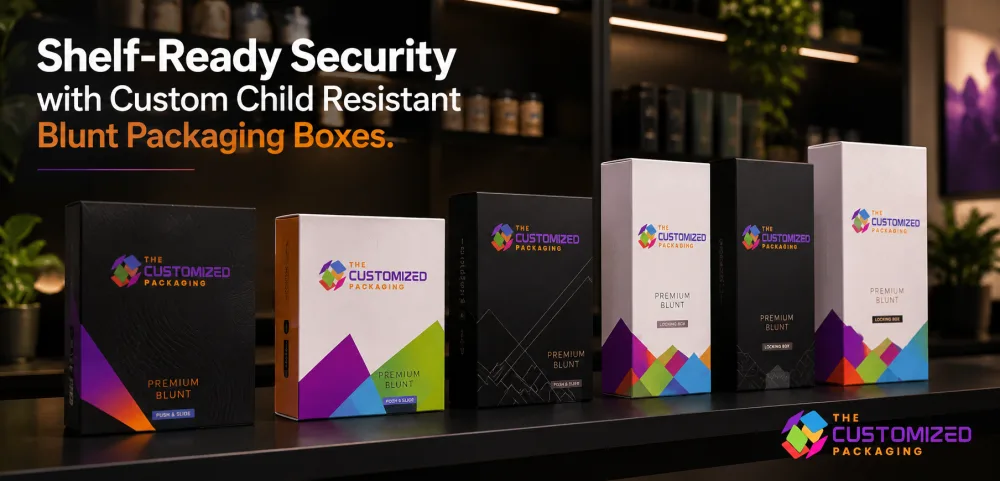
Shelf-Ready Security with Custom Child Resistant Blunt Packaging Boxes
Shelf-ready child resistant blunt packaging combines controlled access, clear labeling, fitted protection and retail-focused design in one box.
 Published June 17, 2026
Updated August 05, 2026
11 min read
Published June 17, 2026
Updated August 05, 2026
11 min read
A blunt package may look attractive online but still perform poorly in a retail store. It can tip over, waste display space, hide important product details or allow the product to move inside. These problems affect how retailers arrange the product and how adult customers evaluate it.
Custom child resistant blunt packaging boxes address these issues by combining a controlled-access structure with practical retail features. Accurate dimensions, stable panels, readable information, visible opening instructions and fitted product support help create packaging that arrives ready for merchandising.
Shelf readiness is not only about appearance. The package must remain closed during normal handling, protect the blunt from crushing and present the brand consistently from the stockroom to the sales display.
For a broader explanation of child-resistant structures, materials and branding options, read our guide to how custom child resistant blunt packaging boxes improve safety, branding and product presentation.
What Does Shelf-Ready Blunt Packaging Mean?
Shelf-ready blunt packaging is designed to move efficiently through packing, distribution and retail display without requiring the store to repackage or reorganize the product.
A shelf-ready box should:
-
Stand, stack or hang in its intended retail position
-
Keep the blunt from rolling, bending or shifting
-
Keep the closure engaged during ordinary handling
-
Present the product name and brand clearly
-
Leave appropriate space for required information
-
Make adult opening instructions easy to find
-
Fit efficiently inside retail displays and shipping cartons
The exact priorities depend on where the package will be sold. A box intended for a countertop display may need a compact upright profile, while a premium product placed inside a display case may benefit from a wider rigid structure.
Start with the Retail Display, Not the Decoration
Foil, embossing and special coatings should not be the first decisions in a retail packaging project. Brands should begin by understanding how the product will physically appear in the store.
Important questions include:
-
Will the package stand vertically or lie flat?
-
How much shelf width can each product use?
-
Will several varieties be displayed side by side?
-
Does the retailer use shelves, hooks or counter displays?
-
Which panel will face the customer?
-
Where will the barcode be scanned?
-
Can staff restock the package without damaging it?
Designing around these conditions helps prevent oversized boxes, unstable structures and hidden product information.
A compact rectangular profile is often easier to align and stack than an irregular shape. However, the dimensions should still allow enough room for the blunt, its inner barrier and any protective insert.
Selecting a Child-Resistant Structure for Retail Use
Different controlled-access structures create different retail and customer experiences.
| Packaging structure | Retail advantage | Points to review |
|---|---|---|
| Push-and-slide sleeve box | Clean rectangular presentation and a large printable sleeve | Release point, tray movement and reclosure |
| Squeeze-and-pull box | Compact structure with controlled access from designated pressure points | Adult-use instructions and material strength |
| Locking-tab carton | Lightweight paperboard option for individual products | Tab durability and repeated-use performance |
| Rigid sleeve-and-tray box | Strong presentation for premium collections | Shelf space, weight and production cost |
A push-and-slide structure can provide a polished product reveal while keeping the inner tray enclosed. A squeeze-and-pull box may suit brands that need a compact format with clearly marked pressure points. Lock-tab cartons can reduce material weight, but the locking areas must remain accurate and durable.
The right option depends on the product size, number of blunts, intended number of openings, material and applicable packaging requirements.
A Locking Design Is Not Automatically Certified Child-Resistant
A coordinated opening action may support child-resistant performance, but the appearance of a lock does not by itself prove that the finished package meets a particular standard.
Child resistance is a performance-based characteristic. The completed package may need applicable testing and documentation for the product and sales jurisdiction. Single-use packaging and packages intended to remain child-resistant after repeated opening can also be treated differently.
Brands should confirm:
-
Which requirements apply to the product
-
Whether initial or repeated-use child resistance is needed
-
Whether the finished size, material and closure match existing documentation
-
Whether changes to the structure could affect prior testing
-
Which statements and warnings must appear on the package
The term “childproof” should not be used. Child-resistant packaging does not replace responsible storage, adult supervision or instructions to keep products away from children.
Packaging buyers remain responsible for confirming applicable testing, certification, labeling and market requirements with their compliance advisers and relevant authorities.
Design the Front Panel for a Fast Retail Scan
Adult customers often evaluate several products within a short time. The principal display area should therefore communicate the most important information without becoming crowded.
A practical front-panel hierarchy may include:
-
Brand name or logo
-
Product identity
-
Variety or collection name
-
Quantity or size
-
Required symbol, warning or age statement
Supporting information can be organized on the side and back panels. Depending on the product and market, this may include batch information, ingredients, storage directions, opening instructions, barcode, QR code and business details.
Important text should contrast clearly with its background. Foil, patterns and decorative typography should not reduce the readability of warnings or opening directions.
A QR code can provide access to additional product information, but it should not replace details that must remain physically visible on the package.
Use Custom Sizing to Improve Shelf Efficiency
Stock boxes often contain more empty space than the product requires. That unused space can increase material consumption, reduce the number of units that fit on a shelf and allow the blunt to move during distribution.
Custom blunt packaging boxes can be sized around:
-
The blunt’s length and diameter
-
A single product or multipack arrangement
-
An inner pouch, wrap, tube or liner
-
The chosen opening mechanism
-
The thickness of the insert
-
Suitable removal clearance
The objective is not to make the package as tight as possible. It should secure the product without compressing it or making adult removal difficult.
Consistent dimensions also help retailers create orderly rows of products. Brands selling several varieties can retain the same structure while changing the artwork or color system, creating a recognizable product family.
Inserts Protect the Product and Improve Presentation
A secure outer box cannot prevent damage if the product moves freely inside it. Repeated impacts may affect the blunt’s shape, wrapping or tip before it reaches the customer.
A fitted insert can hold the product in a defined position and create a more intentional presentation after opening.
Paperboard inserts offer a lightweight solution for single products and multipacks. Molded pulp may support a natural brand direction, while rigid-board trays can create a more premium unboxing experience. The selected insert should support the product without excessive pressure.
For a variety pack, individual channels can keep products separated. Printed names, numbers or color markers can help adult customers identify each option without removing everything from the box.
Separate Structural Protection from Freshness Protection
A paperboard or rigid box primarily provides structure, printing space, controlled access and retail presentation. It may not create the complete air, moisture or aroma barrier required by the product.
Brands may need to pair the outer box with an appropriate inner pouch, tube, liner, wrap or other barrier component. The inner layer supports product preservation, while the printed box supports handling, security and branding.
Terms such as “airtight,” “smell-proof,” “moisture-proof” or “freshness guaranteed” should only be printed when the complete packaging system and supporting documentation justify those claims.
This distinction helps brands avoid expecting a decorative carton to perform functions for which it was not designed.
Child Resistance and Tamper Evidence Serve Different Purposes
Child-resistant and tamper-evident packaging are related but not interchangeable.
A child-resistant feature is intended to make the package more difficult for young children to access. A tamper-evident feature helps retailers and customers identify whether the package may have been opened or altered.
Possible tamper-evident additions include:
-
Branded security labels
-
Perforated seals
-
Tear strips
-
Shrink bands
-
Breakable closure elements
The feature should be easy to inspect without covering required information or interfering with the opening mechanism. A short instruction such as “Do not use if seal is broken” may be added when appropriate.
Combining tested controlled access with visible tamper evidence can provide a more complete retail security system.
Materials and Finishes for Shelf-Ready Blunt Boxes
The material should be selected according to the product weight, locking mechanism, display environment and desired brand position.
| Material | Suitable use |
|---|---|
| Paperboard | Compact individual boxes and lightweight multipacks |
| Reinforced cardstock | Structures requiring greater crease and locking strength |
| Rigid board | Premium collections and high-value presentation |
| Kraft stock | Natural or understated visual direction |
| Corrugated board | Outer shipping protection and heavier packaging systems |
Finishing choices may include matte or gloss lamination, soft-touch coating, embossing, debossing, foil stamping and spot UV.
One or two purposeful finishes usually create a stronger result than applying every available effect. Finishes should not interfere with locking tabs, pressure points, barcode scanning, opening instructions or required text.
Run a Shelf-Readiness Test Before Bulk Production
A physical sample should be reviewed with the actual product before approving a wholesale order.
During the review, check whether:
-
The package remains stable in its intended display position
-
The product stays aligned after movement and vibration
-
The closure remains engaged during ordinary handling
-
An adult can follow the opening instructions
-
The package can be correctly reclosed when required
-
Warnings and product information remain readable
-
The barcode and QR code scan successfully
-
Seals remain visible and undamaged
-
The finished box fits the planned display and shipping carton
Retail staff can also provide useful feedback. They may identify restocking, stacking or scanning problems that are not obvious during artwork approval.
Planning Wholesale Child Resistant Blunt Boxes
Ordering wholesale child resistant blunt boxes can help brands maintain consistent structures and artwork across retail locations, distributors and ecommerce orders.
Before requesting pricing, prepare the following details:
-
Finished product dimensions
-
Number of products per box
-
Preferred opening structure
-
Need for single-use or reclosable packaging
-
Inner barrier or container details
-
Insert requirements
-
Printing and finishing preferences
-
Order quantity
-
Delivery destination
-
Required documentation or testing considerations
The cost is influenced by the structure, dimensions, materials, insert, printing, finishes, quantity and project-specific requirements. Custom orders generally begin at 100 units for most packaging styles, although engineered structures may have different minimums.
Why Work with The Customized Packaging?
The Customized Packaging develops custom printed blunt boxes around the product, retail environment and brand presentation rather than applying artwork to a generic stock carton.
Available customization can include:
-
Custom dimensions and structural design
-
Push-and-slide or other controlled-access formats
-
Paperboard and rigid material options
-
Single-product and multipack inserts
-
Inside and outside printing
-
Logo placement and coordinated variety systems
-
Tamper-evident additions
-
Matte, gloss, foil, embossing and spot UV finishes
-
Wholesale production for eligible projects
Our team can help evaluate product fit, panel layout, opening instructions, insert arrangement and retail presentation. However, the buyer remains responsible for confirming that the final package and labeling meet all requirements applicable to the product and sales location.
Frequently Asked Questions
What makes blunt packaging shelf-ready?
Shelf-ready packaging fits the intended display, remains stable during handling, protects the product, presents important information clearly and allows retailers to merchandise it without repacking.
Does a push-and-slide box automatically qualify as child-resistant?
No. A push-and-slide structure may be engineered for controlled access, but the finished package must meet any testing, certification and documentation requirements applicable to the product and jurisdiction.
Are blunt boxes enough to preserve freshness?
Not necessarily. The box provides structural protection and branding, but some products also require an inner pouch, tube, liner or other barrier component.
Can one box structure be used for several varieties?
Yes. Brands can use one consistent structure and distinguish varieties through colors, names, artwork or printed insert details. This can improve shelf organization and brand recognition.
Should retail blunt boxes also be used as shipping boxes?
A customer-facing retail box may require an outer corrugated mailer or shipping carton for ecommerce delivery. The retail package and shipping layer should be tested together with the actual product.
Build a Safer and More Organized Retail Presentation
Effective retail blunt packaging combines more than a locking structure. It considers how the product fits, how the box is displayed, how information is read and how the package performs after repeated handling.
Accurate sizing, reliable product support, clear adult-use instructions, appropriate materials and disciplined artwork can turn custom child resistant blunt packaging boxes into a practical retail system rather than only a decorated container.
Use the Custom Box Packaging Cost Calculator for an initial estimate, or request a custom quote based on your box dimensions, product count, structure, material, printing, finishes and order quantity.


