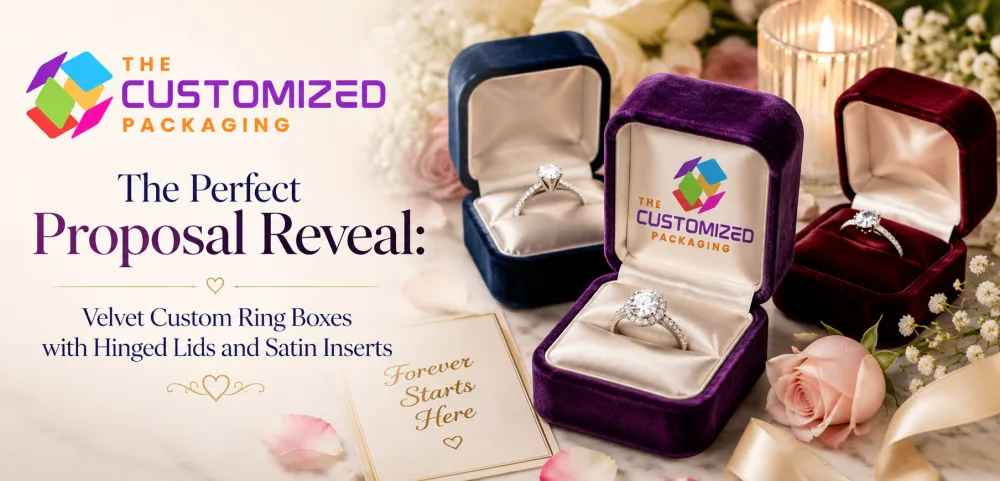
The Perfect Proposal Reveal: Velvet Custom Ring Boxes with Hinged Lids and Satin Inserts
Discover how velvet custom ring boxes with hinged lids and satin inserts create a memorable proposal presentation while protecting engagement rings, wedding bands, bridal sets, and heirloom jewelry. This guide covers velvet types, hinge styles, satin colors, inserts, personalization, prices, MOQ, samples, and wholesale planning.
 Published June 29, 2026
26 min read
Published June 29, 2026
26 min read
A Proposal Box Should Support the Ring, the Brand, and the Moment
A proposal is remembered through emotion, timing, setting, and the first sight of the ring, which is why velvet custom ring boxes should be designed as more than simple jewelry containers. The exterior texture, lid movement, interior color, ring angle, and satin detailing all influence how the jewelry appears when the box opens. Jewelers, bridal brands, ecommerce stores, and wedding-focused businesses comparing custom engagement ring packaging can develop compact boxes that keep the ring secure while making the presentation feel deliberate, personal, and suited to the importance of the moment.
Velvet provides softness, color depth, and a tactile surface that feels appropriate for engagement rings, wedding bands, bridal sets, anniversary pieces, gemstones, signet rings, and heirloom jewelry. A hinged lid keeps the presentation connected and controlled, while a satin insert introduces light and contrast around the band and setting. Businesses planning personalized proposal ring boxes can combine these materials with foil logos, monograms, names, dates, coordinates, or private messages without placing so much decoration around the jewelry that the box becomes more noticeable than the ring.
The most effective box should open smoothly, remain stable when held in one hand, and position the setting toward the recipient rather than allowing the ring to lean, rotate, or sink too deeply into the insert. Jewelry companies sourcing made-to-size ring boxes should therefore begin with the product dimensions, stone height, band width, insert tension, and lid clearance before selecting velvet colors or decorative finishes. This product-first approach also supports more accurate custom ring box pricing, because the structural requirements are established before optional features are added.
This cluster expands on the main pillar article, “Custom Ring Boxes: How Materials, Opening Styles, Printing, Prices, and Wholesale Choices Shape Better Jewelry Presentation.” Brands comparing wholesale velvet ring boxes can use this guide to understand how fabric selection, hinged construction, satin interiors, ring holders, personalization, quantities, samples, and production decisions influence the final box.
Why Velvet and Satin Create a Strong Proposal Presentation
Velvet and satin produce two different visual effects that work especially well together. Velvet absorbs light, giving the exterior and surrounding areas a deep, soft appearance, while satin reflects light and introduces a gentle sheen around the jewelry. Businesses developing luxury proposal packaging can use this contrast to make diamonds, gold, silver, platinum, rose gold, pearls, and colored gemstones easier to notice without relying on heavy graphics or oversized logos.
The tactile difference also improves the opening experience. The customer first touches the soft velvet surface and then sees the smoother satin lining as the lid rises. This progression gives custom bridal ring boxes a layered quality that can feel more considered than a single-material case. A velvet exterior with an ivory satin interior may create a warm bridal mood, while a black velvet case with white satin can produce a stronger contemporary contrast. Burgundy velvet with champagne satin, forest green with cream, navy with silver-grey, and blush with ivory can each support a different collection style.
Material coordination should still begin with the jewelry. A pale diamond may disappear against white satin under bright lighting, while a dark gemstone may lose definition against black velvet. Brands ordering custom colored ring boxes should place actual rings against several velvet and satin combinations before approving the final palette. Physical testing is more reliable than choosing colors from a screen because pile direction, satin reflection, store lighting, daylight, and photography can change the way each shade appears.
The satin should also be used with restraint. A full glossy interior may create distracting reflections, while a satin-covered cushion, inner lid, or raised platform can provide enough contrast without overwhelming the ring. Businesses comparing engagement ring box styles can combine a velvet base with a satin lid panel, a satin cushion with a velvet slot, or a satin platform surrounded by a darker velvet frame.
Velvet Materials Used in Custom Proposal Ring Boxes
Traditional velvet has a dense raised pile that creates a formal and ceremonial appearance. It is well suited to custom engagement ring boxes, wedding-band cases, heirloom jewelry, gemstone rings, and anniversary collections where softness and visual depth are important. Because the pile changes direction when touched, the same fabric may appear lighter or darker from different angles. This movement can be visually attractive, but it also means the material must be wrapped consistently across lids, corners, bases, and ring holders.
Flocked material provides a velvet-like effect by applying short fibers to a formed or flat surface. It is commonly used for affordable velvet ring boxes because it creates consistent color across compact cases and molded interiors while generally costing less than fully wrapped traditional fabric. Flocking works well for proposal collections, fashion rings, wedding bands, and larger quantity programs, although rubbing, fiber shedding, and pressure marks should be tested before production.
Velour is more flexible than some dense velvet fabrics and can adapt well to rounded cases, cushions, curved holders, and compact hinged structures. Jewelry brands exploring custom rounded ring boxes can use velour where the structure contains soft curves or padded forms that would be difficult to wrap neatly with a stiff textile. The softness can produce a gift-ready appearance, although fabric density and long-term wear should be reviewed before a large order.
Suede-effect microfiber has a lower pile and smoother visual character. It can provide a more controlled background for contemporary solitaire rings, signet rings, geometric settings, men’s bands, and minimalist bridal collections. Businesses developing modern proposal ring packaging may prefer microfiber when they want a soft surface without the strong directional movement of traditional velvet.
Velvet can also be laminated or wrapped over foam, EVA, paperboard, or molded holders. A velvet-covered foam slot creates cushioning, while a velvet-covered EVA insert provides sharper product positioning. A velvet-covered paperboard tray may support lighter rings and more economical structures. Brands buying custom ring boxes with inserts should compare these combinations according to product weight, slot precision, removal, durability, and budget.
Velvet Material Comparison
| Velvet Option | Visual and Tactile Quality | Suitable Ring Categories | Main Production Consideration |
|---|---|---|---|
| Traditional velvet | Dense, soft and ceremonial | Engagement rings, bridal sets and heirlooms | Maintain consistent pile direction |
| Flocked material | Uniform velvet-effect finish | Fashion rings and larger-volume orders | Test fiber shedding and rubbing |
| Velour | Flexible and softly padded | Rounded boxes and cushions | Compare density and long-term wear |
| Suede-effect microfiber | Smooth and controlled | Signet rings and modern collections | Check product contrast under lighting |
| Velvet-covered foam | Soft surface with cushioning | Solitaires and bridal sets | Test slot tension after covering |
| Velvet-covered EVA | Refined appearance with precise support | Gemstone and statement rings | Approve cavity depth and removal |
| Velvet-covered paperboard | Lightweight structured presentation | Wedding bands and fashion rings | Inspect wrapped edges and strength |
| Removable velvet cushion | Adaptable and reusable support | Wide bands and gift rings | Match cushion size to band width |
The final fabric should match the ring, the box shape, the hinge style, the order quantity, and the expected handling conditions. Jewelry businesses comparing velvet ring boxes wholesale should approve actual swatches and completed samples rather than relying on digital images alone.
Hinged Lids and the Importance of a Controlled Reveal

The hinged lid is central to the proposal experience because it controls the pace and direction of the opening. A well-designed hinged proposal ring box should open smoothly, remain stable, and frame the ring without requiring the user to hold the lid in place. The angle should reveal both the jewelry and any interior branding while avoiding strong shadows over the stone.
A lid that opens too far may stop acting as a background and make the box feel less connected. A lid that remains too upright may block light, hide the interior logo, or make the ring difficult to photograph. Businesses developing custom hinged ring boxes can test several opening angles using the actual insert, ring, and interior lining before approving the construction.
One-handed use is also important. Many proposals take place outdoors, during travel, at events, or in situations where the person opening the box may be holding it at waist or chest height. The case should remain balanced and should not twist, snap shut, or allow the ring to move when opened. Brands creating proposal-ready ring packaging should test carrying, pocket storage, opening pressure, and product retention under realistic conditions.
The inside lid offers useful space for a satin panel, a foil logo, a monogram, a short message, initials, coordinates, or a date. Jewelry companies ordering personalized hinged ring boxes can keep the outer surface simple while using the interior to create a more emotional reveal. A restrained outer lid followed by a message and ring inside often feels more personal than placing every detail on the exterior.
Standard Hinges, Spring Hinges, Magnets, and Ribbon Stays
Standard hinged boxes use a connected lid without a spring mechanism. This style creates a steady opening and works well for custom wedding ring boxes, anniversary jewelry, proposal collections, and store packaging. The hinge may be concealed, fabric-backed, molded, paper-connected, or built into a rigid structure. Its main advantages are controlled movement and a quieter opening.
Spring-hinged boxes create the familiar compact proposal reveal. The mechanism opens the lid with a defined movement and can make the box feel formal and recognizable. Businesses sourcing spring-hinged engagement ring boxes should test the spring strength carefully because an aggressive mechanism may jerk the case, while a weak one may allow the lid to fall or feel loose.
Magnetic hinged boxes provide a smooth closing action without visible clasps. They can be especially effective for custom magnetic ring boxes with rigid or book-style construction. The magnet should keep the lid secure during transport but should not create a sudden pull that disturbs the opening. Its strength needs to be tested after the fabric, satin, board, and insert have been installed because each layer affects the final closure.
Ribbon stays use narrow fabric strips to control the lid angle. Satin or grosgrain ribbon can coordinate with the insert and outer velvet, creating a decorative detail while supporting the structure. Brands ordering ribbon-stay ring boxes wholesale should test ribbon length, tension, attachment strength, and repeated use so the lid remains stable without pulling the walls inward.
Each hinge style changes cost, assembly, durability, and the character of the reveal. A simple hinge may suit a broad bridal collection, a spring mechanism may serve signature proposal boxes, and magnets may support higher-end limited editions. Companies comparing custom ring box opening styles should match the mechanism to the product level rather than applying the same closure to every collection.
Satin Inserts and How They Affect Ring Positioning
Satin should not be treated only as decoration because the material is usually applied over a structural insert that controls the ring’s position. A satin insert ring box may use foam, EVA, paperboard, molded forms, cushions, or padded platforms beneath the fabric. The correct choice depends on the ring’s weight, setting height, band width, and intended display angle.
Foam provides adaptable cushioning and can accommodate slight differences between ring sizes. A satin-covered foam slot may work well for solitaires, wedding bands, and bridal sets, although the fabric should remain tight after repeated use. Companies ordering foam insert proposal boxes should test whether the satin loosens, creases, or pulls around the slot when the ring is removed several times.
EVA provides firmer support and more precise cavities. A satin-covered EVA holder can position a tall setting consistently and reduce movement during shipping or presentation. Businesses developing made-to-size engagement packaging may choose EVA for gemstone rings, statement pieces, signet rings, and higher-value collections where product control is especially important.
Satin cushions are useful for wide wedding bands, signet rings, anniversary pieces, and paired rings. The cushion should match the circumference of the product so the ring does not stretch or rotate. Brands purchasing custom ring cushion boxes can compare removable and fixed cushions depending on whether the package is intended for display, gifting, or long-term storage.
Raised satin platforms place the ring closer to the opening and can make compact boxes feel more visually balanced. The platform should still leave enough clearance beneath the lid, especially for halo, cathedral, cluster, and high-set solitaire designs. Jewelry businesses sourcing product-fit proposal ring boxes should test the complete ring-to-lid distance before approving the interior height.
Choosing Satin Colors for Different Rings
Ivory and champagne satin create warm, ceremonial interiors that work well with yellow gold, rose gold, pearls, antique settings, and bridal jewelry. Businesses developing wedding proposal ring boxes can pair these shades with burgundy, green, cream, brown, blush, or navy velvet. The final contrast should still be checked with the actual ring because pale stones can become less distinct against warm light interiors.
White satin creates a clean, formal appearance and works particularly well with dark velvet exteriors. A black, navy, purple, burgundy, or forest-green case with white satin can create a clear reveal. Brands ordering white satin ring boxes should make sure platinum, silver, white gold, and diamonds do not disappear against the background. A darker ring slot or surrounding velvet frame can improve definition.
Blush satin creates a softer romantic mood for rose gold, bridal sets, pink gemstones, and feminine collections. Companies producing blush engagement ring packaging should compare several shades because a satin tone that closely matches rose gold may reduce the visual separation between the ring and insert.
Black satin creates strong contrast for diamonds, platinum, white gold, silver, and bright gemstones. It can work well inside white, grey, burgundy, navy, or black velvet cases. Businesses ordering black interior proposal boxes should plan careful storage and packing because dust and fibers can become more visible on dark reflective surfaces.
Navy, burgundy, and green satin can create stronger brand distinction. Navy supports gold, silver, white stones, wedding bands, and men’s rings. Burgundy works well for heritage collections, anniversaries, yellow gold, and rubies when sufficient contrast remains. Forest green and emerald can support gold, diamonds, botanical branding, and vintage jewelry. Jewelry companies comparing custom colored engagement boxes should always view the satin and velvet as one complete combination.
Velvet and Satin Color Pairing Guide
| Velvet Exterior | Satin Interior | Presentation Character | Suitable Jewelry |
|---|---|---|---|
| Deep purple | Ivory | Rich exterior with a soft bridal reveal | Diamonds and engagement rings |
| Burgundy | Champagne | Warm, classic and ceremonial | Yellow gold and anniversary rings |
| Forest green | Cream | Distinctive and heritage-inspired | Gold, diamonds and vintage settings |
| Black | White | Sharp and contemporary | Platinum and bright gemstones |
| Navy | Silver-grey | Formal and balanced | Wedding bands and men’s rings |
| Blush | Ivory | Romantic and delicate | Rose gold and bridal sets |
| Cream | Burgundy | Soft outside with dramatic interior contrast | Gold and ruby jewelry |
| Charcoal | White | Clean and modern | Silver and white gold |
| White | Blush | Light wedding-focused presentation | Rose gold and colored stones |
| Brown suede-effect | Champagne | Warm and natural | Signet rings and wood-themed collections |
Color selection should support the ring rather than follow a trend alone. Brands sourcing custom velvet proposal boxes can approve product-loaded combinations under natural light, store lighting, and photography conditions before production.
Box Shapes That Work for Proposal Ring Packaging

Square boxes remain one of the most practical formats because they provide a balanced structure, stable base, efficient packing, and enough room for hinges, inserts, and branding. Businesses buying square velvet ring boxes can use compact dimensions for proposals while maintaining space for satin interiors, foil logos, and high settings.
Rounded or oval cases create a softer profile and can feel comfortable in a pocket or small bag. The main challenge is fabric application because curves require even tension and carefully positioned seams. Jewelry companies developing rounded proposal boxes should inspect the finished wrapping around the hinge, lid edge, and base.
Hexagonal boxes create a distinctive appearance without becoming difficult to stack or ship. A custom hexagon ring box can combine velvet with satin cushions, metallic logos, or contrasting interior colors. The ring holder must remain centered within the angled structure so the design does not feel visually unbalanced.
Heart-shaped cases communicate romance directly and can suit Valentine’s collections, anniversaries, wedding gifts, and proposal products. Brands offering heart-shaped engagement ring boxes should keep the decoration restrained because the shape already carries a strong visual message.
Book-style proposal boxes provide additional room for a story, photograph, message, certificate, or proposal question. The ring may appear after the message or sit beside it on a satin platform. Businesses sourcing book-style proposal packaging should consider the extra size, material, storage, and freight because these structures are generally larger than compact hinged cases.
Ring Fit, Stone Clearance, and Interior Depth
The box should be designed around the entire ring profile. A tall setting requires more top clearance than a flat wedding band, while a broad signet ring needs a different slot from a thin solitaire band. Businesses developing custom-size velvet ring boxes should provide the full product width, setting height, band thickness, stone projection, and preferred display angle.
The holder should keep the ring upright without gripping it so tightly that removal becomes difficult. An insert that is too loose can allow the ring to tilt or move during transport, while excessive tension may strain delicate bands or create pressure near the setting. Jewelry companies ordering fitted engagement ring boxes can test the smallest and largest pieces intended for one insert.
The stone should remain clear of the lid, satin panel, logo plate, and any decorative trim. This is especially important for halo, cluster, cathedral, tension, and high-set gemstone designs. Brands sourcing protective proposal ring packaging should check the loaded box from the front, side, and top before finalizing the structure.
Bridal-set boxes require additional spacing because the engagement ring and wedding band should not rub against one another. A double slot, shared cushion, divided cavity, or parallel platform can support both pieces. Companies purchasing double ring boxes wholesale should confirm that the stones, prongs, and metal surfaces remain separated when the lid is closed.
Personalization That Supports the Proposal Story
Proposal boxes can include names, initials, dates, coordinates, locations, monograms, photographs, or short messages. These details may be added through foil stamping, digital printing, engraving, embroidery, screen printing, printed sleeves, labels, interior cards, or metal plates. Businesses developing personalized engagement ring boxes should choose the method according to the material, quantity, artwork detail, and deadline.
Foil stamping works well for logos, names, dates, monograms, and concise messages. Gold, silver, rose gold, copper, black, white, or colored foil can coordinate with the ring and velvet. On selected fabrics, foil compatibility should be tested because deep pile may reduce edge clarity. Brands producing foil-stamped velvet ring boxes can also apply the foil to an outer sleeve, interior satin panel, or rigid paper-wrapped component.
Embroidery can create a fabric-focused appearance but may require simplified artwork and higher minimums. Engraving is suitable for wooden components, acrylic plates, or metal badges. Digital printing supports multiple names, photographs, gradients, and smaller personalized runs. Companies ordering custom proposal boxes in quantity can use removable cards or sleeves when permanent personalization would make unused stock difficult to reuse.
A short interior message often creates a stronger emotional result than covering the outside with text. The lid might include initials, a date, or a few meaningful words while the exterior carries only the logo. Jewelry brands developing proposal ring boxes with messages can create a more controlled reveal by deciding which detail appears before and after the lid opens.
Logo Placement and Brand Visibility
A proposal box should feel personal, but it also needs to remain connected to the jewelry brand. The outer lid, inner lid, base, ribbon, satin panel, sleeve, card, or metal plate can carry the company mark. Businesses designing custom ring boxes with logo should select one primary placement and one subtle supporting detail rather than repeating the logo on every available surface.
A small foil mark on the outer lid can create recognition without making the box feel promotional. An interior logo appears only after opening and can sit beneath a message or above the ring. A printed sleeve offers more space for product information while protecting the velvet from dust and rubbing.
Logo scale is especially important on compact ring boxes. Large artwork may distort around curved lids or dominate the small surface. Brands ordering branded velvet ring boxes should approve the final logo size, placement, foil color, and contrast on a completed sample.
Proposal Photography, Lighting, and Social Content
Velvet and satin respond differently to light, which makes photography testing important. Velvet absorbs light and may appear darker in low-light proposal settings, while satin creates highlights that can become too bright under direct studio lamps. Businesses producing camera-ready ring boxes should test the completed box in daylight, indoor lighting, candlelight, store displays, and mobile-camera photography.
A pale satin interior may create attractive softness around a gold ring but may wash out a diamond or platinum band. A dark velvet case can provide strong contrast but may hide details if the lid angle creates a shadow. Jewelry brands planning photogenic proposal packaging can adjust the insert height, lid angle, and interior color after reviewing real images rather than relying only on the physical sample.
Stable hinged lids also improve photography because the box remains open without support. The ring, logo, message, and interior lining can appear together in proposal photographs, ecommerce images, social media posts, and advertising. Companies developing social-media-ready engagement ring boxes should avoid reflective decoration that produces glare or unreadable logos.
Compact Boxes for Discreet Proposal Carrying
Many proposal settings require the box to fit inside a pocket, jacket, purse, or small bag without revealing its shape. A compact engagement ring box should remain thin enough for discreet carrying while still providing clearance for the setting and enough structure to protect the ring.
The closure should resist accidental opening, especially during travel or outdoor proposals. Spring hinges, magnets, and fitted lids should be tested under light pressure. Businesses sourcing pocket-size velvet ring boxes can check the box inside different garments and carrying positions before approving the size.
Reducing the external dimensions should not make the holder too tight or place the stone against the lid. A compact design may use a lower-profile cushion, angled ring slot, or shaped cavity to preserve presentation without unnecessary height. Jewelry companies producing small proposal ring boxes wholesale should test several ring profiles before standardizing one size.
Velvet and Satin Boxes for Wedding Bands and Bridal Sets
Velvet-and-satin packaging can continue beyond the engagement ring into wedding bands, anniversary rings, and full bridal sets. Businesses ordering custom wedding ring boxes can use matching exterior colors with different holders, allowing the engagement box and wedding-band box to feel related without being identical.
Single wedding bands may sit on a satin cushion, while paired rings can use double slots, parallel holders, divided cavities, or a shared padded platform. The rings should remain separated to prevent contact between polished surfaces, stones, and prongs. Brands purchasing bridal-set ring boxes in bulk can test the complete arrangement before confirming the insert.
Names, wedding dates, monograms, ceremony colors, and ribbon details can coordinate the packaging with the event. A company may use one core hinged structure with different satin colors or inserts for engagement rings, wedding bands, bridesmaid gifts, and anniversary products. This approach can simplify wholesale bridal packaging while maintaining visual variety.
Pricing Factors for Velvet Proposal Ring Boxes
The cost of custom velvet ring boxes depends on dimensions, structural core, fabric type, satin quality, hinge mechanism, insert material, logo method, personalization, quantity, assembly, protective packing, and delivery. A small flocked case with a standard hinge and foam slot will generally cost less than a rigid traditional-velvet box with a magnetic lid, satin-covered EVA, foil branding, personalization, and an outer sleeve.
Fabric coverage influences labor because full wrapping around curves, corners, hinges, and slots requires more careful application than a velvet insert inside a paper-wrapped box. Custom-dyed velvet, specialty satin, embroidery, metal plates, spring mechanisms, magnets, and custom-shaped structures add production steps. Businesses comparing proposal ring box prices should separate features that improve product protection or the reveal from decorative additions that provide limited value.
Protective packing should also be included in the budget. Velvet and satin may require tissue, sleeves, individual bags, dividers, or fitted cartons to prevent dust, rubbing, and pressure. Companies purchasing velvet proposal boxes wholesale should calculate the delivered cost rather than comparing the undecorated box price alone.
MOQ and Wholesale Quantity Planning
MOQ depends on the box shape, velvet availability, satin color, hinge mechanism, insert, printing process, tooling, and level of personalization. Businesses exploring low-MOQ engagement ring boxes may begin with standard shapes, available fabric colors, digital printing, and simplified inserts.
Custom-dyed velvet, embroidered marks, specialty satin, unique molds, spring mechanisms, metal hardware, and custom-shaped cases may require larger production quantities. Jewelry brands planning custom proposal packaging wholesale should confirm the minimum for every component before finalizing artwork.
Small projects can use stock velvet cases with custom sleeves, foil stickers, printed cards, ribbons, labels, engraving, or removable inserts. These approaches provide partial customization when fully made-to-size production is not economical. Companies searching for custom ring boxes with no minimum should confirm which elements can genuinely be changed at very low quantities.
Higher quantities spread structural development, dies, printing setup, foil tooling, insert preparation, and sampling across more units. Businesses comparing bulk velvet ring boxes can review several quantity levels using the same specification. A lower unit price at a larger volume should still be weighed against storage capacity, collection changes, branding updates, color trends, and the expected life of the design.
Sampling Before Full Production
Velvet and satin swatches should be reviewed together because the combination matters more than either material alone. A fabric swatch confirms color, pile direction, softness, satin sheen, and lighting response. Brands developing custom proposal packaging can place the actual ring beside these materials before moving to structural sampling.
A blank prototype confirms the box dimensions, hinge movement, lid angle, ring position, slot tension, stone clearance, and closure. Jewelry companies ordering hinged ring boxes in bulk should test several representative rings if one box will serve multiple products.
A finished sample confirms velvet wrapping, satin folds, seams, logo placement, foil clarity, personalization, holder quality, and overall appearance. The box should be carried, opened one-handed, photographed, closed repeatedly, packed, stacked, and placed inside the shipping package. Businesses purchasing custom engagement ring boxes can use one approved sample as the reference for the full order.
Sustainable Design and Practical Reuse
Velvet, satin, foam, EVA, magnets, springs, adhesives, and mixed structural materials can make recycling more difficult. Brands developing responsibly designed ring packaging can use removable inserts, paperboard cores, simplified hinges, separable components, or reduced fabric coverage where the product still receives suitable protection.
Right-sizing can reduce board, fabric, filler, master cartons, storage space, and freight. Businesses ordering low-waste proposal boxes should establish the ring and insert dimensions before increasing the box size for visual impact.
A durable hinged case may remain useful as ring storage after the proposal or wedding. Companies creating reusable velvet ring boxes can use strong hinges, timeless colors, removable cushions, and limited event-specific text so customers can continue using the packaging.
Velvet Custom Ring Boxes Across the USA
The Customized Packaging creates velvet custom ring boxes with standard hinges, spring mechanisms, magnetic closures, ribbon stays, satin inserts, foam, EVA, cushions, foil logos, sleeves, and personalized details.
These structures can be developed for engagement rings, wedding bands, bridal sets, signet rings, gemstone jewelry, anniversary gifts, proposal collections, and heirloom pieces. Businesses can coordinate box dimensions, velvet colors, satin linings, insert styles, logo placement, quantities, and delivery according to their product range.
Companies seeking custom engagement ring boxes across the USA can plan prototypes, small collections, bridal programs, ecommerce launches, seasonal campaigns, and larger production quantities using exact ring measurements, preferred materials, order volume, deadline, and destination.
Estimate Your Proposal Packaging Budget
Use the Custom Box Packaging Cost Calculator
The Custom Box Packaging Cost Calculator can help jewelers, bridal businesses, ecommerce stores, designers, wedding planners, and gift companies prepare an early estimate for custom proposal ring boxes.
The calculator can include rigid construction, velvet wrapping, satin interiors, hinged lids, spring mechanisms, magnetic closures, foam, EVA, foil, personalization, sleeves, and production quantities.
The result provides an initial planning figure. Final costs depend on confirmed dimensions, velvet and satin choices, hinge style, insert construction, decoration, quantity, protective packing, and delivery.
Why Choose The Customized Packaging?
The Customized Packaging develops custom velvet ring boxes with logo around ring dimensions, setting height, opening movement, presentation, branding, fulfillment, storage, and delivery.
Velvet options include traditional fabric, flocked finishes, velour, suede-effect microfiber, and fabric-covered inserts. Satin colors include ivory, champagne, white, blush, black, navy, burgundy, green, grey, and custom shades.
Hinged formats include standard lids, spring hinges, magnetic closures, ribbon stays, book-style openings, compact cases, rounded boxes, hexagonal boxes, and custom-shaped structures.
Insert choices include satin-covered foam, EVA, cushions, pads, raised platforms, velvet slots, double-ring holders, removable inserts, and bridal-set trays.
Branding options include foil stamping, screen printing, digital printing, embroidery, engraving, sleeves, labels, ribbons, metal plates, names, dates, monograms, coordinates, and interior messages.
Final Thoughts
The Perfect Proposal Reveal: Velvet Custom Ring Boxes with Hinged Lids and Satin Inserts explains how material, structure, color, product fit, and opening movement work together to shape an engagement-ring presentation.
Velvet creates softness and depth, while satin adds reflection, contrast, and a ceremonial interior. Standard hinges, spring mechanisms, magnets, and ribbon stays create different opening experiences for proposals, weddings, anniversaries, and gifting.
Foam, EVA, cushions, satin platforms, velvet slots, and bridal-set holders determine how securely the ring sits and how clearly the setting is displayed. Foil, engraving, embroidery, monograms, names, dates, sleeves, and interior messages can personalize the box without distracting from the jewelry.
Pricing and MOQ depend on dimensions, velvet, satin, hinge construction, inserts, branding, quantity, assembly, protective packing, storage, and delivery.
For broader guidance on ring-box materials, opening styles, inserts, printing, prices, MOQ, samples, and wholesale planning, read the main pillar article, “Custom Ring Boxes: How Materials, Opening Styles, Printing, Prices, and Wholesale Choices Shape Better Jewelry Presentation.”
At The Customized Packaging, we create velvet proposal ring boxes that keep engagement jewelry secure, open smoothly, support personalized branding, and make the moment of reveal feel intentional from the first touch to the final question.