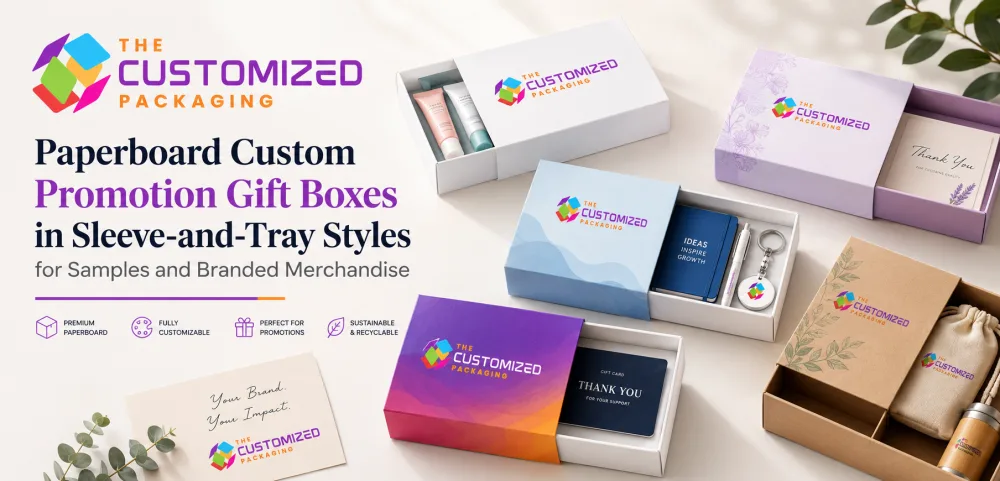
Paperboard Custom Promotion Gift Boxes in Sleeve-and-Tray Styles for Samples and Branded Merchandise
Explore how paperboard sleeve-and-tray boxes create organized product reveals for sample kits, promotional merchandise, welcome packs and marketing campaigns.
 Published June 26, 2026
Updated August 05, 2026
11 min read
Published June 26, 2026
Updated August 05, 2026
11 min read
A small product sample can easily disappear inside oversized packaging. Branded merchandise can also look disorganized when pens, cards, pins, cosmetics or accessories are placed loosely inside a general-purpose gift box.
Custom sleeve and tray boxes solve this presentation problem through a simple two-part structure. The outer sleeve carries the campaign branding, while the inner tray holds the products in a planned arrangement and reveals them through a sliding motion.
For marketing teams, this structure offers a practical middle ground between an ordinary folding carton and a heavier rigid presentation box. Paperboard keeps the package lightweight and relatively space-efficient, while the sliding tray makes the recipient experience feel deliberate.
The result is packaging that can support product sampling, customer onboarding, promotional merchandise, event giveaways and selected direct-mail campaigns without making every project look like a luxury gift hamper.
Why Sleeve-and-Tray Packaging Works for Promotions
Promotional packaging has a different purpose from standard retail packaging.
A retail carton usually introduces one product and provides information needed for purchase. A promotional box may need to introduce several items, explain a campaign, direct the recipient to an online experience and encourage a specific action.
A sleeve-and-tray structure separates these jobs naturally.
| Packaging component | Campaign function |
|---|---|
| Outer sleeve | Brand identity, campaign message and visual introduction |
| Inner tray | Product arrangement and controlled reveal |
| Insert or divider | Holds samples and merchandise in position |
| Printed interior | Instructions, storytelling or next-step message |
| Card or QR code | Offer, registration, video or campaign landing page |
The recipient first sees the sleeve, then interacts with the tray and finally discovers the contents. This sequence gives the brand more control over how the campaign is understood.
Use the Sleeve as the Campaign Cover
The outer sleeve should introduce the promotion without trying to communicate everything at once.
Depending on the campaign, it may include:
-
The brand logo
-
Campaign name
-
A short benefit-led message
-
Launch or event artwork
-
Recipient or membership category
-
A QR code or promotional URL
The main message should remain readable before the box is opened. Important information should not be placed too close to the open edges, where it may be interrupted when the tray begins to slide.
Brands running several campaigns can retain one approved tray size and change the outer sleeve artwork. This can be useful for seasonal promotions, regional events, product launches and customer tiers when the items inside have similar dimensions.
Turn the Tray into a Product Story
The inner tray should do more than stop products from moving.
Its layout can establish the order in which the recipient notices each item. A hero sample may be placed in the center, while smaller supporting products, information cards or promotional merchandise occupy secondary positions.
For example, a beauty sampling kit might arrange:
-
A featured serum or cream sample
-
Two smaller supporting products
-
An instruction card
-
A limited-time offer or QR code
A corporate welcome kit might instead contain a membership card, pen, pin and folded information booklet.
The tray arrangement should reflect the campaign objective. If the goal is product trial, the sample must remain visually dominant. If the purpose is membership onboarding, the identification card or introductory information may need the clearest position.
Product Samples Need More Than Attractive Artwork
Samples are often lightweight, but that does not mean they are easy to package.
Sachets can slide underneath cards. Small bottles may rotate or leak if held incorrectly. Tubes can lift out of shallow inserts, while delicate confectionery samples may require an appropriate direct-contact wrapper or tray.
Before designing custom sample packaging, record:
-
The dimensions of every item
-
The filled weight
-
The preferred presentation side
-
Whether the item can lie flat
-
Any fragile cap, seal or applicator
-
Required separation between products
-
Whether the item directly contacts the insert
-
How the recipient will remove it
A paperboard carton is not automatically suitable for direct contact with cosmetics, food or other sensitive contents. Primary containers, wraps, pouches, trays and liners should be planned according to the product.
Branded Merchandise Should Feel Curated
Promotional merchandise often includes unrelated shapes: a pen beside a keychain, gift card, pin, notebook or USB drive.
Placing these items loosely inside a box makes the campaign feel assembled rather than designed.
Branded merchandise boxes can use separate cavities or compartments so each item has an intentional position. However, the insert should not become more complicated than the products require.
A simple paperboard platform may support a gift card and badge. A divided tray may work for several small accessories. Foam can provide precise cavities for selected electronics or premium merchandise, but it may increase cost and material complexity.
The best insert is the simplest one that holds the products securely and presents them clearly.
Choose a Sleeve-and-Tray Structure That Fits the Campaign
Not every sliding box needs the same construction.
| Structure | Best suited to |
|---|---|
| Single-open-end sleeve | Controlled reveal from one side |
| Open-ended sleeve | Simple, economical slide-out packaging |
| Thumb-notch tray | Easy manual opening without an added ribbon |
| Ribbon-pull tray | Gift-led campaigns and premium sample kits |
| Partially exposed tray | Fast access and visible color contrast |
| Divided sliding tray | Multi-item merchandise or sample collections |
A fully enclosed sleeve creates a cleaner visual appearance. A partially exposed tray makes the opening point more obvious and can introduce a second brand color before the package is opened.
Ribbon pulls should be used selectively. They can support a gift-like experience but may be unnecessary for high-volume event giveaways or simple promotional samples.
Paperboard Is Practical, but Grade Still Matters
Paperboard sleeve boxes can normally be supplied flat or partially assembled, which may reduce storage requirements compared with fully assembled rigid boxes.
The board grade should still match the package dimensions and total product weight.
SBS paperboard offers a smooth white printing surface and is suitable for detailed campaign artwork. Kraft paperboard creates a natural brown appearance but changes how printed colors and white areas reproduce. Heavier paperboard may be required for larger trays, several merchandise items or structures with wide openings.
Using unnecessarily thick board can increase cost without improving the recipient experience. Using board that is too light may cause tray walls to bow or the sleeve to lose its shape.
A structural sample should be tested with the complete product set before the material is approved.
Tray Clearance Controls the Sliding Experience
A sleeve-and-tray box should open smoothly without the tray falling out unexpectedly.
If the sleeve is too tight, friction, ink coverage or lamination can make the box difficult to open. If it is too loose, the tray may slide during carrying or shipping.
The final clearance can be affected by:
-
Paperboard thickness
-
Printed ink coverage
-
Lamination or coating
-
Folding accuracy
-
Tray gluing
-
Insert pressure
-
Product weight
This is why measurements should be confirmed using an assembled sample rather than only a digital dieline.
The sample should also be tested after the products and insert have been placed inside. A tray that slides correctly while empty may behave differently after it carries several items.
Design the Package Around Fulfillment
A promotional box may look impressive but still create problems for the team packing hundreds or thousands of campaign kits.
Before production, review:
-
Whether the tray arrives assembled or flat
-
How long the insert takes to fold
-
Which product is loaded first
-
Whether items can be inserted consistently
-
How the filled tray enters the sleeve
-
Whether the package needs a seal or belly band
-
How completed boxes will be counted and packed
A complex insert with many folds may be reasonable for a small VIP campaign but inefficient for a large trade-show distribution.
Packing trials can help estimate labor and identify whether products are likely to be placed in the wrong cavities.
Plan Direct-Mail Protection Separately
A paperboard sleeve-and-tray box is primarily a presentation structure. It should not automatically be treated as a courier-ready shipping package.
For mailed sample kits, the promotional box may need an outer corrugated mailer or shipping carton. The external layer can protect the sleeve from labels, abrasion, moisture and crushing.
The complete shipment should be tested for:
-
Tray movement
-
Sleeve separation
-
Product movement inside inserts
-
Damage to corners
-
Pressure on bottles or accessories
-
Barcode and shipping-label placement
-
Condition after normal courier handling
A compact promotional box may also reduce the size of the shipping container, but dimensions should never become so tight that the campaign products are compressed.
Use Printing to Guide the Recipient
A sleeve-and-tray format creates several communication surfaces: the outside of the sleeve, the visible tray edge, the inside of the tray and any insert cards.
These areas should work as a sequence rather than repeat the same logo and slogan.
One effective approach is:
-
Sleeve front: Brand and campaign introduction
-
Sleeve back: Essential details or contact information
-
Tray edge: Short opening prompt
-
Tray interior: Product explanation
-
Insert card: Offer, instructions or next action
A QR code can connect the physical sample to a tutorial, product page, registration form, survey or special offer. The destination should be useful and active throughout the campaign.
Foil, embossing, spot UV and other finishes can emphasize selected elements, but they should not distract from the campaign message or make the box unnecessarily expensive.
Create a Reusable Structure for Recurring Campaigns
Brands that run several promotions each year can develop a modular packaging system.
The same tray dimensions may support different campaigns through interchangeable paperboard inserts, printed sleeves, cards or product labels. This can reduce the need to redesign the complete structure every time.
A reusable packaging platform works best when:
-
Product dimensions remain within a predictable range
-
The same number of items is normally included
-
The overall campaign quality level remains consistent
-
Artwork can be changed independently
-
Previous structural tooling can still be used
The design should not be made so universal that every campaign contains excessive empty space. A small number of standardized sizes is usually more practical than one oversized box for every purpose.
Avoid Generic Sustainability Claims
Paperboard packaging may help reduce the weight and assembled storage volume of selected campaign boxes, but this does not automatically make the finished package sustainable, recyclable or biodegradable.
Windows, laminations, metallic finishes, adhesives, foam inserts and mixed materials can affect disposal.
More responsible decisions may include:
-
Right-sizing the box
-
Removing unnecessary insert layers
-
Using paperboard dividers where they provide adequate support
-
Limiting decorative components
-
Designing one structure for several compatible campaigns
-
Providing accurate disposal guidance
Environmental statements should describe the actual finished package rather than rely on broad claims about paper.
Prepare the Complete Campaign Before Requesting Pricing
An accurate quote requires more than the desired box dimensions.
Provide:
-
Campaign purpose
-
Recipient type
-
Every product and merchandise item
-
Product dimensions and weight
-
Required item arrangement
-
Box quantity
-
Preferred sleeve opening
-
Insert requirements
-
Artwork variations
-
Printing and finishes
-
Assembly requirements
-
Packing method
-
Delivery destination
-
Required date
Most custom packaging styles begin at 100 units. Final pricing depends on the dimensions, paperboard grade, sleeve and tray construction, insert, printing, finishes, quantity and delivery requirements.
Why Choose The Customized Packaging?
The Customized Packaging develops custom promotion boxes for product sampling, branded merchandise, customer welcome programs, employee kits, events and marketing campaigns.
Sleeve-and-tray projects can include custom paperboard dimensions, printed outer sleeves, contrasting inner trays, thumb notches, ribbon pulls, product-fit inserts, divided layouts and inside printing.
Our team can help evaluate the product arrangement, tray movement, board strength, artwork placement and packing requirements before production. Standard production generally takes 8–12 business days after final approval, with rush service available for eligible projects.
Frequently Asked Questions
Are sleeve-and-tray boxes the same as rigid drawer boxes?
Not always. A sleeve-and-tray structure can be manufactured from folding paperboard or thicker rigid board. Paperboard versions are lighter and can often be supplied flat or partially assembled.
Can one tray hold several promotional products?
Yes. A divided paperboard insert or fitted tray can organize several samples and merchandise items. The layout should be tested with the actual products.
Are paperboard promotional boxes suitable for mailing?
They may require a separate corrugated shipping carton or mailer. The complete packed shipment should be tested before a direct-mail campaign.
Can the outer sleeve be changed for different promotions?
Yes. Brands may retain the same tray dimensions and create different printed sleeves when the campaign contents have compatible sizes and weights.
What is needed for an accurate quotation?
Provide the product dimensions, complete item arrangement, sleeve style, paperboard preference, insert, artwork, quantity, delivery destination and required date.
Make the Sliding Reveal Part of the Campaign
The value of sliding gift boxes is not limited to the opening motion.
A well-planned structure introduces the campaign, organizes every item and guides the recipient toward the next action. Paperboard construction can keep the format practical for larger promotional runs, while the sleeve and tray create more interaction than an ordinary folding carton.
When product fit, message order, fulfillment and shipping are considered together, custom sleeve and tray boxes can turn samples and branded merchandise into a more organized and memorable campaign experience.