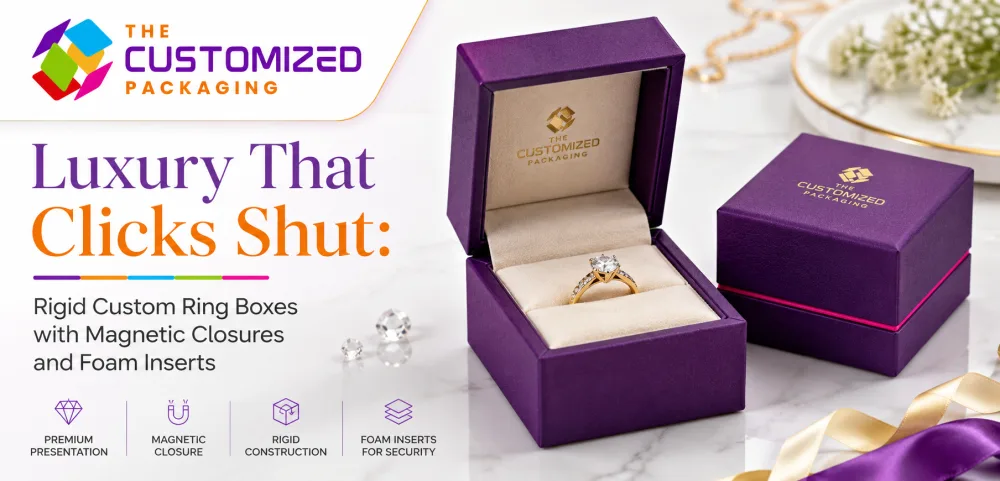
Luxury That Clicks Shut: Rigid Custom Ring Boxes with Magnetic Closures and Foam Inserts
Discover how rigid custom ring boxes with magnetic closures and foam inserts protect engagement rings, wedding bands, signet rings, gemstone jewelry, and bridal sets while creating a clean, secure opening experience. This guide covers materials, magnetic styles, foam inserts, printing, prices, MOQ, samples, and wholesale planning.
 Published June 30, 2026
27 min read
Published June 30, 2026
27 min read
A Stronger Ring Box Built Around Structure, Security, and Presentation
Rigid custom ring boxes with magnetic closures and foam inserts combine a firm outer structure with a controlled opening and a fitted interior that keeps engagement rings, wedding bands, signet rings, gemstone pieces, bridal sets, and anniversary jewelry in position. Jewelry businesses comparing high-quality ring packaging options can order made-to-size magnetic ring boxes that protect delicate settings while creating a smooth opening and closing experience.
The familiar magnetic “click” gives the box a clear sense of completion. It keeps the lid aligned, reduces accidental opening, and allows the structure to close without visible tabs, tuck flaps, or external clasps. Companies evaluating branded jewelry presentation boxes can choose concealed magnetic closures for hinged, book-style, fold-over, shoulder-neck, and compact rigid formats.
Foam inserts add the product control that rigid walls alone cannot provide. The insert can be cut into a ring slot, shaped cavity, padded platform, double-ring layout, or multi-product arrangement according to the band width, setting height, stone projection, and preferred display angle. Jewelers sourcing custom fitted ring packaging can approve product-loaded foam prototypes before confirming dimensions and production quantities.
A successful magnetic ring box should not rely on appearance alone. The greyboard thickness, wrap material, magnet position, hinge movement, foam density, product clearance, printing, finish, quantity, storage, and shipping method all affect the final result. Businesses planning wholesale custom ring boxes can compare complete packaging specifications instead of selecting a structure only because it looks substantial.
This cluster expands on the main pillar article, “Custom Ring Boxes: How Materials, Opening Styles, Printing, Prices, and Wholesale Choices Shape Better Jewelry Presentation.” Brands exploring custom ring boxes with logo can use this guide to plan rigid magnetic packaging around product protection, brand identity, quantities, costs, and long-term use.
What Makes a Rigid Magnetic Ring Box Different?
A rigid magnetic ring box is normally built from dense greyboard or chipboard that is cut, formed, and wrapped rather than folded from thin carton stock. Jewelry brands comparing rigid jewelry box construction can select compact hinged or fold-over formats that maintain their shape during handling, storage, presentation, and repeated opening.
The magnetic closure is usually hidden between the board and outer wrap, giving the package a clean exterior. Businesses sourcing magnetic closure ring boxes can choose single-magnet, dual-magnet, flap, book-style, or concealed-lid systems according to box size and desired opening resistance.
Inside the structure, foam supports the ring and reduces movement. Companies developing custom insert ring boxes can order precision-cut foam cavities for solitaires, wide wedding bands, signet rings, gemstones, bridal pairs, and coordinated jewelry sets.
The combination works because each component performs a different role. The board provides strength, the magnet secures the opening, and the foam controls the product. Brands purchasing complete ring packaging solutions can develop all three components together so the structure remains balanced rather than treating the insert and closure as later additions.
Why Magnetic Closures Work Well for Ring Packaging
Magnetic closures provide a smooth and repeatable action that can make small boxes easier to open and close. Jewelers evaluating modern ring packaging styles can choose magnetic lids when they want a quieter opening than a spring mechanism and a cleaner look than tuck tabs or clasps.
The closure can help the box remain shut inside a shopping bag, drawer, shipping carton, proposal kit, or display cabinet. Businesses sourcing secure engagement ring boxes can select magnet strength according to the finished structure so the lid stays closed without requiring excessive force.
A strong magnet is not always better. If the pull is too aggressive, the lid may snap shut or create a sudden movement during opening. Companies comparing commercial magnetic box specifications can test closure resistance on finished samples after the wrap, hinge, insert, and interior lining are installed.
Magnetic placement also affects alignment. A poorly positioned magnet may pull the lid sideways, create an uneven gap, or place pressure on the wrapped edge. Brands ordering custom magnetic ring boxes in bulk can approve lid alignment and closing action before the full production run.
Rigid Greyboard and Board Thickness
Greyboard is the structural core used in many rigid custom ring boxes. It is available in different thicknesses and densities, allowing jewelry brands to choose a board grade that suits compact ring cases, deeper presentation boxes, hinged formats, and larger bridal-set packaging.
A thicker board can produce a heavier feel and stronger walls, but unnecessary thickness can increase weight, freight, and material usage. Businesses comparing wholesale rigid jewelry boxes can select practical board strength rather than assuming the thickest option will automatically create the best result.
The board should remain flat and stable after wrapping. If the outer paper, adhesive, or fabric applies uneven tension, the panels may bow or the lid may lose alignment. Companies sourcing well-finished magnetic ring boxes can inspect wrapped production samples for warping, corner lift, and surface unevenness.
Compact boxes also require accurate cutting because small differences are more noticeable around the lid and base. Brands developing made-to-measure rigid ring packaging can approve dielines and blank prototypes before printing, foil, or lamination are added.
Outer Wrap Materials for Rigid Ring Boxes
Rigid greyboard is normally covered with decorative paper, textured stock, kraft, linen paper, soft-touch material, velvet, suede-effect fabric, leather-look wrap, pearl stock, or printed sheets. Jewelry businesses comparing custom wrapped ring boxes can choose surface materials according to product level, branding, photography, durability, and budget.
Smooth coated paper supports detailed printing, gradients, patterns, and consistent brand colors. Companies ordering custom printed rigid ring boxes can use offset or digital printing when the artwork contains several colors, product stories, illustrations, or collection graphics.
Uncoated and textured papers create a softer, more tactile appearance. Brands sourcing textured jewelry packaging can select linen, canvas, leather-grain, or fibrous finishes for minimal logos, foil stamping, embossing, or blind debossing.
Kraft wraps create a natural and understated direction. Businesses developing rigid kraft ring boxes can combine brown or white kraft with hidden magnets and foam inserts for handmade, artisan, botanical, and environmentally focused collections.
Soft-touch materials create a smooth surface but may show scuffs, fingerprints, or edge wear. Companies comparing soft-touch magnetic ring boxes can test rubbing and handling before choosing the finish for higher-volume programs.
Material Comparison for Rigid Magnetic Ring Boxes
| Wrap Material | Main Appearance | Suitable Ring Categories | Important Ordering Check |
|---|---|---|---|
| Smooth printed paper | Clean, colorful and versatile | Fashion rings, bridal collections and branded ranges | Approve printed color on final stock |
| Uncoated paper | Soft and understated | Minimalist and handmade jewelry | Check rub resistance and ink absorption |
| Linen-textured paper | Tactile and refined | Wedding bands and heirloom pieces | Test foil and embossing clarity |
| Natural kraft | Warm and artisan-focused | Handmade rings and natural stones | Review color contrast on brown stock |
| Soft-touch wrap | Smooth and contemporary | Engagement rings and signature collections | Inspect fingerprints and scuffing |
| Velvet wrap | Soft and ceremonial | Proposals and bridal jewelry | Protect the surface during packing |
| Suede-effect microfiber | Controlled and modern | Signet rings and gemstone pieces | Compare texture under lighting |
| Leather-effect wrap | Structured and traditional | Men’s rings and wedding bands | Review mixed-material composition |
| Pearl or shimmer paper | Light-reflective and decorative | Bridal rings and anniversary jewelry | Check glare and print visibility |
| Wood-effect paper | Warm keepsake-style appearance | Gift rings and heritage collections | Approve grain realism and edge wrapping |
The outer material should support the ring, logo, insert, closure, and expected handling. Brands sourcing custom rigid ring boxes wholesale can compare physical wrap samples before selecting a final finish.
Magnetic Closure Styles for Rigid Ring Boxes
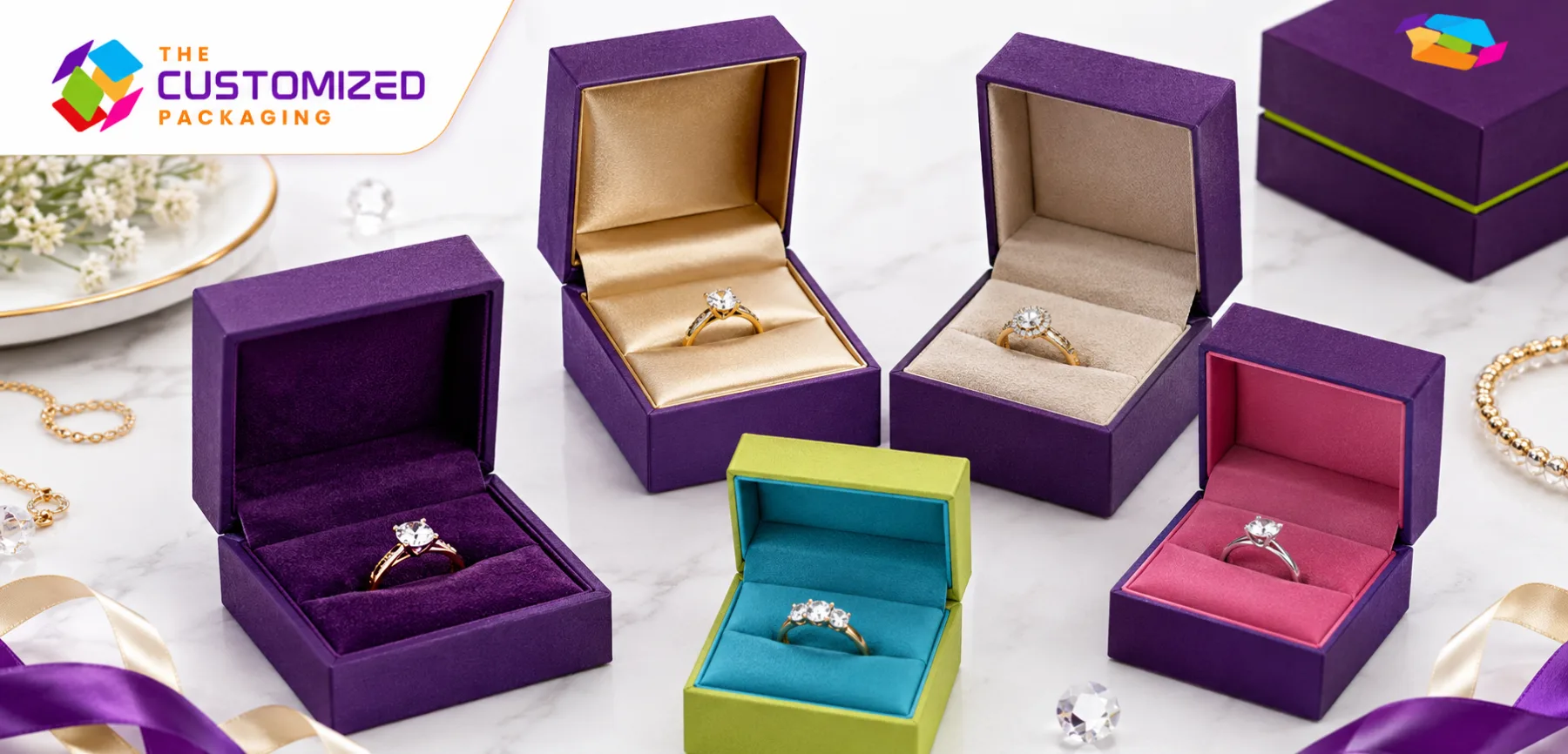
Hinged Magnetic Lids
A hinged magnetic lid remains connected to the base and closes against concealed magnets along the front edge. Jewelers choosing hinged magnetic ring boxes can order compact structures for engagement rings, bridal sets, wedding bands, gemstones, and gift jewelry.
The hinge may use wrapped paper, fabric, ribbon, or a constructed joint. Businesses developing custom hinged jewelry boxes can test the lid angle and hinge resistance so the cover stays open without pulling backward.
The interior lid can carry a logo, message, satin panel, certificate pocket, or printed artwork. Brands purchasing inside-branded ring boxes can place the main identity inside the lid while keeping the exterior simple.
Book-Style Magnetic Boxes
Book-style boxes open from one side and resemble a compact presentation case. Companies sourcing book-style magnetic ring boxes can create space for a ring, message, photograph, certificate, or product story within the same structure.
The fold-over cover may use one or more magnets to secure the front edge. Businesses comparing story-driven jewelry packaging can develop a controlled opening sequence that reveals the message and ring in a planned order.
These structures use more board and wrap than very compact hinged cases. Brands ordering book-style ring boxes wholesale can compare the added space with storage, freight, and unit cost before selecting the format.
Fold-Over Magnetic Flaps
A fold-over flap extends from the lid and secures against a magnet in the front or base. Jewelry businesses choosing magnetic flap ring boxes can use narrow or broad flaps depending on available branding space and the desired opening movement.
The flap can carry a foil logo, printed pattern, sleeve, ribbon, or embossed mark. Companies developing custom logo jewelry boxes can test magnet position and wrap tension so the flap closes evenly.
Shoulder-Neck Magnetic Boxes
Shoulder-neck structures include a raised inner platform that helps align the lid and frames the insert. Brands sourcing shoulder-neck ring boxes can combine the raised neck with magnetic closure for engagement rings, heirloom pieces, and gemstone collections.
The neck may match the outer wrap or use a contrasting color. Businesses purchasing high-end rigid ring packaging can approve shoulder height and lid clearance before production.
Magnetic Drawer Structures
Some rigid ring boxes combine a drawer with magnets that hold the sleeve, tray, or front panel in position. Companies choosing magnetic drawer ring boxes can create a sliding reveal while maintaining a secure closed form.
The drawer movement should remain smooth after wrapping and finishing. Brands ordering drawer jewelry boxes in bulk can test tray clearance and magnet resistance using finished samples.
Magnetic Closure Comparison
| Closure Format | Opening Experience | Suitable Use | Main Technical Check |
|---|---|---|---|
| Hinged magnetic lid | Smooth connected opening | Engagement rings and wedding bands | Approve lid angle and pull strength |
| Book-style magnetic cover | Story-led reveal | Proposals and limited collections | Test fold movement and alignment |
| Fold-over magnetic flap | Clean and compact closure | Fashion rings and gift jewelry | Confirm flap position after wrapping |
| Shoulder-neck magnetic box | Layered structured opening | Gemstone and heirloom rings | Check neck height and lid fit |
| Dual-magnet lid | Firmer closure across a wider front | Bridal sets and larger ring cases | Balance both magnets evenly |
| Magnetic drawer format | Sliding reveal with secure closure | Gift sets and multi-ring packaging | Test tray movement and resistance |
| Hidden side magnets | Minimal exterior appearance | Contemporary jewelry collections | Inspect edge alignment |
| Ribbon-assisted magnetic lid | Soft opening with a decorative detail | Bridal and anniversary jewelry | Test ribbon tension and attachment |
The closure should match the structure, product weight, opening style, and desired handling experience. Businesses comparing magnetic ring box designs can approve functional samples before decoration is finalized.
Foam Inserts and Their Role in Product Protection
Foam inserts hold the ring in position and reduce contact with the box walls during handling, shipping, and storage. Jewelry brands sourcing foam insert ring boxes can select density, thickness, color, covering, and cavity shape according to the product.
Soft foam can adapt to differences in band width, while firmer foam provides more precise positioning. Businesses developing custom fitted jewelry packaging can test several densities before selecting the insert for solitaires, signet rings, bridal sets, or statement pieces.
The insert should support the band without pressing against stones, prongs, or decorative settings. Companies ordering protective ring boxes with foam can approve the loaded insert from the front, side, and top.
Foam also affects the visual height of the ring. A raised insert can bring the jewelry closer to the opening, while a deeper cavity creates a more enclosed presentation. Brands purchasing display-focused ring boxes can adjust insert height to improve visibility without reducing lid clearance.
Types of Foam Used in Ring Box Inserts
Polyurethane Foam
Polyurethane foam is soft and compressible, making it useful for ring slots, cushions, and adaptable cavities. Jewelry businesses comparing soft foam ring inserts can choose different densities for thin bands, solitaires, wedding rings, and light fashion jewelry.
The foam may be covered with velvet, satin, microfiber, paper, or fabric. Companies ordering fabric-covered foam inserts can test whether the covering loosens or wrinkles after repeated ring removal.
EVA Foam
EVA is firmer and can be cut into more precise shapes. Brands developing EVA insert ring boxes can order structured cavities for signet rings, gemstone settings, statement rings, and higher-value jewelry.
A precise cavity improves product control but must allow easy removal. Businesses sourcing custom-cut EVA inserts can add finger notches, ribbon lifts, or angled edges where the ring sits deeply.
PE Foam
Polyethylene foam provides firmer support and greater resistance to compression. Companies selecting PE foam jewelry inserts can use layered or shaped construction for heavier rings, multi-ring sets, and shipping-focused packaging.
The surface may require covering because exposed PE can appear technical. Brands purchasing covered foam ring packaging can coordinate the insert with the interior color and outer wrap.
Memory-Style Foam
Memory-style foam compresses around the product and returns gradually to shape. Jewelry companies exploring cushioned ring packaging can use it in padded presentations where softness is more important than a sharply cut cavity.
The recovery time, surface covering, and long-term compression should be tested. Businesses ordering specialty foam ring boxes can approve performance before larger quantities.
Recycled or Reprocessed Foam
Reprocessed foam may support certain material goals, though color, density, appearance, and availability can vary. Brands considering recycled-content foam inserts can review material documentation before using environmental claims.
The insert should still provide suitable product protection and presentation. Companies sourcing responsibly designed jewelry packaging can compare recycled foam with molded pulp, paperboard, and removable insert options.
Foam Insert Comparison
| Foam Type | Main Performance | Suitable Ring Applications | Important Design Point |
|---|---|---|---|
| Polyurethane foam | Soft and adaptable | Solitaires, wedding bands and light rings | Test long-term compression |
| EVA foam | Firm and precise | Signet rings, gemstones and statement pieces | Provide easy finger access |
| PE foam | Strong and supportive | Heavier rings and multi-ring sets | Cover exposed surfaces if needed |
| Memory-style foam | Soft conforming support | Gift and comfort-focused presentations | Check recovery and pressure |
| Layered foam | Adjustable depth and structure | Tall settings and bridal sets | Align every layer accurately |
| Velvet-covered foam | Soft visual finish | Engagement and proposal rings | Inspect fabric tension near slots |
| Satin-covered foam | Light-reflective presentation | Bridal rings and anniversary jewelry | Control wrinkles and glare |
| Paper-wrapped foam | Clean and structured appearance | Fashion and contemporary rings | Test edge durability |
The insert material should be selected according to ring weight, band width, setting height, desired display angle, and expected handling. Businesses buying custom foam inserts in quantity can approve representative products before production tooling begins.
Ring Slots, Cavities, Cushions, and Multi-Ring Layouts

A straight ring slot is one of the most common insert formats. It can hold the band upright while displaying the stone toward the viewer. Jewelers sourcing single-slot ring boxes can choose slot width and depth according to narrow bands, standard engagement rings, and wider wedding jewelry.
Angled slots can improve visibility by tilting the setting forward. Businesses developing display-angle ring packaging can test several ring positions before fixing the foam cut.
Custom cavities surround more of the product and reduce movement. Brands ordering precision-cut ring boxes can develop shaped openings for signet rings, unusually wide bands, large stones, and distinctive settings.
Foam cushions provide a softer alternative and work well for broad bands, men’s rings, wedding rings, and gift pieces. Companies sourcing custom ring cushion boxes can match the cushion size to the band circumference.
Double-ring layouts may use parallel slots, paired cushions, divided cavities, or a single shaped platform. Businesses purchasing bridal set ring boxes wholesale can keep the rings separated to reduce contact between stones, prongs, and polished surfaces.
Measuring the Ring Before Designing the Foam Insert
The ring’s finger size does not provide enough information for insert development. Jewelry businesses creating custom-size ring boxes can measure the overall width, height, band thickness, stone projection, setting profile, and preferred display angle.
High-set solitaires, halos, clusters, cathedral settings, and large gemstones require additional top clearance. Brands sourcing engagement ring packaging with foam can check the stone-to-lid distance after all interior coverings are installed.
Wide signet rings and men’s bands require broader slots or deeper cavities. Companies ordering custom signet ring boxes can test the smallest and largest products intended for one insert.
Where one box is expected to serve several styles, the foam must balance adaptability with stability. Businesses planning multi-product ring packaging can approve a representative product group rather than testing only one ring.
Interior Coverings for Foam Inserts
Velvet-covered foam creates a soft, light-absorbing surface that works well with diamonds, gemstones, gold, silver, and platinum. Brands developing velvet foam ring boxes can choose dark or neutral colors according to the ring collection.
Satin-covered foam reflects more light and supports bridal, anniversary, and ceremonial presentation. Companies ordering satin foam inserts can test glare and fabric tension before approving the interior.
Microfiber provides a smooth, low-pile finish that can suit signet rings and contemporary jewelry. Businesses sourcing microfiber-lined ring boxes can compare the surface under product photography lighting.
Paper coverings create a cleaner and more structured look. Brands purchasing paper-lined foam inserts can coordinate the interior with printed artwork, Pantone colors, and outer wraps.
The covering should remain tight around cuts, slots, and edges. Jewelry companies ordering finished foam insert packaging can inspect visible seams and corners on production-quality samples.
Printing Options for Rigid Magnetic Ring Boxes
Digital printing supports short quantities, multiple designs, personalized names, photographs, and seasonal artwork. Businesses sourcing short-run custom ring boxes can choose digital printing for proposals, weddings, influencer kits, and limited collections.
Offset printing provides consistent color and detailed artwork for medium and larger runs. Brands purchasing offset printed rigid boxes wholesale can coordinate packaging colors with shopping bags, certificates, care cards, and other brand materials.
Screen printing works well for bold logos and opaque inks on textured paper, kraft, fabric, velvet, leather-effect surfaces, and selected soft-touch wraps. Companies developing screen-printed ring boxes can simplify artwork for cleaner reproduction.
UV printing can place graphics directly onto selected coated surfaces, acrylic plates, wood-effect panels, and decorative elements. Businesses ordering UV-branded jewelry boxes can use white ink beneath colors when the substrate is dark or transparent.
Foil Stamping, Embossing, and Debossing
Foil stamping is widely used on rigid magnetic ring boxes because metallic detail coordinates naturally with jewelry. Brands can choose gold, silver, rose gold, copper, champagne, black, white, matte, brushed, or holographic foil.
A small foil logo on the lid can create clear branding without making the package visually crowded. Companies buying foil-stamped ring boxes can approve foil color beside the actual ring before production.
Embossing raises the artwork, while debossing presses it into the surface. Businesses sourcing embossed jewelry boxes can use logos, monograms, borders, patterns, or initials to add tactile detail.
Blind debossing creates texture without ink or foil and suits minimalist packaging. Brands ordering debossed rigid ring boxes wholesale can test depth and clarity on the final wrap material.
Soft Touch, Spot UV, Sleeves, and Additional Finishes
Soft-touch finishes create a smooth surface that can complement magnetic openings and rigid construction. Jewelry businesses selecting soft-touch ring packaging can test scuffing, edge wear, and fingerprints before committing to large quantities.
Spot UV adds gloss contrast over matte printing and can highlight a logo, pattern, or collection name. Companies developing specialty finished ring boxes can review the effect under directional lighting.
Protective sleeves can help prevent rubbing, dust, and accidental opening. Brands ordering ring boxes with sleeves can add printing, foil, labels, or product information to the sleeve while keeping the main box simple.
Ribbons, metal plates, pull tabs, belly bands, inner cards, and certificate pockets can add function or decoration. Businesses purchasing customized jewelry boxes can select only the features that support the product and customer experience.
Custom Magnetic Ring Boxes for Engagement Rings
Engagement rings often need upright positioning, secure closures, and enough space above the setting. Jewelers choosing custom engagement ring boxes can combine compact rigid construction, concealed magnets, and fitted foam slots.
The box should open easily with one hand and remain stable during a proposal or presentation. Companies developing proposal-ready magnetic ring boxes can test grip, opening force, and lid angle under realistic conditions.
A dark insert may create contrast for diamonds and light metals, while ivory, cream, blush, or grey can support warmer collections. Brands ordering custom colored engagement packaging can compare product-loaded samples before choosing the interior.
Custom Magnetic Boxes for Wedding Bands and Bridal Sets
Wedding bands may be displayed individually, as a pair, or beside an engagement ring. Businesses sourcing custom wedding ring boxes can choose single slots, paired cavities, divided foam, or removable cushions.
Bridal sets need enough separation to keep the stones and metal surfaces from contacting each other. Companies ordering double ring boxes in bulk can approve spacing and removal before production.
Matching outer wraps with different insert layouts can help coordinate engagement, ceremony, anniversary, and gift packaging. Brands planning wholesale bridal jewelry boxes can standardize selected structures while varying colors or interior configurations.
Custom Magnetic Boxes for Signet Rings and Men’s Bands
Signet rings and wide bands require stronger support and broader cavities. Jewelry companies developing custom signet ring boxes can use firm EVA or PE foam to prevent leaning or rotation.
Black, navy, charcoal, brown, forest green, burgundy, and cream can support different metal and stone combinations. Businesses sourcing men’s ring packaging can choose colors based on the collection rather than relying on a single standard palette.
Leather-effect wraps, wood-look papers, uncoated textures, and matte finishes can complement wider bands. Brands purchasing custom men’s jewelry boxes wholesale can compare surface materials and foam densities together.
Rigid Magnetic Boxes for Fashion and Gemstone Rings
Fashion rings often benefit from strong color, detailed printing, and compact storage. Businesses choosing fashion ring boxes can use rigid magnetic structures for signature items while using folding cartons for lower-priced collections.
Gemstone rings may require shaped cavities and additional top clearance. Brands sourcing custom gemstone ring boxes can order precision-cut foam for large stones, asymmetrical settings, and decorative bands.
Interior contrast is especially important with colored stones. Companies developing gemstone jewelry packaging can test the ring against several foam coverings before approving the final shade.
What Determines Rigid Magnetic Ring Box Prices?
The price depends on dimensions, board thickness, wrap, magnetic system, hinge, insert material, printing, finishing, quantity, assembly, protective packing, and delivery. Businesses comparing custom ring box prices can review itemized specifications rather than judging only the unit figure.
A compact rigid box with a smooth printed wrap, two concealed magnets, and a basic foam slot will generally cost less than a shoulder-neck structure with soft-touch paper, custom EVA, foil, embossing, interior printing, and a protective sleeve. Brands buying luxury magnetic ring boxes wholesale can separate essential protection from optional decoration.
Custom shapes, several magnets, metal plates, fabric coverings, specialty foam, and complex inserts increase production steps. Companies planning bulk rigid jewelry packaging can compare simplified alternatives that preserve the main structure and product fit.
Tooling and Setup Costs
Rigid boxes may require structural design, dielines, cutting dies, wrap templates, print plates, foil dies, embossing plates, foam cutting files, or insert tooling. Businesses sourcing made-to-size magnetic ring boxes can confirm which setup costs are reusable for repeat orders.
Tooling is spread across the quantity, making very small runs more expensive per box. Brands comparing wholesale ring packaging rates can review several quantity tiers before choosing the production level.
Changes to dimensions, magnets, cavities, or artwork after sampling may require revised tooling. Companies ordering custom fitted ring boxes can finalize the product and insert before approving the full structure.
MOQ and Quantity Planning
MOQ depends on board, wrap material, magnet type, insert, printing, finishing, and production method. Businesses exploring low-MOQ magnetic ring boxes can begin with available papers, standard magnets, digital printing, and basic foam cuts.
Custom-dyed fabrics, specialty wraps, metal hardware, complex inserts, and multiple finishes may require higher quantities. Brands planning custom rigid boxes wholesale can confirm component minimums before final artwork.
Small projects may use stock rigid boxes with custom sleeves, labels, foil stickers, cards, ribbons, or replacement foam. Companies looking for custom ring boxes with no minimum can verify which elements remain genuinely customizable at very low volumes.
Higher quantities spread design, dies, printing setup, foil tooling, and foam preparation across more boxes. Businesses comparing bulk ring boxes can review prices at 100, 250, 500, 1,000, 2,500, and larger quantities using the same specification.
Sampling Before Full Production
A material sample helps compare papers, textures, foils, coatings, fabrics, and foam coverings. Brands developing custom magnetic jewelry boxes can approve physical swatches before structural sampling.
A blank prototype confirms dimensions, lid fit, hinge action, magnet pull, foam depth, ring angle, and stone clearance. Companies ordering rigid ring boxes in bulk can test several representative products before decoration is added.
A finished sample confirms print color, foil registration, embossing, wrap quality, interior lining, magnet alignment, and foam fit. Businesses purchasing custom logo ring boxes can approve one production-style reference sample before the full run.
The sample should be opened, closed, stacked, photographed, carried, packed, and shipped. Brands sourcing ecommerce-ready ring packaging can test the presentation box inside its outer shipping carton.
Shipping, Storage, and Landed Cost
Rigid magnetic boxes are usually shipped assembled and therefore occupy more space than folding cartons. Businesses buying wholesale rigid ring boxes can review carton dimensions, box counts, pallet quantities, and warehouse space before choosing the final order volume.
Protective tissue, sleeves, dividers, and individual bags may be needed to prevent rubbing between surfaces. Brands ordering finished magnetic jewelry boxes can include protective packing in the total project cost.
Landed cost includes manufacturing, tooling, samples, inserts, decoration, cartons, freight, duties, taxes, customs, local delivery, and receiving. Companies comparing custom jewelry packaging costs can evaluate delivered totals rather than factory prices alone.
Boxes should be stored away from humidity, heat, dust, direct sunlight, and crushing pressure. Businesses purchasing bulk custom ring packaging can prepare suitable storage conditions for paper wraps, adhesives, magnets, foam, fabrics, and coatings.
Sustainable Design Considerations
Rigid boards, paper wraps, foam, magnets, adhesives, lamination, foil, and fabric coverings may create a mixed-material structure. Brands developing responsibly designed ring boxes can use removable inserts and simplified finishes where product protection allows.
Right-sizing can reduce board, wrap, foam, cartons, storage, and freight. Companies ordering low-waste rigid ring packaging can finalize the insert and product layout before increasing the outer size.
Paperboard or molded-fiber inserts may replace foam in selected applications, though they provide a different appearance and level of cushioning. Businesses comparing sustainable jewelry packaging options can test alternative inserts rather than making unsupported claims.
Durability can support reuse when customers keep the box for storage or travel. Brands creating reusable magnetic ring boxes can choose strong hinges, adaptable inserts, and evergreen branding that remain useful after the sale.
Rigid Custom Ring Boxes Across the USA
The Customized Packaging creates rigid custom ring boxes with magnetic closures, hinged lids, shoulder-neck structures, book-style formats, drawers, foam inserts, EVA cavities, printing, foil, embossing, and interior branding.
These boxes can be developed for engagement rings, wedding bands, bridal sets, signet rings, gemstones, anniversary jewelry, fashion collections, and heirloom pieces. Businesses can plan custom ring packaging across the USA using exact dimensions, materials, insert requirements, quantities, deadlines, and delivery destinations.
Available wrap options include smooth printed paper, kraft, linen texture, soft-touch surfaces, pearl paper, velvet, microfiber, leather-effect finishes, and wood-look materials. Companies sourcing custom ring boxes near me can compare suitable constructions for ecommerce, bridal, gifting, jewelry stores, and nationwide product programs.
Estimate Your Magnetic Ring Box Budget
Use the Custom Box Packaging Cost Calculator
The Custom Box Packaging Cost Calculator can help jewelers, bridal brands, ecommerce businesses, designers, and gift companies prepare an early estimate for custom rigid ring boxes.
The calculator can account for board thickness, dimensions, magnetic closures, foam inserts, EVA, printed wraps, foil, embossing, coatings, sleeves, and production quantities. Businesses comparing magnetic ring box costs can use the estimate for early planning before the specification is finalized.
The calculation provides an initial figure rather than guaranteed pricing. Final costs for custom printed ring boxes can be confirmed after structural and insert review because materials, dimensions, finishes, quantity, packing, and delivery affect the total.
Why Choose The Customized Packaging?
The Customized Packaging develops custom ring boxes with logo around product dimensions, stone height, magnetic movement, insert fit, branding, fulfillment, storage, and delivery.
Rigid structures can include hinged lids, concealed magnets, book-style covers, fold-over flaps, shoulder-neck bases, drawers, compact cases, and multi-ring layouts. Businesses can select custom box styles according to ring type and collection needs.
Insert options include polyurethane foam, EVA, PE foam, layered foam, velvet coverings, satin coverings, microfiber, paper wraps, cushions, single slots, double slots, and custom cavities. Brands can approve product-loaded inserts before ordering wholesale jewelry boxes.
Decoration options include digital, offset, screen, and UV printing, Pantone matching, foil stamping, embossing, debossing, soft touch, spot UV, ribbons, sleeves, labels, metal plates, cards, and interior messages. Companies can choose focused branding methods while developing custom rigid jewelry packaging.
Final Thoughts
Luxury That Clicks Shut: Rigid Custom Ring Boxes with Magnetic Closures and Foam Inserts explains how a strong structure, concealed closure, and fitted interior work together to protect jewelry and improve presentation.
Rigid greyboard provides stability, magnetic systems create a clean and controlled closing action, and foam inserts keep rings upright, separated, and visible. Jewelry businesses can order custom magnetic ring boxes while comparing rigid packaging specifications for engagement rings, wedding bands, signet rings, gemstones, bridal sets, and anniversary pieces.
Smooth paper, kraft, linen texture, soft touch, velvet, microfiber, leather-effect wraps, pearl stock, and wood-look materials create different visual and tactile results. Brands can approve physical wrap samples before buying custom ring boxes wholesale.
Polyurethane, EVA, PE, layered, velvet-covered, satin-covered, and paper-covered foam provide different levels of cushioning and precision. Companies can test product-loaded inserts before confirming custom fitted jewelry boxes.
Printing, foil, embossing, debossing, spot UV, sleeves, ribbons, metal plates, and interior messages can strengthen brand identity without making the box visually crowded. Businesses can select appropriate finishing options before ordering branded ring boxes in bulk.
Pricing and MOQ depend on dimensions, board, wrap, magnets, hinges, foam, printing, finishing, tooling, quantity, packing, storage, and delivery. Jewelry brands can compare quantity-based packaging rates while planning wholesale magnetic ring boxes for long-term use.
For broader guidance about materials, opening formats, inserts, printing, prices, MOQ, samples, and wholesale choices, read the main pillar article, “Custom Ring Boxes: How Materials, Opening Styles, Printing, Prices, and Wholesale Choices Shape Better Jewelry Presentation.”
At The Customized Packaging, we create rigid magnetic ring boxes that hold their shape, close securely, keep jewelry correctly positioned, and support consistent branding from the first opening to long-term storage.