Luxury Custom Boxes for Premium Ties, Bow Ties, and Gift Sets
Explore luxury packaging structures, inserts and branding systems for premium ties, bow ties, wedding accessories and coordinated menswear gift sets.
 Published June 08, 2026
Updated August 05, 2026
11 min read
Published June 08, 2026
Updated August 05, 2026
11 min read
Premium ties and formal accessories are often sold as individual products, coordinated sets or ready-to-present gifts. Their packaging therefore needs to do more than cover the product. It should maintain the intended arrangement, distinguish the collection and help the recipient understand how the accessories belong together.
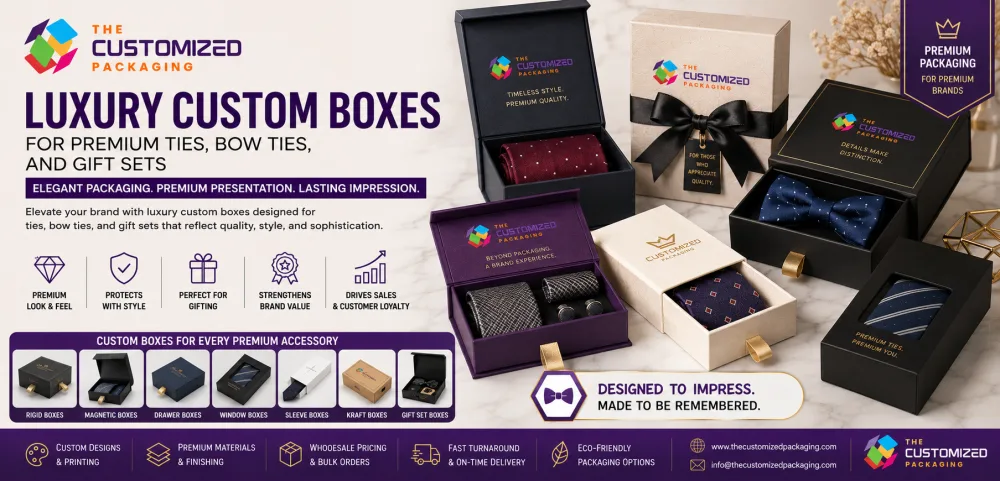
Luxury custom tie boxes can be developed for single neckties, bow ties, pocket squares, cufflinks and complete menswear gift sets. The structure, depth and insert should reflect the contents rather than forcing every accessory into the same generic box.
A successful design begins with the way each product will be folded and presented. Materials and decorative finishes should be selected only after the interior layout has been confirmed.
For more detailed information, read our main pillar blog titled “How Custom Tie Boxes Help Apparel and Fashion Brands Improve Product Presentation.”
Design the Box Around the Product Arrangement
A tie can be folded, lightly rolled or displayed at an angle. A bow tie may arrive pre-tied or self-tie, while a pocket square can be folded into a compact square or displayed in a fan arrangement.
Each presentation changes the required box dimensions.
Before developing custom tie packaging, decide:
-
How the tie will be folded
-
Which side should face the customer
-
Whether the product includes a branded band or tag
-
Whether several accessories will share the box
-
How the customer should remove each item
-
Whether the box will be used for ongoing storage
A structural sample should be tested with the actual products. Measurements taken from an unfolded tie will not establish the correct finished box size.
Match the Interior to the Gift-Set Configuration
The insert should explain the relationship between the items instead of simply filling empty space.
| Gift-set configuration | Practical interior layout |
|---|---|
| Single necktie | Long folded channel, platform or restrained paper band |
| Single bow tie | Compact central recess or paperboard holder |
| Tie and pocket square | Main tie section with a smaller coordinated compartment |
| Tie and cufflinks | Tie platform with two secure accessory cavities |
| Tie, pocket square and cufflinks | Divided presentation tray with a clear visual hierarchy |
| Wedding party set | Repeated compartments or individually packed accessories |
| Corporate gift set | Tie section with space for a card, message or branded accessory |
The tie should remain the visual focus when it is the primary product. Small items such as cufflinks, lapel pins or tie clips should be secure but easy to remove.
A finger notch, ribbon tab or accessible edge can improve removal without requiring the customer to pull directly on delicate fabric.
Select the Structure According to the Presentation Level
Not every tie requires a heavy rigid box. Brands can create different packaging levels across the same collection.
Folding Tie Cartons
Paperboard folding cartons are suitable for retail ties, seasonal collections and higher-volume orders. They can normally be supplied flat, reducing storage requirements before assembly.
A paperboard insert or internal panel can keep the folded tie positioned correctly.
Sleeve-and-Tray Tie Boxes
A sliding sleeve creates a controlled reveal without requiring a fully rigid construction. It can work for individual ties, bow ties and tie-and-pocket-square combinations.
The sleeve can carry collection artwork while the tray remains consistent across several designs.
Two-Piece Rigid Tie Boxes
A lift-off lid and separate base create a traditional gift presentation. This structure is suitable for silk ties, designer neckwear, wedding sets and premium retail collections.
The lid depth should allow smooth opening without becoming so loose that it separates during handling.
Magnetic Tie Gift Boxes
A hinged magnetic box provides a large interior surface for a brand story, styling guide or gift message. It works well for multi-item sets and corporate presentations.
Brands should account for its assembled storage volume and separate shipping protection.
Drawer Tie Boxes
A drawer structure introduces the products gradually and can include a ribbon pull or thumb notch. It is especially suitable for tie and cufflink gift boxes, bow-tie sets and limited-edition accessories.
The loaded tray should slide smoothly without moving unexpectedly.
Keep Ties Neat Without Excessive Compression
A box should support the product’s intended fold, but it should not compress the fabric unnecessarily.
The internal dimensions should account for:
-
Folded tie length and width
-
Fabric thickness
-
Interlining and construction
-
Product bands or tags
-
Tissue or protective wrap
-
Number of stacked products
-
Removal clearance
A thick wool tie may require more depth than a lightweight silk or microfiber tie. A self-tie bow tie also requires a different arrangement from a pre-tied bow tie with an adjustable strap.
Accurate sizing can reduce movement while avoiding creases caused by forcing the product into an undersized carton.
Develop Inserts for Fabric and Accessories Separately
The same insert material may not be suitable for every item inside a gift set.
A tie can often be supported with folded paperboard, tissue or a paper band. Metal accessories such as cufflinks and tie clips require firmer cavities so they do not move against the fabric.
Useful insert directions include:
-
Folded paperboard platforms
-
Divided paperboard trays
-
Fabric-covered rigid inserts
-
EVA or foam cavities for small metal accessories
-
Paper bands for individual ties
-
Separate accessory cards
-
Removable lower compartments
Foam should not be added automatically. A paperboard insert may provide sufficient organization for lightweight products while keeping the material system simpler.
The insert should also allow the product to be packed consistently during larger wholesale runs.
Create a Clear Brand Hierarchy
Tie boxes with logo should identify the brand without making the exterior unnecessarily busy.
A practical information hierarchy may include:
-
Brand logo
-
Collection or product name
-
Fabric or material
-
Product combination
-
Care or styling information
-
Barcode and SKU
The exterior can remain restrained, while product details appear on the base, sleeve, card or printed interior.
For a coordinated menswear range, keep the logo position, typography and information layout consistent across neckties, bow ties, pocket squares and gift sets. Different colors or small graphic devices can distinguish each collection.
Use Keywords and Product Language Naturally
The article should support a broad semantic topic without repeating one exact phrase in every paragraph.
For example:
-
Custom tie boxes describe the general product category.
-
Custom bow tie boxes identify the smaller accessory format.
-
Luxury custom tie boxes indicate premium construction and presentation.
-
Tie gift boxes support gifting searches.
-
Rigid tie boxes identify a structural option.
-
Wedding tie boxes and corporate tie gifts represent specific applications.
-
Wholesale tie boxes address commercial ordering intent.
Using these terms inside relevant explanations is more useful than placing them together in repetitive keyword lists.
Plan Wedding Tie Sets Around the Recipients
Wedding packaging may be created for the groom, groomsmen, family members or the complete wedding party.
The box can contain:
-
Tie or bow tie
-
Pocket square
-
Cufflinks
-
Lapel pin
-
Socks
-
Personalized card
-
Wedding details
Personalization may include the recipient’s name, wedding date, initials or role in the event.
When several boxes are needed, the brand should decide which elements remain standard and which are personalized. A universal printed structure with a personalized sleeve, card or label may be more practical than producing a different box for every person.
Make Corporate Tie Gifts Easy to Customize
Corporate tie gift boxes may be used for employees, executives, clients, conferences, awards or branded uniform programs.
The company logo can appear on the outer box, inner lid, card or accessory compartment. However, the tie brand and corporate identity should not compete for the same visual position.
Before producing a corporate order, confirm:
-
Number of recipients
-
Individual or universal personalization
-
Tie and accessory combinations
-
Brand-color requirements
-
Event date
-
Delivery locations
-
Packing and distribution method
For recurring programs, one approved structure can be retained while sleeves, cards or artwork are changed for individual events.
Add Styling and Care Information Carefully
Custom printed tie boxes provide room for useful information beyond the logo.
A printed card or interior panel can include:
-
Fabric composition
-
Care directions
-
Tie length or width
-
Suggested knot styles
-
Bow-tie instructions
-
Pocket-square folding ideas
-
Coordinating shirt or suit suggestions
-
QR code linking to a styling guide
A QR code should lead to a relevant, maintained destination. It should not replace basic product and care information that customers need without using a phone.
Use Premium Finishes with Restraint
Luxury packaging is not improved by adding every available finish.
A foil logo can emphasize the brand. Debossing can introduce texture, while a printed interior can create contrast after opening. The chosen finish should support the menswear collection rather than overpower the fabric patterns inside.
Options may include:
-
Gold, silver or colored foil
-
Embossing or debossing
-
Matte lamination
-
Soft-touch coating
-
Spot UV
-
Textured paper wraps
-
Interior printing
-
Ribbon pulls
-
Printed sleeves
Dark matte surfaces should be tested for fingerprints and rubbing. Foil and coated wraps should also be reviewed under the lighting used for product photography and retail display.
Separate the Gift Box from Shipping Protection
A luxury presentation box may not be suitable for direct courier handling.
For ecommerce orders, the tie box should normally be placed inside an outer corrugated mailer or shipping carton. This protects the lid, corners, wrap and decorative finishes from labels, dirt and abrasion.
The complete shipping system should be tested for:
-
Movement inside the outer carton
-
Crushing around the rigid box
-
Tray or lid separation
-
Accessory movement
-
Surface rubbing
-
Condition after opening
The retail or gift box presents the product. The shipping layer protects that presentation during transportation.
Order Wholesale Packaging by Structure and Artwork Version
The cost of wholesale tie boxes depends on more than the combined order quantity.
A brand ordering 1,000 boxes may require several sizes, structures or artwork versions. Each variation can affect production setup and pricing.
Prepare:
-
Folded product dimensions
-
Items included in each set
-
Required box structure
-
Insert layout
-
Material preference
-
Exterior and interior printing
-
Logo finish
-
Number of artwork versions
-
Quantity per variation
-
Delivery destination
-
Required date
Most custom box styles begin at 100 units. Brands should provide the quantity for each tie, bow-tie or gift-set version rather than only the total collection volume.
Why Choose The Customized Packaging?
The Customized Packaging develops luxury custom tie boxes for menswear brands, fashion boutiques, wedding suppliers, corporate gifting companies and ecommerce retailers.
Available options include folding cartons, sleeve-and-tray boxes, rigid tie boxes, magnetic gift boxes, drawer packaging, two-piece structures and fitted accessory inserts.
Projects can be developed for individual neckties, custom bow tie boxes, pocket-square sets, cufflink combinations, wedding gifts and corporate collections. Printing options include branded exteriors, coordinated interiors, sleeves, information cards and selected premium finishes.
The final structure can be planned around the actual folded products, preferred presentation and distribution method.
Frequently Asked Questions
Which box style is best for a luxury tie?
Two-piece rigid, magnetic and drawer boxes work well for premium neckties. The correct structure depends on the folded product dimensions, included accessories, desired reveal and budget.
Can one box hold a tie, pocket square and cufflinks?
Yes. A divided insert can hold the tie as the primary product while creating separate positions for the pocket square and cufflinks.
Are bow-tie boxes the same size as tie boxes?
Usually not. Bow ties require a shorter and more compact layout, although gift sets containing additional accessories may need a larger structure.
Can tie boxes be personalized for weddings?
Yes. Names, initials, wedding dates, roles or personal messages can be added through printed sleeves, labels, cards or selected variable-printing methods.
Do rigid tie boxes need an outer shipping carton?
Generally, yes. An outer corrugated package protects the presentation box and its finishes during ecommerce delivery.
Make Every Accessory Part of One Presentation
A luxury tie gift set should not feel like several unrelated products placed inside one large box.
The tie, bow tie, pocket square and small accessories should each have a defined position and a clear relationship to the collection. The box structure controls the reveal, the insert organizes the products and the artwork connects them to the brand.
When these elements are planned together, luxury custom tie boxes can turn premium menswear accessories into organized, gift-ready collections for retail, weddings, corporate programs and ecommerce.