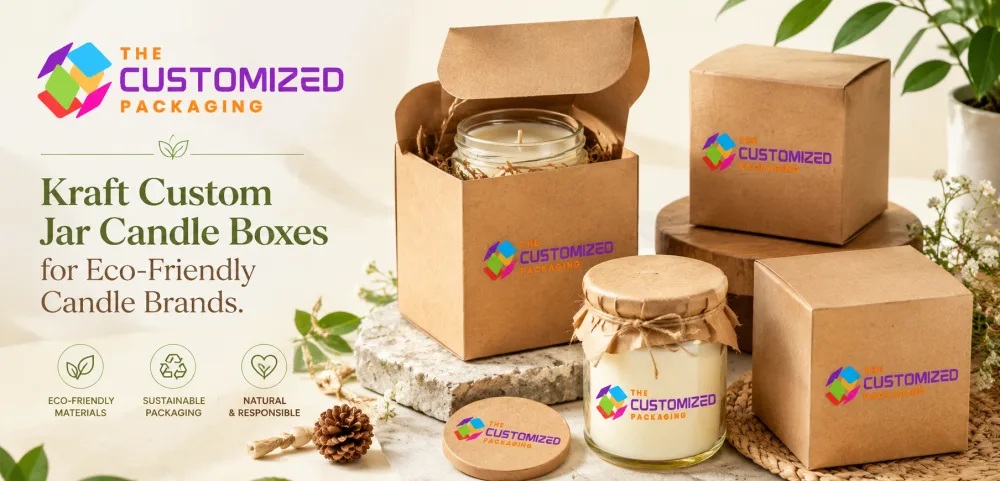
Kraft Custom Jar Candle Boxes for Eco-Friendly Candle Brands
Kraft packaging can support a natural candle brand, but brown paper alone does not prove sustainability. Learn how material choices, sizing, printing and product protection shape the complete package.
 Published June 13, 2026
Updated August 05, 2026
14 min read
Published June 13, 2026
Updated August 05, 2026
14 min read
A natural brown box can immediately suggest simplicity, craft and reduced decoration. That makes kraft packaging appealing to brands selling soy candles, beeswax candles, botanical fragrances and hand-poured collections.
But appearance and environmental performance are not the same thing.
Kraft jar candle boxes may use virgin fibers, recycled content, protective coatings, transparent windows, metallic finishes, adhesives or mixed-material inserts. Each choice affects how the finished package performs, how it should be described and what happens to it after use.
For candle brands, the better question is not simply, “Does kraft look eco-friendly?” It is:
Does the complete packaging system use the right amount of material, protect the candle effectively and support environmental claims that the brand can verify?
Start with the Exact Kraft Material
The word “kraft” is often used as a broad description for any brown paper or paperboard. In practice, several materials can create a similar appearance.
| Material direction | Typical characteristics | Suitable application |
|---|---|---|
| Natural kraft paperboard | Brown surface with visible paper character | Lightweight and medium retail candles |
| Recycled kraft board | Contains verified recovered fiber at a stated percentage | Brands prioritizing documented recycled content |
| Kraft-back paperboard | White printable exterior with a brown reverse side | Artwork needing brighter color reproduction |
| Kraft corrugated board | Fluted structure with stronger transit resistance | Ecommerce mailers and heavier candle vessels |
| Kraft-wrapped rigid board | Thick setup construction covered with kraft paper | Premium gifts and limited collections |
The material should be identified by its specification rather than its color alone.
A box printed to look brown on white paperboard is not the same as an unbleached natural kraft stock. Likewise, a recycled-content claim should state the verified percentage instead of assuming all brown board is recycled.
Brown Paper Does Not Automatically Prove Sustainability
Terms such as “eco-friendly,” “green,” “sustainable” and “environmentally responsible” are broad claims. They can imply more than the brand intends unless they are explained clearly.
The FTC Green Guides advise marketers to make environmental claims that are specific, qualified where necessary and supported by evidence. Recyclable claims may also need qualification when appropriate recycling facilities are not widely available.
Instead of placing a general “eco-friendly packaging” statement on the box, a candle company can communicate a verified feature:
-
“Made with 80% recycled paperboard”
-
“Plastic window removed”
-
“Paper insert replaces foam”
-
“Designed without lamination”
-
“FSC-certified paper available for this production”
-
“Check locally for recycling instructions”
These statements are more informative because they identify the actual packaging decision.
Use Certification Claims Only When the Supply Chain Supports Them
A brand should not place the FSC logo on packaging simply because the selected paper supplier describes its material as responsibly sourced.
FSC Chain of Custody certification verifies the movement of certified forest-based material through the supply chain. Companies manufacturing or labeling products with an FSC on-product claim must follow the applicable certification and trademark requirements.
Before including a certification mark, confirm:
-
The exact paper grade is eligible.
-
The manufacturer can provide the required claim.
-
The order is produced through the appropriate certified chain.
-
The label artwork has been approved where required.
-
Purchase and production records support the claim.
The box can still use kraft paper without certification. The brand should simply avoid printing a certification statement it cannot document.
Right-Sizing Is More Important Than a Natural Color
A large brown carton containing a small candle is not automatically a responsible package.
Oversized packaging uses more board, requires more storage space and can increase the size of the outer shipping carton. It also allows the jar to move unless the empty space is filled with additional material.
Measure the finished candle after the label, lid, dust cover and decorative components are applied.
Record:
-
Maximum vessel width
-
Complete height with the lid
-
Filled product weight
-
Base shape
-
Lid overhang
-
Required insert thickness
-
Comfortable removal clearance
-
Outer shipping requirements
The carton should be compact without pressing against the glass, ceramic vessel, label or lid.
A properly fitted structure can reduce material while improving protection and presentation.
Choose the Structure According to the Candle Weight
Natural paperboard works well for many candle products, but not every vessel should use the same construction.
Folding Kraft Cartons
Folding cartons suit smaller and medium-weight jars intended for retail shelves, markets and boutique displays.
Straight tuck, reverse tuck and auto-lock structures can be selected according to the product weight and packing method. A heavier candle may require a reinforced base rather than a standard friction-lock bottom.
Kraft Sleeves
A printed sleeve can wrap around an inner tray or carton. This approach allows several fragrances to use one main structure while changing only the outer artwork.
Sleeves are useful when the brand wants a restrained presentation but still needs space for fragrance names, care guidance and product details.
Corrugated Kraft Packaging
Corrugated board provides stronger protection for ecommerce orders, subscription deliveries and heavier vessels.
It may serve as the direct shipping package or as an outer layer around a smaller retail carton. The correct flute, board strength and internal clearance should be tested with the filled candle.
Kraft-Wrapped Rigid Boxes
Rigid construction can create a premium gift presentation, but it also uses more material and occupies greater storage volume than a folding carton.
It is better suited to limited releases, ceramic vessels, corporate gifts and collections designed for continued storage than to every standard candle SKU.
Treat Product Protection as Part of Material Efficiency
A lightweight package that allows the candle to break is not an efficient packaging system.
Broken glass, damaged wax, replacement shipments and discarded products can create additional material and transportation requirements. The structure should therefore use enough strength and internal support to help the candle survive its expected handling.
That does not mean using the thickest possible board. It means selecting material according to:
-
Jar weight
-
Vessel fragility
-
Retail or ecommerce use
-
Distance travelled
-
Number of units per shipping case
-
Insert design
-
Outer-carton protection
A physical transit sample provides better guidance than choosing a board solely because it is described as natural or recycled.
Select the Simplest Insert That Protects the Jar
Kraft candle box inserts can keep the vessel centered and reduce contact with the outer walls.
For many products, a folded paperboard platform or corrugated support is sufficient. Molded pulp may suit rounded or unusually shaped vessels, while a heavy ceramic jar may require a stronger engineered support.
| Insert type | Useful application |
|---|---|
| Folded paperboard platform | Lightweight retail candles |
| Corrugated support | Heavier glass jars and delivery orders |
| Molded pulp cavity | Shaped support and natural presentation |
| Wrapped board platform | Premium gifting |
| Foam cavity | Fragile or unusually shaped vessels where required |
Paper-based inserts can support a simpler material system, but they should not be assumed recyclable without checking the coating, adhesive and local collection requirements.
Foam should not be added only to make the box look premium. It should solve a genuine product-protection problem.
Think Carefully Before Adding a Window
A window can reveal the candle label, wax color, lid or vessel finish. It also changes the package construction.
A transparent panel normally adds another material and adhesive. An open die-cut eliminates the film but allows more dust and handling exposure.
The brand should decide what the customer truly needs to see.
A small opening may reveal the candle label while preserving most of the board strength. A full-height window may provide more visibility but reduce branding space and structural support.
Questions to review include:
-
Is product visibility necessary?
-
Is the candle already shown clearly through retail photography?
-
Does the window weaken a weight-bearing panel?
-
Is a transparent film required?
-
Can the film be separated after use?
-
Will glare reduce product visibility?
-
Does the opening create additional packing steps?
Removing an unnecessary window may provide a more meaningful material reduction than printing an environmental message beside it.
Design Artwork for the Natural Brown Surface
Colors behave differently on kraft than on white paperboard.
The brown background can mute pale shades and change the appearance of CMYK artwork. White areas in the digital design will normally show the board color unless white ink is printed underneath.
Effective directions include:
-
Black one-color printing
-
Dark green, navy or burgundy ink
-
White ink for selected details
-
Limited two-color systems
-
Bold line illustrations
-
Debossed logos
-
Small labels for variable information
A botanical design does not need to cover the complete surface. Leaving intentional unprinted areas allows the board texture to become part of the visual identity.
For brands requiring bright pastels, photographic artwork or exact color matching, a white coated board may deliver more reliable results than natural kraft.
Use Finishes Without Undermining the Material Strategy
A kraft box can include foil, coatings, lamination and raised finishes, but every addition should have a purpose.
Debossing can create a tactile logo without covering a large area. A small foil accent may identify a premium collection. A water-based coating may be considered where surface protection is needed.
Heavy plastic lamination can change the package’s feel and may affect how it is handled in local recycling systems. EPA guidance also notes that shiny or laminated paper products may not be accepted in the same way as untreated paper, and consumers should check local recycling rules.
The brand should select finishes according to actual handling requirements rather than applying them because they appear on a general list of premium options.
Put Useful Information Ahead of Green Imagery
Leaves, recycling arrows and earth-tone graphics can make packaging look environmentally focused, but they do not explain the product or package.
A jar-candle carton may need to prioritize:
-
Fragrance name
-
Scent notes
-
Net weight
-
Wax and wick information
-
Candle-care guidance
-
Safety instructions
-
Barcode
-
Batch or product code
-
Website or QR code
-
Verifiable material details
Environmental information should be specific enough to understand.
For example, “Box made with 70% recycled paperboard” provides more value than a generic leaf symbol. A QR code may lead to detailed disposal or refill information, but essential product guidance should remain accessible without scanning it.
Keep the Packaging Story Separate from Candle Claims
Natural-looking packaging should not be used to imply unsupported qualities about the candle itself.
A kraft box does not prove that the wax is natural, the fragrance is non-toxic, the candle is clean-burning or the product has a lower environmental impact.
Claims about soy wax, beeswax, ingredients, burn performance, refillability or production methods should be verified separately from statements about the box.
The packaging design can visually connect these ideas, but the wording should distinguish:
-
What applies to the candle
-
What applies to the jar
-
What applies to the box
-
What applies to the complete order or refill program
This distinction makes the brand’s communication clearer and more trustworthy.
Create a Flexible System for Multiple Fragrances
One verified structure can serve several scents when the jar dimensions remain consistent.
The brand can keep the board, box size, logo location and information hierarchy unchanged while varying:
-
Fragrance name
-
Ink color
-
Label
-
Sleeve
-
Illustration
-
Product code
-
Dust-cover artwork
This reduces the need to develop a different structural format for every seasonal release.
A universal kraft carton with smaller fragrance-specific labels may suit brands launching frequent limited runs. Fully printed versions may be more appropriate when each scent has predictable demand.
The best option depends on order volume, storage space and the number of artwork variations.
Protect Retail Packaging During Ecommerce Delivery
A lightweight retail carton may not provide enough protection for parcel shipping by itself.
For online orders, the candle may require a corrugated outer package with paper cushioning, a fitted insert or another movement-control system.
Test the complete shipment for:
-
Jar movement
-
Pressure on the base
-
Damage to corners
-
Insert displacement
-
Surface rubbing
-
Lid separation
-
Condition after normal courier handling
The retail box communicates the brand. The shipping layer protects the complete presentation until it reaches the customer.
Avoid describing an ecommerce order as plastic-free unless every component—including tape, labels, coatings, pouches and protective materials—supports that claim.
Questions to Ask a Packaging Supplier
Before ordering custom kraft candle boxes, ask for details that can be documented rather than relying only on terms such as natural or green.
Useful questions include:
-
What is the exact paperboard grade?
-
Does it contain verified recycled fiber?
-
What percentage is pre- or post-consumer content?
-
Is FSC-certified material available for this order?
-
Will the box carry an approved certification claim?
-
Which coatings, laminations and adhesives are included?
-
Is the window film removable?
-
Can the insert be made from paperboard or molded pulp?
-
What board strength is recommended for the filled jar?
-
Can a physical sample be tested before production?
The answers should be reflected in the final quotation and production specification.
Planning a Wholesale Order
Pricing for wholesale kraft candle boxes depends on the structure, dimensions, board grade, printing, insert, coatings, artwork variations, quantity and destination.
Prepare:
-
Finished candle dimensions
-
Filled vessel weight
-
Retail or ecommerce use
-
Preferred board specification
-
Required box structure
-
Insert design
-
Printing colors
-
Environmental claims to be supported
-
Number of fragrance versions
-
Quantity for each version
-
Delivery destination
-
Required date
Most custom box styles begin at 100 units. Highly specific materials, certified production, custom wraps or multiple artwork versions may affect the minimum and final price.
Why Choose The Customized Packaging?
The Customized Packaging develops paperboard candle boxes for soy candles, beeswax candles, botanical collections, handmade brands, wellness products and ecommerce businesses.
Available options include folding kraft cartons, sleeves, corrugated mailers, rigid presentation boxes, paperboard supports, molded pulp inserts, windows, custom printing and selected certified material choices.
The structure can be developed around the actual jar, product weight, sales channel and branding system. Material and environmental statements should be confirmed against the final production specification before they are printed.
Standard production generally takes 3–5 business days after structural and artwork approval, with rush production usually taking 2–4 business days when our team confirms it.
Frequently Asked Questions
Are all brown candle boxes made from recycled paper?
No. A brown appearance does not confirm recycled content. Request the exact board specification and verified percentage before making a recycled-material claim.
Can kraft candle packaging be recycled?
Many paperboard packages enter paper recycling streams, but coatings, windows, adhesives and local program rules can affect acceptance. Disposal claims should reflect the completed package and the market where it is sold.
Is FSC-certified kraft paper available?
It may be available for selected projects, but the material, manufacturer and production chain must meet the applicable certification and labeling requirements.
Does an eco-focused candle box need to be plain?
No. Kraft can support printing, white ink, debossing, foil accents and custom structures. The design should use finishes selectively and describe the materials accurately.
Which kraft structure is best for a heavy glass candle?
A reinforced folding carton, corrugated structure or rigid presentation box may be appropriate depending on the vessel weight and shipping method. The finished package should be tested with the actual candle.
Let Verified Choices Tell the Sustainability Story
Natural brown paper can support an honest, understated candle brand, but it should not carry the complete environmental message by itself.
The strongest natural candle packaging uses a material specification the brand understands, dimensions fitted to the vessel, enough strength to prevent damage and finishes selected for a defined purpose.
When those choices are documented and communicated accurately, kraft packaging can become more than an earthy visual style. It can become a practical part of a clearer and more credible packaging strategy.