
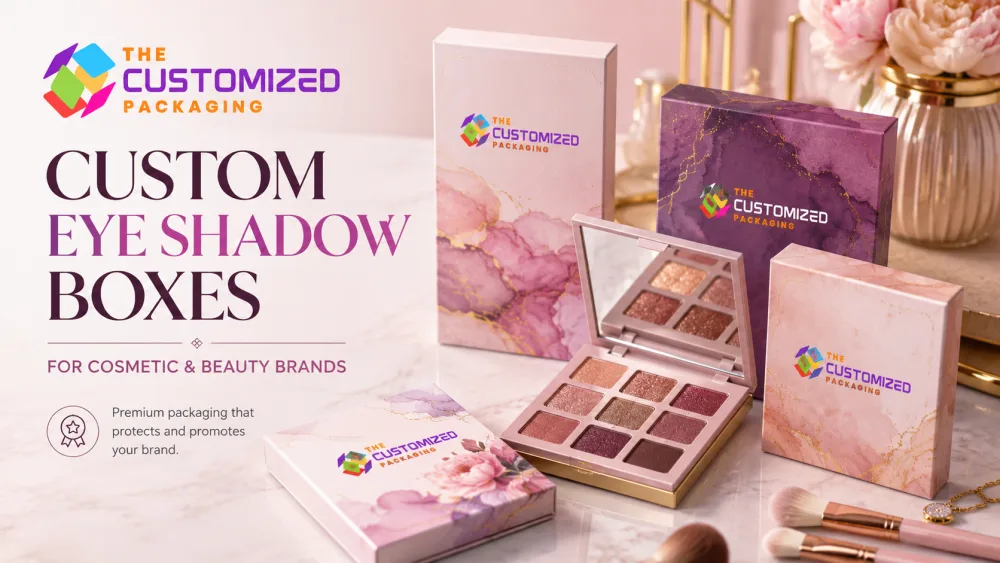
How to Choose Eye Shadow Packaging for Palettes and Pans
Eye shadow packaging should be designed around the finished pan, compact, palette or pigment container. Compare dimensions, movement control, carton structures, support, labeling space and retail or ecommerce requirements before finalizing the box.
 Published June 02, 2026
Updated September 08, 2026
13 min read
Published June 02, 2026
Updated September 08, 2026
13 min read
Eye shadow packaging should be designed around the finished pan, compact, palette or pigment container. Pressed powders can be sensitive to impact, while mirrors, hinges, decorative compact surfaces and loose-pigment containers create different fit and handling requirements.
A practical selection sequence is:
product format → finished dimensions → packed weight → fragility → carton structure → support → labeling space → sales channel → physical test
Brands ready to specify the finished carton can develop custom eye shadow boxes around the actual product dimensions, artwork and distribution requirements.
Start With the Eye Shadow Format
“Eye shadow” can describe several different physical products.
Packaging requirements can change significantly between:
-
Single pressed pans
-
Small compacts
-
Multi-pan palettes
-
Loose pigment jars
-
Cream shadow pots
-
Liquid eye shadow tubes
-
Eye shadow kits with applicators
The box should therefore be designed around the finished cosmetic product rather than a generic eye-shadow box size.
Separate the Primary Package From the Outer Carton
The primary package directly contains or holds the cosmetic.
Examples include:
-
Compact
-
Palette
-
Pigment jar
-
Pot
-
Tube
The secondary carton surrounds that finished primary package.
Its jobs may include:
-
Product identification
-
Additional structural support
-
Surface protection
-
Printed information
-
Retail presentation
-
Barcode placement
-
Tamper-evident components where specifically designed
The carton should not be expected to perform the same product-contact or sealing function as the primary cosmetic container.
Measure the Finished Product
Measure the actual closed product after every component has been assembled.
Record:
-
Maximum length
-
Maximum width
-
Overall height
-
Hinge projection
-
Lid projection
-
Decorative outer features
-
Label thickness
-
Applicator location
-
Filled weight
For a palette, measure the closed compact rather than the individual pans inside it.
For jars or pots, include the lid.
For liquid eye shadow, measure the complete tube and cap.
Match the Carton to the Product Format
| Eye shadow format | Main packaging consideration | Practical starting point |
|---|---|---|
| Single pan | Small size and compact fit | Folding carton or sleeve |
| Compact | Surface protection and fit | Tuck carton |
| Multi-pan palette | Wider footprint and movement control | Folding carton or supported sleeve |
| Heavy premium palette | Weight and presentation | Reinforced carton or presentation structure |
| Loose pigment jar | Upright fit and lid clearance | Small tuck carton |
| Cream shadow pot | Container fit | Folding carton |
| Liquid shadow tube | Length and cap clearance | Slim tuck carton |
| Palette + applicator | Component separation | Carton with divider where needed |
These are starting points.
The finished structure should always be tested with the real product.
Pressed Powders Need Movement Control
Pressed eye shadow can crack or crumble when the primary palette experiences enough impact.
The secondary carton cannot eliminate every impact, but correct fit can reduce unnecessary movement around the compact.
Check:
-
Side clearance
-
Top and bottom clearance
-
Palette movement
-
Hinge position
-
Lid position
-
Orientation
An oversized carton can allow the palette to move repeatedly inside the package.
An excessively tight carton can make packing difficult or put pressure on the compact.
Do Not Assume Every Palette Needs an Insert
Some eye shadow compacts fit securely inside a correctly sized folding carton without an additional insert.
Support becomes more useful when:
-
The palette moves excessively
-
A heavy compact needs positioning
-
An applicator must remain separate
-
A presentation structure needs elevation
-
Several components share one box
Possible options include:
-
Folded paperboard collar
-
Paperboard platform
-
Divider
-
Product well
-
Tray
Use the simplest structure that solves the actual fit problem.
Protect Mirrors Through the Primary Package First
Some eye shadow palettes include mirrors.
The mirror is normally protected primarily by the compact or palette itself.
Secondary packaging should therefore focus on:
-
Controlling movement
-
Protecting the compact exterior
-
Providing suitable clearance
-
Supporting the complete closed palette
Do not assume adding a large amount of empty space around the palette improves mirror protection.
Excess movement can create its own problems.
Keep Hinge Clearance in Mind
A compact or palette hinge may extend beyond the main body.
If the carton is sized only from the central body dimensions, the hinge area may:
-
Rub against the wall
-
Catch during packing
-
Distort the carton
-
Create an uneven fit
Measure the widest finished point.
Choose a Structure That Matches the Product
Tuck-End Folding Cartons
Useful for:
-
Individual shadows
-
Compacts
-
Small palettes
-
Pigment jars
-
Cream shadow pots
They provide multiple printable panels and can normally be stored flat before filling.
Sleeve Packaging
A sleeve can work around a compact or palette when only limited secondary structure is required.
The product should not slide out unintentionally.
Sleeve-and-Tray Packaging
A tray adds more controlled positioning and can suit:
-
Premium palettes
-
Sets
-
Product-and-applicator combinations
Two-Piece Boxes
A lid-and-base structure can be used for gift-oriented or presentation-focused makeup products.
Rigid Packaging
Rigid structures can suit selected high-value collections, PR sets and premium palettes.
They are not automatically necessary for an expensive eye shadow product.
For deeper decisions about structure, opening sequence and tactile presentation, see the premium eye shadow packaging resource.
Match Material to Product Weight
Folding paperboard works for many eye shadow cartons.
The required board should be selected according to:
-
Product dimensions
-
Packed weight
-
Box structure
-
Opening size
-
Insert
-
Retail handling
-
Distribution method
A small single-pan product does not need the same board specification as a large weighted palette.
Larger or heavier sets may require stronger paperboard or a different structure.
Right-Size the Secondary Carton
Too much empty space can:
-
Increase movement
-
Increase material use
-
Increase shipping volume
-
Require unnecessary filler
-
Make a compact product look lost inside the box
Too little space can:
-
Rub printed compact surfaces
-
Press against hinges
-
Cause carton bulging
-
Slow packing
-
Make removal difficult
The target is controlled clearance rather than maximum tightness.
Decide Whether a Secondary Carton Is Needed
Some eye shadow palettes already use a substantial primary compact.
A separate carton may still provide value when it has a clear job, such as:
-
Additional labeling space
-
Retail presentation
-
Barcode placement
-
Surface protection
-
Product-family organization
-
Bundling
-
Tamper-evident design
-
Gift presentation
If the additional box does not solve a functional, informational or merchandising problem, the brand can reconsider whether the layer is necessary.
Brands specifically evaluating material use can review reduced-material eye shadow packaging.
Plan Windows Carefully
A window can expose part of the palette or compact.
Before adding one, ask:
-
What does the customer need to see?
-
Does the primary package already show the shades?
-
Will the window reduce usable labeling space?
-
Does it weaken a narrow carton panel?
-
Is clear film required?
-
Does the window align consistently with the product?
An oversized window can reduce structural area without adding useful product information.
Separate Retail Packaging From Parcel Shipping
An eye shadow carton designed for the retail shelf does not automatically become a suitable shipping container.
For ecommerce, the complete system may be:
eye shadow palette → secondary carton → protective parcel mailer
or:
eye shadow palette → secondary carton → corrugated shipper
depending on fragility and order configuration.
Pressed-powder products should be evaluated in the complete shipment, not only inside the retail carton.
Test Ecommerce Packaging With the Real Palette
Check:
-
Product movement
-
Compact movement
-
Carton crushing
-
Surface scuffing
-
Secondary-box opening
-
Outer-shipping protection
-
Multi-product collisions
A visually attractive retail box is not sufficient evidence that the complete order can tolerate parcel distribution.
Give the Front Panel a Clear Hierarchy
The customer should be able to identify the product quickly.
A useful hierarchy may include:
-
Brand
-
Product identity
-
Palette or collection name
-
Shade information where relevant
-
Net quantity or other applicable information
Secondary panels can carry additional approved content.
Avoid filling the front panel with every shade name, product benefit and promotional statement when those details can be organized elsewhere.
Leave Space for Cosmetic Labeling
Eye shadow is regulated as a cosmetic in the United States.
The responsible cosmetic company should determine the labeling requirements that apply to its product before carton artwork is approved.
Depending on the product and configuration, the package may need space for information such as:
-
Product identity
-
Net quantity
-
Ingredient declaration
-
Business information
-
Directions
-
Warnings
-
Batch or traceability information
-
Barcode
-
Other required or useful statements
Required information should remain readable rather than being treated as an afterthought after the decorative artwork is complete.
Eye-Area Color Additives Need Special Attention
Eye shadow is applied in the eye area.
Color additives used in an eye-area cosmetic must be permitted for that specific use under applicable U.S. requirements.
A color that is permitted in another cosmetic application is not automatically permitted around the eye.
The formula owner or responsible cosmetic business should verify ingredient and color-additive compliance.
The packaging supplier's role is to provide enough usable space for the approved ingredient and product information.
Keep Cosmetic Claims Separate From Packaging Claims
Packaging can organize information clearly, but it does not substantiate product-performance claims.
Statements about:
-
Long wear
-
Waterproof performance
-
Hypoallergenic properties
-
Sensitive-eye suitability
-
Clinical testing
-
Ophthalmologist testing
-
Vegan status
-
Cruelty-free status
should be supplied and approved by the responsible cosmetic company where appropriate.
The carton should communicate approved claims accurately rather than create stronger claims simply to fill the artwork.
Do Not Describe Ordinary Cosmetics as FDA Approved
Cosmetic products generally do not receive FDA premarket approval, although color additives are subject to specific approval requirements.
Avoid creating packaging artwork that incorrectly presents an ordinary eye shadow product as FDA approved.
Regulatory wording should reflect the actual status of the product and ingredients.
Use Product-Family Design Without Hiding Variants
Eye shadow often comes in multiple palettes and collections.
A useful family system might keep:
-
Logo position
-
Typography
-
Structure
-
Information hierarchy
consistent while changing:
-
Collection color
-
Palette name
-
Shade identifier
-
Secondary artwork
For example:
same structure + same typography + different collection color
This creates recognition without forcing every SKU to look identical.
Deeper artwork, printing and finish decisions belong in the printed eye shadow packaging resource.
Use Printing to Communicate, Not Just Decorate
Printing may need to communicate:
-
Product name
-
Palette title
-
Shade collection
-
Ingredient information
-
Directions
-
Warnings
-
Brand information
-
Barcode
-
QR code
Decorative printing should not make important information difficult to read.
Very small type, low-contrast colors and reflective finishes can reduce legibility.
Choose Finishes Selectively
Available treatments can include:
-
Matte coating
-
Gloss coating
-
Soft-touch treatment
-
Foil
-
Embossing
-
Debossing
-
Spot UV
-
Holographic effects
Eye shadow packaging does not automatically need metallic or holographic finishes simply because the product contains shimmer or glitter.
Use finishes when they support the intended product positioning.
Consider Shade Accuracy Separately From Carton Color
Printed packaging can communicate a collection theme, but the carton should not be assumed to reproduce the exact appearance of the cosmetic powder.
Color can vary between:
-
Printed board
-
Screen display
-
Cosmetic pan
-
Lighting environments
Where exact shade identification matters, use approved shade names or codes in addition to decorative artwork.
Make QR Codes Useful
A QR code may lead to:
-
Shade swatches
-
Tutorials
-
Application instructions
-
Ingredient information
-
Product page
-
Reorder page
The destination should provide a clear purpose.
A QR code should not automatically replace information that needs to remain physically printed on the package.
Match Premium Packaging to the Product
A higher-priced palette does not automatically require rigid packaging.
Premium presentation can also come from:
-
Accurate fit
-
Consistent printing
-
Controlled opening
-
Good paper selection
-
Restrained foil
-
Precise embossing
-
Well-designed tray
-
Clean typography
Use more complex structures when they add a real presentation or protection function.
Consider Material Reduction Separately
A kraft appearance does not automatically make packaging environmentally preferable.
The complete package may contain:
-
Coatings
-
Laminates
-
Window film
-
Foils
-
Adhesives
-
Inserts
-
Magnets
-
Other components
Environmental statements should reflect the finished construction and realistic recovery options.
For a deeper analysis of right-sizing, unnecessary inserts and secondary-layer reduction, see reduced-material eye shadow packaging.
Plan Procurement After the Specification Is Stable
Before comparing production pricing, establish:
-
Finished dimensions
-
Structure
-
Material
-
Insert
-
Printing
-
Finishes
-
Artwork versions
-
Quantity
-
Delivery destination
Comparing quotes for two different structural specifications does not give a useful unit-cost comparison.
Brands planning larger production runs can use the eye shadow packaging procurement guide for quantity planning and quote comparison.
Test the Finished Eye Shadow Package
A physical sample should be checked with the real product.
Evaluate:
-
Product fit
-
Compact clearance
-
Hinge clearance
-
Movement
-
Insert position
-
Carton closure
-
Opening
-
Product removal
-
Window alignment
-
Label readability
-
Barcode scanning
-
Print alignment
-
Finish placement
For ecommerce, also test the complete outer-shipping configuration.
Eye Shadow Packaging Decision Table
| Decision | Main question |
|---|---|
| Product format | Pan, compact, palette, pigment, pot or tube? |
| Dimensions | What are the maximum finished outside dimensions? |
| Fragility | Is the product a pressed powder or mirrored palette? |
| Movement | Does the closed primary package shift inside the carton? |
| Structure | What carton style fits the product and channel? |
| Support | Is an insert actually required? |
| Labeling | Is enough readable panel space available? |
| Window | Does product visibility add useful information? |
| Retail | Can the customer identify the palette quickly? |
| Ecommerce | What additional parcel protection is needed? |
Information to Prepare Before Ordering
Have these details ready:
-
Product format
-
Closed product dimensions
-
Packed weight
-
Palette or container material
-
Number of pans where relevant
-
Mirror or applicator details
-
Preferred box structure
-
Insert requirements
-
Window requirements
-
Artwork
-
Required labeling copy
-
Quantity
-
Sales channel
-
Delivery destination
Clear specifications make structural recommendations and pricing more accurate.
Frequently Asked Questions
What is the best packaging for an eye shadow palette?
The best structure depends on the palette's dimensions, weight, primary compact and distribution method. Many palettes work with correctly sized folding cartons, while heavier or presentation-focused products may need additional support or a different structure.
Do eye shadow palettes need inserts?
Not always. An insert is useful when it solves a specific problem such as excessive movement, component separation or presentation positioning.
How should an eye shadow palette be measured?
Measure the closed finished palette at its maximum length, width and height, including hinges, projections and decorative components.
Can an eye shadow box prevent pressed powders from breaking?
Secondary packaging can help reduce unnecessary movement and provide additional protection, but breakage risk also depends on the primary compact, formula, handling and complete shipping system.
Does every eye shadow product need an outer carton?
No. A secondary carton should have a defined structural, informational, merchandising or presentation purpose.
Are eye shadow color additives regulated differently?
Color additives used around the eye must be permitted for eye-area use under applicable U.S. requirements. The responsible cosmetic company should verify the formula and approved ingredient information.
Can an eye shadow carton be used as the shipping box?
Not automatically. Retail cartons and parcel shippers perform different functions. Ecommerce configurations should be tested as a complete system.
Are kraft eye shadow boxes automatically sustainable?
No. Environmental performance depends on the complete packaging construction, not only its brown-paper appearance.
Do luxury eye shadow palettes need rigid boxes?
No. Folding cartons, sleeves and tray structures can also provide premium presentation when they are correctly fitted and well designed.
Choose the Packaging Around the Finished Eye Shadow Product
Effective eye shadow packaging begins with the actual product format.
Measure the finished compact, palette, pan or pigment container, identify its movement and handling risks, then choose the structure and support around those requirements.
After the package fits and functions correctly, organize the approved product information, artwork and finishes around the available panels.
The Customized Packaging can develop eye shadow packaging around your product dimensions, structure, artwork and production requirements. Once the specification is established, you can also estimate custom packaging cost before requesting final pricing.