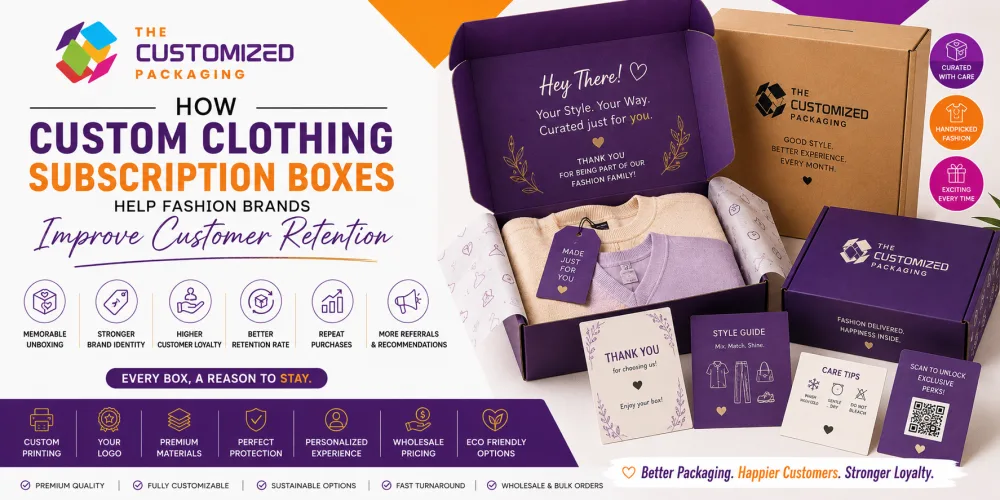
How Custom Clothing Subscription Boxes Help Fashion Brands Improve Customer Retention
Attractive packaging may improve the first impression, but long-term fashion subscription retention depends on fit, relevance, returns and reliable delivery. Learn where the box can genuinely help.
 Published June 06, 2026
Updated August 05, 2026
15 min read
A customer may enjoy opening the first clothing subscription delivery and still cancel before the next one.
The box can create a strong first impression, but long-term retention depends on whether the clothing fits, suits the subscriber’s preferences, arrives consistently and can be exchanged or returned without unnecessary effort.
Custom clothing subscription boxes can support that experience by keeping garments organized, reinforcing the brand and making recurring fulfillment easier. They cannot compensate for irrelevant selections, incorrect sizing, confusing billing or difficult cancellation.
The most useful subscription package is not necessarily the most decorative. It is the one that works repeatedly for the customer, fulfillment team and business.
Packaging Supports Retention; It Does Not Create It Alone
Subscription retention is influenced by several connected factors:
| Retention factor | Packaging’s possible role |
|---|---|
| Product relevance | Present the selected pieces clearly and explain why they were chosen |
| Correct sizing | Display size and fit information without creating packing confusion |
| Delivery condition | Protect garments from dirt, moisture and excessive movement |
| Personalization | Carry customer-specific styling or outfit guidance |
| Returns and exchanges | Make the package practical to reseal and send back |
| Consistency | Deliver a recognizable experience across recurring shipments |
| Perceived value | Organize the items and communicate what is included |
| Customer control | Direct subscribers to preference, pause, exchange or account tools |
| Operational accuracy | Help staff identify the right box, plan or customer segment |
A beautifully printed carton may support satisfaction, but the business should not assume that a packaging update directly reduced churn unless subscriber behavior and related metrics confirm it.
Design for the Second and Sixth Delivery, Not Only the First
Many subscription boxes are designed to make the first shipment dramatic. That approach can become expensive or repetitive when the same customer receives a package every month.
The first delivery may justify a stronger onboarding message, welcome guide or introductory styling card. Later shipments should remain recognizable while providing something relevant to that specific delivery.
A practical lifecycle may look like this:
| Delivery stage | Packaging focus |
|---|---|
| First box | Welcome, account guidance and explanation of the subscription |
| Second box | Preference feedback and fit confirmation |
| Ongoing deliveries | Efficient presentation, styling value and consistency |
| Seasonal box | Collection theme or weather-specific guidance |
| Anniversary delivery | Recognition, loyalty benefit or personalized message |
| Win-back shipment | Clear reason to reconsider the service |
The structural box does not need to change every month. Printed cards, labels, tissue, sleeves or digital content can create controlled variation without producing a new carton for every shipment.
Start with the Subscription Model
Different fashion subscriptions require different packaging systems.
Curated Purchase Boxes
The customer keeps and pays for selected clothing. Packaging should support a gift-like reveal while remaining efficient for recurring shipping.
Try-On-and-Return Services
The customer returns unwanted products. The outer mailer needs to survive opening and support a second shipment. Return instructions and resealing must be planned from the beginning.
Rental Subscriptions
Garments move repeatedly between the brand and customer. The package may need greater durability, simple garment organization and a clear process for return preparation.
Membership Drops
Members receive limited products, accessories or seasonal releases. The package may emphasize collection identity and exclusivity while controlling artwork changes between drops.
Replenishment Subscriptions
Products such as socks, underwear, basics or activewear arrive at regular intervals. Compact sizing, low packing complexity and predictable cost may matter more than elaborate presentation.
The packaging brief should identify the actual model before choosing a structure.
Match the Box to the Typical Order
A subscription may include one folded shirt one month and several bulky garments the next. Using one large box for every order can create excessive empty space, movement and filler.
Review historical or forecast order combinations and group them into a manageable set of packaging sizes.
For example:
-
Small accessory or basics order
-
Standard one-to-three garment delivery
-
Bulky knitwear or hoodie shipment
-
Footwear and clothing combination
-
Premium or gift subscription
-
Return-heavy try-on shipment
Each size should fit a meaningful percentage of orders. Too many box sizes can make fulfillment and inventory harder, while one oversized format can increase material use and shipping volume.
Measure Clothing in Its Packed Form
The package should be based on the garments after they are folded, wrapped and grouped—not their unfolded dimensions.
Record:
-
Folded length and width
-
Packed thickness
-
Number of garments
-
Garment weight
-
Product tags
-
Protective bags or wraps
-
Styling materials
-
Required return documents
-
Necessary movement clearance
A padded bra, structured jacket and knitted sweater behave differently inside a box. Soft clothing can be compressed, but excessive pressure may create creasing, damage decorative elements or make the order appear carelessly packed.
The final box should close without forcing the lid or creating visible bulging.
Use Garment Organization to Reduce Fulfillment Errors
Subscription orders frequently vary by customer, size, style profile and plan. Packaging should help staff confirm that the correct products are entering the correct box.
Possible controls include:
-
Packing slips with customer identifiers
-
Size and product checks before wrapping
-
Clearly separated accessories
-
Color-coded internal labels
-
Printed pick sequences
-
Scannable order references
-
Defined positions for documents and return materials
The outside of the shipping package should not reveal sensitive style, sizing or intimate-apparel information unnecessarily.
The box cannot prevent every fulfillment mistake, but a repeatable internal arrangement can make missing or incorrect items easier to notice before sealing.
Personalization Should Provide Practical Value
Adding a customer’s name to a card does not automatically make the subscription feel meaningfully personalized.
Useful personalization may explain:
-
Why particular garments were selected
-
How the items can be worn together
-
Which previous purchase they complement
-
Fabric and care details
-
Alternative styling options
-
How to update size or preferences
-
How to rate the selection
A styling card can remain concise and direct. A QR code may lead to a customer-specific outfit page, feedback form or preference center.
The destination should be useful and accessible throughout the delivery cycle. Avoid using a QR code only to send every customer to the brand homepage.
Make Fit Feedback Easy to Provide
Fit is central to clothing satisfaction.
Packaging can direct the subscriber to provide structured feedback about:
-
Size
-
Length
-
Cut
-
Fabric feel
-
Color
-
Style preference
-
Occasion
-
Items kept or returned
The feedback system should live in the customer account, app or another suitable digital tool. The box or styling card can provide a clear route to it.
A customer should not need to search through marketing material to report that an item was too large or request a different size.
Brands can use repeated feedback to improve future curation, but the packaging should not promise personalization the company’s systems cannot actually deliver.
Design Returns Before Designing the Reveal
Return usability is one of the clearest functional differences between a normal ecommerce box and some apparel subscription boxes.
A return-ready structure may include:
-
A second adhesive strip
-
A reusable tuck or lock
-
A tear-open section that does not destroy the box
-
Clear resealing guidance
-
Space for a return label
-
Enough strength for a second journey
-
A place for the return document
-
Instructions for folding and repacking garments
The package should remain practical after the customer has removed the original tape or opening strip.
Forcing subscribers to find their own carton or tape can add unnecessary friction to an exchange or try-on service.
Keep Return Instructions Separate from Retention Pressure
The package can explain how to keep, exchange or return products. It should not make cancellation or returns intentionally difficult.
Subscription businesses should communicate recurring charges, renewal terms and cancellation conditions clearly through their signup and account processes. As of 2026, the FTC continues to examine negative-option practices and emphasizes concerns about unclear enrollment, recurring billing and obstructive cancellation.
Packaging may include a concise account-management link or QR code, but it should not be the only place where important subscription terms appear.
Trust is better supported by clear customer control than by hiding cancellation information behind a decorative unboxing experience.
Choose the Structure According to the Delivery System
Corrugated Mailer Boxes
Custom subscription mailer boxes work well for many direct-to-consumer apparel programs. They can combine transit strength, branding and an organized opening in one structure.
The board grade should match the packed weight and shipping route.
Regular Slotted Shipping Cartons
Traditional shipping cartons may be more practical for variable order sizes, bulky garments and return-heavy programs. Branding can appear through tape, labels, internal print or the garment presentation inside.
Folding Apparel Cartons
A folding carton can present one garment or a small curated set, but it may require an outer shipping layer for parcel delivery.
Rigid Presentation Boxes
Rigid boxes may suit luxury memberships, annual gifts or high-value accessories. They are rarely the most efficient choice for every recurring shipment because they occupy more storage space and normally require separate shipping protection.
The structure should reflect the subscription economics rather than the desire to make every delivery feel like a one-time luxury gift.
Protect Clothing Without Overpackaging It
Soft garments do not normally require foam inserts or heavily engineered cavities.
Useful supporting components may include:
-
Tissue paper
-
Paper bands
-
Garment sleeves
-
Dividers for accessories
-
Paperboard platforms
-
Protective pouches
-
Corrugated separation for footwear or hard goods
Each layer should solve a specific problem.
Tissue may reduce surface rubbing and organize the reveal. A divider can prevent a metal accessory from contacting delicate fabric. A protective inner bag may reduce moisture or dirt exposure where suitable.
Adding several layers simply to create a longer unboxing sequence can increase packing time, material use and customer frustration.
Plan Privacy for Intimate or Personal Products
Subscriptions may contain lingerie, underwear, shapewear, maternity garments or other personal items.
The external shipping package can remain discreet, with stronger branding placed inside. Product names, sizes or subscription categories should not appear prominently on the outer surface unless the customer expects that experience.
Privacy considerations may also affect:
-
Shipping labels
-
Return labels
-
Printed order descriptions
-
Exterior illustrations
-
Box messaging
-
Delivery notifications
A tasteful internal presentation can still feel branded without announcing the contents to everyone who sees the parcel.
Keep the Brand Recognizable Without Repeating the Same Message
Clothing boxes with logo can make recurring deliveries easier to recognize, but the same large logo and slogan on every panel can become monotonous.
Consistency can come from:
-
Logo location
-
Typography
-
Color palette
-
Illustration style
-
Interior layout
-
Opening direction
-
Styling-card format
-
Garment-folding standard
Seasonal variation can then appear through one controlled element, such as the inside print, a paper sleeve or a collection card.
The customer should recognize the subscription immediately while still receiving information relevant to that delivery.
Use Seasonal Artwork Without Creating Obsolete Inventory
Fashion subscriptions may change with weather, holidays, product drops and annual collections.
Printing completely different boxes for every season can leave unused packaging after the campaign ends.
A more flexible system may use:
-
One permanent printed mailer
-
Seasonal tissue
-
Collection-specific cards
-
Removable sleeves
-
Printed labels
-
Limited-edition stickers
-
Inside messages
-
Reusable inserts
The structural package should remain suitable for the product range. Seasonal elements can change without affecting box dimensions or shipping performance.
Forecast each artwork variation separately instead of relying only on the combined annual subscription volume.
Avoid Automatic Sustainability Claims
A kraft-colored box is not automatically sustainable, recyclable or environmentally preferable.
The completed package may include coatings, adhesives, tape, labels, tissue, garment bags, laminations and mixed-material components.
More useful environmental communication identifies a verified feature:
-
Stated recycled-content percentage
-
Certified paper used for the order
-
Reduced external dimensions
-
Reusable return construction
-
Plastic insert replaced with paperboard
-
Instructions for separating components
-
Reduced number of packaging layers
The package should also protect the garments adequately. Damaged clothing, replacements and second shipments can undermine material reductions achieved by using a lighter box.
Control Packaging Cost Across Repeated Deliveries
A packaging feature that appears affordable on one order can become expensive when repeated monthly across thousands of subscribers.
Calculate the complete cost, including:
-
Box
-
Printing
-
Tissue
-
Card
-
Labels
-
Return features
-
Assembly labor
-
Storage
-
Outer protection
-
Obsolete seasonal stock
-
Shipping dimensions
-
Damaged packaging
A small increase per shipment can become significant across a full subscriber base.
This does not mean recurring packaging should always be plain. It means each component must create enough operational or customer value to justify its repeated cost.
Align Packaging Inventory with Subscription Forecasts
Subscription fulfillment often involves several customer stages, box sizes and printed variations. This can create more packaging inventory complexity than a standard ecommerce order.
Shopify’s subscription-fulfillment guidance notes that businesses using different packaging for customer stages must identify the correct assets for each order and monitor inventory across those versions.
Track:
-
Active subscribers by plan
-
Expected renewals
-
Cancellation and pause rates
-
Box usage by size
-
First-box versus recurring-box inventory
-
Seasonal variations
-
Damaged packaging
-
Lead time
-
Reserve stock
-
Planned design changes
Do not order every version based only on the total subscriber count. Each box or printed component should have its own forecast.
Measure Packaging’s Contribution to Retention
Packaging performance should be connected to specific customer and operational metrics.
| Metric | What it may reveal |
|---|---|
| Damage complaints | Whether garments are adequately protected |
| Incorrect-item rate | Whether fulfillment controls are working |
| Size-exchange rate | Whether fit selection needs improvement |
| Return completion time | Whether the return package is easy to use |
| Packing time | Whether the structure supports efficient fulfillment |
| QR-code engagement | Whether customers use styling or feedback content |
| Packaging complaints | Whether the box creates waste or opening frustration |
| Renewal rate | Whether subscribers continue after receiving the package |
| Churn by delivery number | When customers are most likely to cancel |
| Packaging cost per retained subscriber | Whether the investment is financially useful |
Packaging should not receive full credit for retention changes. Product relevance, sizing, price, billing, service and delivery speed also influence subscription behavior.
The strongest evidence comes when packaging-specific problems improve alongside customer metrics.
Test a Complete Subscription Cycle
One attractive sample does not show how the packaging performs over several deliveries.
Run a pilot that includes:
-
First-time shipment
-
Standard recurring order
-
Bulky seasonal delivery
-
Return or exchange
-
Repacked return shipment
-
Customer feedback collection
-
Fulfillment-team review
Observe how the box looks, packs, opens, reseals and returns.
A structure that performs well for the first delivery may become inconvenient when reused, while a seasonal design may not fit heavier winter garments.
Testing the cycle provides more useful information than approving one empty printed mockup.
Prepare a Complete Packaging Brief
For accurate pricing, provide:
-
Subscription model
-
Common garment types
-
Typical products per shipment
-
Folded dimensions and weight
-
Box sizes required
-
Return or exchange needs
-
Privacy requirements
-
Exterior and interior artwork
-
First-box and recurring-box differences
-
Seasonal variations
-
Printed cards or labels
-
Monthly quantity by version
-
Delivery destination
-
Required production date
Most custom packaging styles begin at 100 units. The final price depends on dimensions, board strength, printing, components, order volume and destination.
Why Choose The Customized Packaging?
The Customized Packaging develops fashion subscription packaging for boutique clothing services, personal-styling programs, activewear memberships, basics subscriptions, streetwear drops, baby-apparel plans and premium fashion clubs.
Available options include corrugated mailers, shipping cartons, folding apparel boxes, return-ready structures, branded interiors, tissue, paperboard dividers and selected premium presentation formats.
Packaging can be planned around typical order combinations, subscriber stages, privacy requirements and return workflows.
Standard production generally takes 8–12 business days after structural and artwork approval, with rush service available for eligible projects.
Frequently Asked Questions
Can packaging reduce clothing subscription cancellations?
It may support retention by improving delivery condition, organization, returns and brand consistency. It cannot overcome poor fit, irrelevant product selection, pricing problems or difficult account management.
Which box is best for an apparel subscription?
Corrugated mailers work well for many recurring apparel deliveries. Traditional shipping cartons may be better for variable or bulky orders, while rigid boxes are generally better reserved for premium or special shipments.
Should the first subscription box differ from later deliveries?
It can. The first box may include onboarding and account guidance, while recurring shipments can use a simpler structure with delivery-specific styling or product information.
How can clothing subscription packaging support returns?
Use a structure that remains intact after opening, provides a second closure or resealing method and includes clear instructions for repacking and applying the return label.
Do soft garments need custom inserts?
Usually not. Tissue, paper bands, dividers or protective inner wraps are often sufficient. Inserts are more useful when the shipment includes footwear, accessories or structured products.
What should a fashion subscription brand measure?
Track damage, fulfillment errors, packing time, return usability, subscriber feedback, renewal rates, churn by delivery number and the full packaging cost per retained customer.
Make Every Delivery Easier to Keep or Return
A subscription customer should not remain because the packaging makes leaving difficult.
They should continue because the clothing feels relevant, the service works consistently and every delivery is easy to understand, use and manage.
The package contributes by protecting the garments, organizing the selection, supporting feedback and making exchanges or returns straightforward.
When those functions are planned together, subscription packaging for fashion brands can support a dependable recurring experience instead of relying on novelty that disappears after the first unboxing.