Foldable Paperboard Luxury Gift Boxes: How to Create a Premium Look Without Rigid Board
Foldable paperboard packaging can look refined without relying on thick rigid board. Learn how board selection, reinforced folds, inserts, ribbons, printing and finishing work together to create a premium gift-box presentation.
 Published June 25, 2026
Updated September 04, 2026
15 min read
Published June 25, 2026
Updated September 04, 2026
15 min read
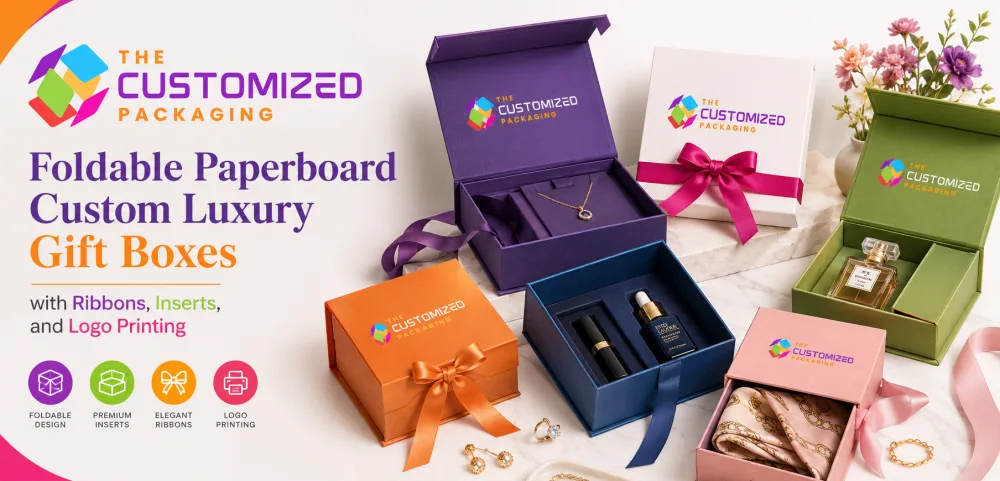
Foldable paperboard luxury gift boxes can create a refined product presentation without using the thick wrapped greyboard found in conventional rigid boxes.
The difference is not simply material thickness.
A folding gift box feels more considered when its structure holds its shape cleanly, the product fits correctly, the insert aligns with the opening, artwork suits the paper surface and decorative details such as ribbons or foil serve a clear purpose.
That means premium presentation comes from how the complete package works together rather than from one material or finish alone.
For brands comparing custom luxury gift boxes, understanding what foldable paperboard can and cannot do helps determine whether it is the right structure for the product.
What Is a Foldable Paperboard Luxury Gift Box?
A foldable paperboard gift box is produced from paperboard that is cut, creased and folded into its final shape.
Depending on the structure, it may use:
-
Tuck flaps
-
Locking tabs
-
Reinforced side walls
-
Double-wall panels
-
Sleeves
-
Trays
-
Ribbon closures
-
Adhesive sections
-
Folding corner supports
Many of these boxes are supplied flat before packing.
This is different from a conventional rigid setup box, which normally uses thicker board wrapped with decorative paper and keeps its three-dimensional shape after manufacturing.
Foldable Paperboard vs Rigid vs Collapsible Rigid
These terms are sometimes used interchangeably, but they describe different constructions.
| Structure | Main Construction | Supplied Flat? | Typical Character |
|---|---|---|---|
| Foldable paperboard box | Creased folding board | Usually | Lightweight, printable and space-efficient |
| Reinforced folding box | Paperboard with doubled or locking walls | Usually | More substantial than a simple folding carton |
| Conventional rigid box | Thick greyboard wrapped with paper | Usually no | Dense and highly structured |
| Collapsible rigid box | Wrapped rigid board with folding joints | Often | Rigid-style appearance with reduced storage volume |
This distinction matters because a foldable paperboard box should not be described as a rigid box simply because it looks substantial after assembly.
Brands specifically comparing thick wrapped constructions should use the custom rigid boxes guidance separately.
Premium Presentation Starts With the Structure
Decorative finishing cannot compensate for a box that does not form cleanly.
Before choosing ribbon, foil or inserts, look at how the paperboard structure behaves after assembly.
A well-designed foldable gift box should form clean walls and controlled corners without excessive bowing or distortion.
Look for:
-
Panels that align correctly
-
Corners that stay square where required
-
End flaps that close without excessive pressure
-
Lid or sleeve alignment
-
Stable base construction
-
Consistent opening resistance
-
Enough strength for the packed product
A clean structure provides the foundation for everything added later.
Simple Folding Cartons and Reinforced Gift Boxes Are Different
Not every paperboard gift box needs reinforced walls.
A lightweight scarf, cosmetic accessory or small retail gift may work well in a straightforward folding carton.
A heavier candle, bottle or multi-product set may need more substantial paperboard engineering.
Reinforcement can come from:
-
Double-wall panels
-
Folded side supports
-
Layered bases
-
Locking corners
-
Sleeves around inner trays
-
Internal platforms
More reinforcement also means more paperboard, more folding operations and potentially more assembly time.
Use it when the product requires it.
The Board Should Match the Product Weight
Paperboard selection affects how the box forms, prints and carries the product.
A lightweight product does not automatically need the heaviest available board.
Likewise, a decorative carton should not be expected to hold a heavy gift set if the structure was developed for a much lighter item.
When reviewing material, consider:
-
Product weight
-
Box dimensions
-
Wall height
-
Closure style
-
Insert design
-
Number of products
-
Handling
-
Storage
-
Final assembly
The correct board should support the actual packed configuration.
Paperboard Surface Changes the Visual Result
The board surface also influences the appearance of the finished package.
Smooth white paperboard can support detailed color printing and fine typography.
Natural kraft creates a different visual background.
Black or colored paperboard can reduce the need for heavy ink coverage but may require different printing techniques for light artwork.
Specialty stocks can introduce texture or visual effects before any additional finish is applied.
Choose the surface before deciding how much decoration the box needs.
How Foldable Packaging Can Look More Substantial
Paperboard does not need to imitate rigid packaging to feel well designed.
Instead, use structural details that suit folding construction.
Examples include:
-
Reinforced side walls
-
A fitted sleeve
-
A separate tray
-
Double-layer lid panels
-
Controlled opening flaps
-
Hidden locking tabs
-
Interior platforms
These features can make the package feel more deliberate while preserving the benefits of folding construction.
The goal should be structural clarity rather than making the customer believe the material is something it is not.
When a Sleeve-and-Tray Structure Works Well
A sleeve-and-tray box can create a gradual reveal while remaining primarily paperboard-based.
The outer sleeve provides a large printing area.
The inner tray holds the product.
The movement between the two pieces can also make a relatively lightweight package feel more considered.
For promotional samples and branded kits, custom sleeve and tray boxes can provide a useful alternative to conventional lid-and-base structures.
The sliding tolerance should still be tested.
A tray that is too loose can slip out unexpectedly.
One that is too tight can make opening frustrating.
Inserts Can Change the Entire Presentation
An insert often has more influence on the interior appearance than another exterior finish.
Without controlled positioning, several products can move into different orientations each time the package is handled.
A properly designed custom packaging insert can:
-
Center the product
-
Separate several components
-
Raise products closer to the opening
-
Prevent direct contact between items
-
Create consistent spacing
-
Organize a gift set
-
Improve product removal
The insert should be designed around the actual products rather than around estimated dimensions.
Paperboard Inserts Work Naturally With Folding Boxes
For many lightweight and moderately weighted gifts, a folded paperboard insert can provide enough organization without introducing a completely different material.
Possible formats include:
-
Raised platform
-
Product collar
-
Divider
-
Folded cradle
-
Slot
-
Paperboard cavity
-
Compartment grid
Paperboard inserts can also be printed when the interior presentation needs product names, instructions or other information.
The right design depends on product shape and weight.
When Another Insert Material May Be Needed
Not every gift set is suitable for a simple paperboard platform.
Heavier bottles, delicate items or products with unusual shapes may require another insert construction.
Options can include corrugated supports, molded pulp or selected foam systems.
The decision should come from the product requirements rather than from the assumption that one insert material always looks more premium.
Make Product Removal Part of the Insert Design
A cavity can hold a product securely and still make it difficult to remove.
Check how customers will reach the product.
Useful features may include:
-
Finger notches
-
Open sides
-
Ribbon lifts
-
Raised platforms
-
Partial cavities
-
Removable trays
Avoid extremely tight cavities simply to make the product appear secure.
The packaging needs to support both presentation and access.
What Does a Ribbon Actually Add?
Ribbon can provide decoration, function or both.
It may be used as:
-
Box closure
-
Drawer pull
-
Product lift
-
Interior restraint
-
Decorative wrap
-
Gift bow
Before adding ribbon, decide which of those jobs it needs to perform.
A ribbon that does nothing except create another assembly step may not improve the package enough to justify the extra component.
Ribbon Closure vs Decorative Ribbon
These two applications should be considered differently.
| Ribbon Use | Main Purpose | Design Consideration |
|---|---|---|
| Closure ribbon | Keeps the box closed | Position, tension and ease of opening |
| Drawer pull | Helps move a tray | Attachment and pull strength |
| Product lift | Helps remove an item | Placement beneath the product |
| Decorative wrap | Adds gift presentation | Assembly time and consistency |
| Bow | Creates a traditional gift look | Packing labor and storage |
| Interior ribbon | Holds or presents a component | Product contact and positioning |
If a paperboard tab or sleeve already closes the package effectively, an additional exterior ribbon may be purely decorative.
That is not necessarily wrong, but it should be intentional.
Choose Ribbon Width Around the Box
A ribbon that looks proportional on a small jewelry carton may look too narrow on a larger gift box.
Similarly, an oversized ribbon can dominate a compact package.
Evaluate:
-
Box width
-
Lid dimensions
-
Logo position
-
Ribbon material
-
Bow size
-
Printed artwork
-
Where the customer grips the box
Test the ribbon on an assembled sample rather than approving it separately.
Logo Printing Should Follow the Structure
Foldable paperboard provides large printable surfaces, but artwork needs to respect folds, creases, flaps and locking areas.
Important logos should remain clear of locations where assembly can distort them.
Before approving artwork, check:
-
Front-facing panels
-
Lid position
-
Fold lines
-
Sleeve overlap
-
Locking tabs
-
Ribbon position
-
Interior artwork
-
Insert printing
The same logo may need different sizes or orientations on different panels.
Full-Color Printing Is Not Always Necessary
A premium paperboard box can use full-color printing, but it does not need to.
Depending on the brand, a restrained design may use:
-
One-color printing
-
Two-color artwork
-
Black typography
-
White ink on dark stock
-
Limited graphics
-
Interior printing
-
One selected decorative finish
The amount of ink does not determine the quality of the design.
Hierarchy and consistency matter more.
Use Finishing Selectively
Foil stamping, embossing, debossing and soft-touch treatments can all be applied to suitable paperboard packaging.
They create different effects.
If you are choosing among these treatments, the dedicated foil vs embossing vs soft touch guide provides the detailed comparison.
For foldable paperboard luxury gift boxes, the key principle is to avoid adding finishes before the structure and surface material have been selected.
A small foil logo may be enough.
A textured stock may need little additional decoration.
A heavily printed carton may not need another large surface treatment.
Make the Exterior and Interior Work Together
The outer panels create the first impression.
The interior determines how the product appears after opening.
A strong package can use those spaces differently.
For example:
Exterior
-
Brand logo
-
Product or collection name
-
Minimal artwork
Interior
-
Product arrangement
-
Printed message
-
Insert branding
-
QR code
-
Instructions
The interior does not need to repeat the entire exterior design.
Do Not Overload a Foldable Box With “Luxury” Features
It is easy to add ribbons, foil, spot effects, printed interiors, sleeves, inserts, cards and other components simply because each one sounds premium.
The better question is:
What does each feature contribute?
| Feature | Useful When | May Be Unnecessary When |
|---|---|---|
| Reinforced walls | Product needs more structural support | Product is very light |
| Ribbon closure | Closure is part of the presentation | Tabs already provide a clean close |
| Insert | Product needs positioning or organization | Product fits securely without one |
| Foil | A focal logo needs contrast | Artwork already has strong visual hierarchy |
| Interior print | Opening reveals useful content | Interior needs to remain simple |
| Sleeve | It improves structure or reveal | It only adds another layer |
| Soft touch | Surface feel is important | Specialty paper already supplies texture |
Premium presentation is often stronger when the design is controlled rather than overloaded.
Foldable Paperboard Is Not the Same as Collapsible Rigid Packaging
This distinction deserves particular attention.
A collapsible rigid box typically uses thick wrapped board connected with folding joints, adhesive areas or magnetic panels so it can collapse for storage.
A foldable paperboard box relies primarily on creased paperboard construction.
Both may arrive flat.
Both can have a premium appearance.
They are still different packaging types.
When a project specifically requires the dense feel, wrapped edges and substantial walls associated with rigid packaging, a collapsible rigid structure may be more appropriate.
When Foldable Paperboard Makes More Sense
Foldable paperboard can be a strong choice when the project values:
-
Flat storage
-
Lightweight construction
-
Efficient assembly
-
High-quality printing
-
Moderate product weight
-
Retail presentation
-
Gift-ready appearance
-
Flexible structure options
It can work particularly well for jewelry cards, apparel accessories, cosmetics, confectionery, stationery, smaller gift sets and selected corporate gifts.
The product itself should still determine the final structure.
When Conventional Rigid Packaging May Make More Sense
A conventional rigid structure may be more suitable when the package requires:
-
Thick permanent walls
-
Greater structural mass
-
A very deep presentation format
-
Heavier product support
-
Wrapped-paper construction
-
Long-term keepsake use
-
Complex magnetic or hinged construction
The choice should come from product and presentation requirements rather than from assuming one format is universally more premium.
Flat Storage Is Useful, but Assembly Still Matters
A flat-packed box occupies less storage space than a permanently assembled box.
That can be useful for retailers, ecommerce businesses and gift programs handling larger packaging inventories.
However, flat supply shifts some work to the packing stage.
Someone has to assemble the box.
Test:
-
Assembly steps
-
Folding sequence
-
Time per box
-
Corner alignment
-
Closure
-
Insert placement
-
Ribbon placement
-
Packing consistency
A complicated structure may save warehouse space but increase labor during fulfillment.
Both sides of that tradeoff matter.
Test the Package Fully Assembled
A flat dieline cannot show the entire customer experience.
Build the sample.
Insert the actual product.
Add the ribbon.
Install the insert.
Close the box.
Then review:
-
Wall shape
-
Corner quality
-
Product fit
-
Closure
-
Ribbon alignment
-
Insert position
-
Logo placement
-
Product removal
-
Opening sequence
-
Overall presentation
This is particularly important for reinforced folding designs, where small structural differences can become much more obvious after assembly.
Test the Package With the Real Product Weight
An empty sample can look perfect.
A filled box may behave differently.
Product weight can affect:
-
Base shape
-
Side-wall bowing
-
Closure
-
Sleeve movement
-
Insert stability
-
Carrying
-
Stacking
Always evaluate the package with the complete product arrangement.
Consider Shipping Separately
A premium folding gift box is not automatically a parcel shipping carton.
If the product will be sold online, consider whether the presentation box needs an outer shipping package.
The shipping layer may protect:
-
Printed surfaces
-
Ribbon
-
Corners
-
Decorative finishes
-
Product arrangement
This keeps the gift package focused on presentation while another structure handles courier exposure.
Avoid Unsupported Environmental Assumptions
Flat supply can reduce the storage volume occupied by empty boxes, but that alone does not establish the environmental performance of the complete package.
Paperboard packaging can also include:
-
Ink
-
Adhesives
-
Coatings
-
Foil
-
Ribbon
-
Windows
-
Inserts
If recycled content or recyclability matters to the project, evaluate the complete construction and use specific material information rather than relying on broad environmental claims.
Common Design Mistakes
Choosing Decoration Before Structure
The box needs to form and hold the product correctly first.
Using Ribbon Without a Purpose
Ribbon should provide closure, access, restraint or deliberate decoration.
Adding an Insert After the Box Is Finished
Product and insert should be planned together.
Trying to Make Paperboard Pretend to Be Rigid Board
Use the strengths of folding construction rather than misrepresenting the material.
Adding Every Available Finish
More decorative processes do not automatically improve the result.
Ignoring Assembly Time
Flat-packed packaging still needs to be formed before use.
Approving an Empty Sample
Test the complete packed product.
Foldable Paperboard Gift Box Design Checklist
| Area | What to Check |
|---|---|
| Product | Dimensions, weight and final arrangement |
| Structure | Wall strength, closure and assembly |
| Paperboard | Surface, thickness and folding performance |
| Insert | Fit, product access and positioning |
| Ribbon | Purpose, width, attachment and placement |
| Printing | Logo size, artwork and crease clearance |
| Finishing | Whether each treatment adds a clear effect |
| Interior | Product reveal and information |
| Assembly | Time and consistency |
| Shipping | Need for an outer protective package |
| Sample | Complete box tested with the real product |
Frequently Asked Questions
Can paperboard gift boxes look premium without rigid board?
Yes. Premium presentation can come from clean structure, good paperboard, accurate product fit, thoughtful inserts, controlled printing and selective decorative details rather than board thickness alone.
Are foldable paperboard gift boxes the same as collapsible rigid boxes?
No. Foldable paperboard boxes use creased folding board, while collapsible rigid boxes typically use thicker wrapped board with folding joints or panels.
Can foldable gift boxes include ribbons?
Yes. Ribbons can be used for closure, drawer pulls, product lifts or decoration when the structure supports them.
Can paperboard gift boxes use custom inserts?
Yes. Folded paperboard platforms, dividers, collars and other insert structures can organize products. Other materials may be appropriate for heavier or more delicate products.
Can foldable paperboard boxes use foil or embossing?
Suitable paperboard surfaces can support finishing such as foil stamping, embossing and debossing. The final artwork and material should be tested together.
Are foldable boxes supplied flat?
Many foldable paperboard structures can be supplied flat or partially assembled, although the exact packing method depends on the box design.
Are foldable gift boxes suitable for heavy products?
Some reinforced structures can support more weight than simple folding cartons, but heavier products may require stronger paperboard, corrugated support or rigid packaging. The actual packed product should be tested.
Does a foldable paperboard gift box need an insert?
Not always. An insert is useful when the product requires positioning, separation, elevation or easier removal.
Build the Premium Effect From the Structure Outward
Foldable paperboard luxury gift boxes work best when structure comes before decoration.
Start with the actual product and determine the board, folding system and closure required to hold it properly. Then decide whether an insert, ribbon, printed interior or selected finish improves the presentation.
That approach makes every component serve a purpose.
If your project needs a foldable paperboard structure with custom printing, inserts or ribbon details, The Customized Packaging can help develop custom printed boxes around the product dimensions and the finished presentation you want to test.