
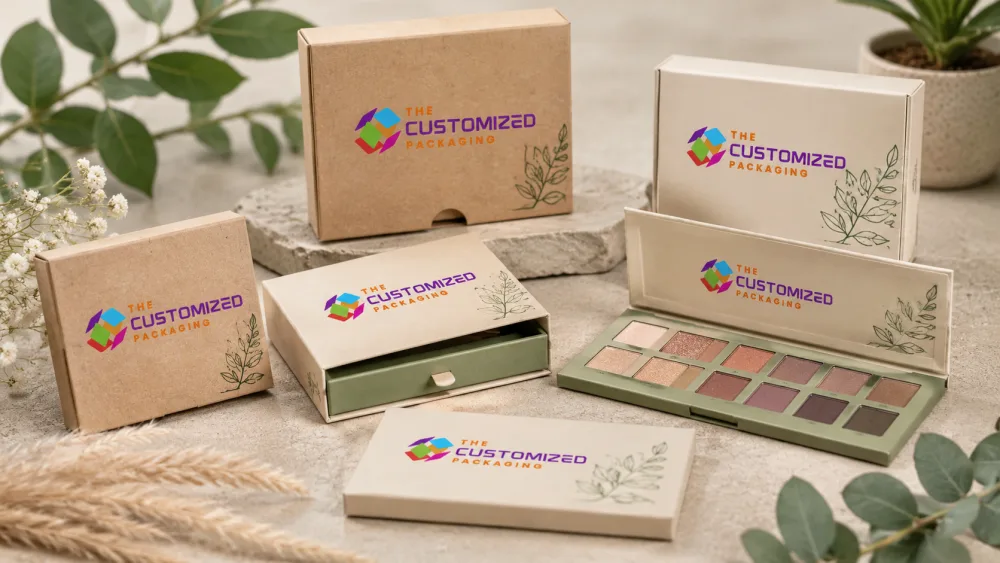
Custom Eye Shadow Boxes: How to Reduce Secondary Packaging Around Palettes and Compacts
Eye shadow palettes already have a primary compact that protects the pans, hinge and mirror. Learn how to determine what the secondary carton still needs to do, right-size it around the finished palette and remove unnecessary inserts, windows and material layers without compromising fit.
 Published June 02, 2026
Updated September 03, 2026
20 min read
Published June 02, 2026
Updated September 03, 2026
20 min read
An eye shadow palette often already has its own primary package.
The powders sit inside pans. The pans are held inside a compact or palette. The palette may have a hinged lid, clasp, mirror and printed exterior before it ever goes inside a secondary carton.
That makes custom eye shadow boxes a good place to ask a simple packaging question:
What does the outer box still need to do?
For some products, the secondary carton provides important labeling space, protects the finished palette from scuffing and helps organize the product at retail. For others, a large rigid presentation box, thick insert, plastic window and several printed components may add more packaging than the product actually requires.
A better approach is to start with the finished eye shadow palette, identify the functions the outer carton needs to perform and then build the simplest structure that performs those functions reliably.
Start With the Finished Eye Shadow Product
Do not size the outer box from pan count alone.
A 9-pan palette can be physically larger than a 12-pan palette depending on:
-
Pan diameter
-
Pan shape
-
Spacing
-
Compact housing
-
Mirror
-
Hinge
-
Clasp
-
Applicator compartment
-
Decorative exterior
Measure the finished, closed palette.
Record its:
length × width × maximum thickness
Then identify anything that projects beyond the main body.
That may include:
-
Hinge
-
Latch
-
Decorative edge
-
Raised logo
-
Ribbon
-
Brush compartment
-
Magnetic closure component
The carton should follow the actual object rather than the number of shades printed on the label.
Decide Whether a Secondary Carton Is Needed
Not every palette automatically needs another box.
The finished primary package may already provide:
-
Product containment
-
Structural housing
-
Shade organization
-
Mirror protection
-
Branding
-
Customer opening
The secondary carton may still be valuable when it provides:
-
Required or useful product-information space
-
Barcode area
-
Protection from retail handling
-
Protection for decorative surfaces
-
Hang-tab display
-
Grouping for sets
-
Tamper-related features where appropriate
-
Additional protection during distribution
The important point is to identify those functions before adding the carton.
If the secondary package has no clear role, the brand should at least question whether it is necessary.
Separate the Primary Palette From the Secondary Box
The two packaging layers perform different jobs.
Primary Palette
The compact itself may hold:
-
Eye shadow pans
-
Mirror
-
Brush
-
Applicator
-
Lid
-
Clasp
-
Product artwork
Secondary Carton
The outer box may provide:
-
Retail identification
-
Ingredient and product information
-
Barcode
-
Batch or coding area
-
Extra surface protection
-
Product grouping
-
Shipping preparation
-
Brand communication
Keeping those jobs separate makes it easier to identify unnecessary duplication.
The secondary box does not need to repeat every structural feature already built into the palette.
Right-Size the Carton Around the Closed Palette
Oversized cosmetic packaging creates unnecessary empty space.
Start with the closed palette dimensions and add only the space needed for:
-
Practical loading
-
Product removal
-
Hinge clearance
-
Clasp clearance
-
Protective support where needed
-
Folding-board allowances
The finished eye shadow box should fit the primary package without squeezing it.
It should also avoid a large amount of unused space around the compact.
A correctly sized carton usually looks more deliberate and requires less filler than an oversized structure.
Protect the Hinge Without Making the Whole Box Larger
Many palettes have a projecting hinge.
If the hinge is the widest point, do not automatically add the same extra space around every side of the product.
Instead, determine whether the structure can provide localized clearance.
The carton should avoid placing concentrated pressure on:
-
Hinge
-
Clasp
-
Mirror area
-
Decorative lid
-
Raised artwork
A small structural adjustment may solve the problem more efficiently than significantly increasing the entire box.
Mirror Clearance Deserves Separate Attention
Some eye shadow palettes contain mirrors inside the lid.
That means excessive pressure on the outer palette can affect an area that is more fragile than the surrounding plastic or board housing.
Do not create a secondary carton that presses heavily against the mirrored lid.
Check:
-
Top clearance
-
Side pressure
-
Insert contact
-
Stacking orientation
The outer carton should protect the palette without becoming another source of concentrated pressure.
Pressed Powders Still Need Protection
Reducing secondary packaging does not mean removing necessary protection.
Pressed powders can crack when exposed to impact, vibration or excessive pressure.
The goal is to reduce unnecessary packaging while preserving the support the actual product needs.
For a small compact palette, a correctly fitted folding carton may provide enough additional control.
A heavier professional palette may need:
-
Stronger paperboard
-
Micro-flute construction
-
Side spacers
-
Paperboard support
-
Appropriate ecommerce shipper
The structure should follow the actual product weight and distribution conditions.
Do Not Add Foam Automatically
A precision-cut foam insert can be useful for some products.
That does not mean every eye-shadow palette needs one.
Ask whether the primary compact already has enough structure.
If the palette sits securely inside a correctly sized carton, adding a thick foam block may provide little additional value.
An insert becomes more useful when:
-
Several palettes share one box
-
Product shape is irregular
-
Heavy compact needs stabilization
-
Palette must remain in one orientation
-
Accessories need separation
-
Gift set contains different cosmetic products
Use the insert only when it solves a defined problem.
Consider Folded Paperboard Supports First Where Suitable
When additional control is needed, a folded paperboard support can sometimes provide enough structure.
Possible designs include:
-
Side tabs
-
Corner supports
-
Raised platform
-
Recessed frame
-
Product collar
-
Divider
This can keep the palette centered without filling the entire box with a solid insert.
The correct solution depends on the size and weight of the palette.
Paper-based does not automatically mean environmentally superior, but simplifying the number and type of components can make the complete package easier to understand and specify.
Inserts Should Not Cover Important Palette Artwork
The primary palette may already carry:
-
Brand logo
-
Collection name
-
Shade theme
-
Limited-edition artwork
If the product is visible immediately after opening, the insert should not hide the most recognizable part of it.
Test the final palette inside the finished support.
Check:
-
Logo visibility
-
Product orientation
-
Removal access
-
Hinge clearance
-
Clasp access
An insert should support the product without making the primary packaging harder to see or use.
Test Whether the Window Is Necessary
Window cartons can reveal the palette or shade colors before the box is opened.
That can be useful.
But a transparent window may also introduce another material into an otherwise paper-based carton.
Ask:
What will the customer actually learn from seeing the palette through the window?
A window may be useful when:
-
Palette artwork is distinctive
-
Shade colors are visible through the primary packaging
-
Retail product recognition improves
-
Customer needs to distinguish variants visually
It may provide little benefit when the visible palette is mostly closed, opaque or covered in the same information already printed on the carton.
Open Window and Film Window Are Different Choices
A die-cut window can remain open or use a transparent film.
The two constructions should not be described the same way.
Film can create:
-
Additional material
-
Reflective glare
-
Another attached component
-
Different end-of-life considerations
If the film is genuinely useful, include it.
If it adds little product visibility, an open cutout or no window may create a simpler construction.
The complete package—not just the paperboard—should guide any environmental claim.
Avoid Oversized Windows
A large window can remove significant material from the carton.
It may also require stronger surrounding areas to maintain shape.
Instead of asking:
How much product can we expose?
ask:
What is the smallest useful viewing area?
That often leads to a more balanced box.
A focused window can show the relevant palette feature while leaving enough space for product information and structural support.
Kraft Color Is a Design Choice, Not Environmental Proof
Natural kraft has a distinct appearance.
It can suit:
-
Minimalist cosmetics
-
Natural-looking collections
-
Neutral branding
-
Limited-color artwork
But brown paper does not automatically make a finished eye shadow carton “eco-friendly.”
The complete specification may still include:
-
Lamination
-
Foil
-
Window film
-
Labels
-
Adhesives
-
Mixed-material insert
-
Specialty coatings
Choose kraft because it works for the product and branding—not because the color itself proves environmental performance.
White Paperboard Can Also Support Reduced-Material Packaging
A white folding carton can be:
-
Right-sized
-
Unlaminated
-
Free from unnecessary windows
-
Free from unnecessary inserts
-
Produced with verified recycled-content board where appropriate
The visual color of the package does not determine how much material it uses.
This is why the article should focus on the actual specification rather than a “brown equals sustainable” visual shortcut.
Ask for Specific Recycled-Content Information
If recycled content is part of the packaging goal, request actual information about the board.
That may include:
-
Recycled-content percentage
-
Post-consumer content where documented
-
Whether the percentage applies to the complete board
-
Supplier documentation
Specific language is more useful than simply saying:
recycled packaging
if only part of the material contains recycled fiber.
The marketing claim should match the approved specification.
Recycled Content Does Not Mean the Same Thing as Recyclability
These are different characteristics.
Recycled content describes material inputs.
Recyclability concerns how the finished package may be collected and processed after use.
A carton may contain recycled fiber and still include:
-
Film window
-
Lamination
-
Foam insert
-
Metallic elements
that affect the complete construction.
Treat the two claims separately.
Avoid Blanket Recyclability Claims
A paperboard eye-shadow carton may be accepted through many paper-recycling systems.
That does not mean every finished structure can automatically be marketed as universally recyclable.
The final package may contain:
-
Adhesives
-
Coatings
-
Plastic film
-
Magnets
-
Foil
-
Fabric
-
Foam
Availability of suitable recycling systems also varies.
If recyclability is part of the printed message, review the complete package and qualify the claim where appropriate.
Avoid “Biodegradable” and “Compostable” Unless Supported
Those are specific environmental claims.
A paper carton may contain multiple added components.
Do not apply the words broadly to the entire finished package just because the primary substrate is paper.
If a component has verified compostability or another environmental attribute, identify exactly which component the claim applies to.
Specific wording is safer and more useful.
Do Not Add a Recycling Symbol Automatically
A recycling symbol communicates a claim.
It should not be treated as decorative artwork.
Before printing one, confirm:
-
Complete packaging construction
-
Window or laminate
-
Insert
-
Local disposal considerations relevant to the claim
-
Any qualification required
If the finished package has changed since the artwork was originally approved, review the claim again.
Reduce Decorative Layers That Do Not Serve a Clear Purpose
Eye-shadow boxes can use:
-
Lamination
-
Foil
-
Spot gloss
-
Embossing
-
Debossing
-
Metallic paper
-
Holographic effects
-
Ribbons
-
Magnets
These finishes can be appropriate for some brands.
Material reduction does not mean every cosmetic box must be plain.
The useful question is:
What does this component contribute?
If a laminate improves necessary surface performance, that is a defined reason.
If a ribbon organizes a gift set, that is a defined reason.
If several decorative layers have been added simply because premium cosmetics are expected to have them, the structure may be worth simplifying.
Magnets Should Be Treated as Another Material Component
Magnetic eye-shadow boxes can create a particular opening experience.
But magnets also introduce another material into the package.
If the palette already has its own magnetic closure, adding another magnetic outer box may be redundant unless it serves a clear gift or presentation purpose.
Evaluate the complete product system.
Do not automatically create:
magnetic palette → magnetic retail box → magnetic presentation package
when a simpler secondary carton can perform the required job.
Distinguish Retail Packaging From PR Packaging
A standard retail palette and an influencer launch kit may need different packaging.
A large rigid presentation box might be appropriate for a limited campaign containing:
-
Palette
-
Brushes
-
Product card
-
Other cosmetics
That does not mean every retail unit needs the same oversized structure.
Use the packaging according to the sales channel.
The everyday customer carton can remain simpler while promotional kits use a separate format.
Do Not Let Limited Editions Create Permanent Packaging Waste
Seasonal palettes and collaborations can change quickly.
Avoid building short-lived information directly into large quantities of permanent packaging where a flexible component could work.
Options can include:
-
Printed sleeve
-
Label
-
Paper band
-
Product card
-
Alternate artwork version
The physical structure can remain consistent where the palette dimensions stay the same.
This helps reduce the risk of leftover boxes becoming unusable after the campaign ends.
Use One Structure Across Shade Collections When the Palette Is the Same
A makeup brand may sell several 12-pan palettes using the same compact.
For example:
-
Nude palette
-
Smoky palette
-
Shimmer palette
-
Festival palette
-
Bridal palette
If the finished primary palette dimensions are identical, the same custom eye shadow box structure may be able to support all of them.
Change:
-
Artwork
-
Shade-map information
-
Accent color
-
SKU
-
Barcode
while keeping the physical carton specification stable.
This can simplify structural packaging inventory.
Do Not Assume the Same Pan Count Means the Same Box
The reverse is also true.
Two palettes can both contain twelve pans and still have completely different dimensions.
One may use:
-
Small round pans
-
No mirror
while another uses:
-
Large rectangular pans
-
Mirror
-
Applicator compartment
Always standardize around the finished physical palette rather than shade count.
Separate Product Information From Decorative Inserts
Eye-shadow cartons may need room for:
-
Ingredients
-
Shade information
-
Net quantity
-
Directions
-
Warnings
-
Barcode
-
Batch information
-
Company details
-
Other applicable labeling
A decorative insert should not reduce the available information area to the point where the carton becomes difficult to read.
Right-sizing means reducing unnecessary volume, not eliminating the space required for clear product communication.
QR Codes Can Replace Some Loose Printed Material
A QR code may be useful for content such as:
-
Makeup tutorial
-
Shade guide
-
Application ideas
-
Collection story
-
Extended product education
If a QR code genuinely replaces a separate booklet or card, the number of loose components may decrease.
If the QR code is printed on an additional card while all existing inserts remain, no material has been removed.
Use digital content where it actually simplifies the package.
Do Not Move Required Information Online
Some information needs to remain on the product or packaging according to the intended market and product requirements.
A QR code should supplement that information, not replace it merely to make the carton smaller.
Design the package around the necessary printed information first.
Then decide what additional content can be digital.
Refillable Palettes Need a Different Secondary-Packaging Plan
Some eye-shadow systems use refillable primary palettes.
In that case, customers may keep the main compact and purchase:
-
Individual refill pans
-
Refill sets
-
Replacement color collections
The refill does not necessarily need the same outer box as the complete palette.
A brand can evaluate separate packaging for:
initial palette purchase
and
repeat refill purchase
This may create an opportunity to use smaller packaging for repeat orders.
Do Not Call a Palette Refillable Unless There Is a Real Refill System
A durable palette that can theoretically be opened and reused is not automatically a refillable product program.
The customer should have a practical way to purchase and install replacement pans.
Environmental messaging should describe the actual system.
If only the pan is refillable, say so rather than describing every packaging layer as reusable.
Refill Pan Packaging Can Be Much Smaller
A refill pan is physically smaller than the complete palette.
Its secondary packaging should reflect that.
A refill carton may need:
-
Pan protection
-
Shade identification
-
Product information
-
Small holder or card
It does not necessarily need a full-size palette carton.
Right-sizing refill packaging separately can reduce unnecessary material in repeat purchases.
Ecommerce Shipping Is a Separate Packaging Layer
A folding retail carton around an eye-shadow palette should not be expected to perform the same job as the outer parcel shipper.
For ecommerce, the complete system may be:
palette → retail carton → protective shipping mailer
The shipping layer can handle:
-
Carrier label
-
Parcel handling
-
Additional impact protection
The retail carton can remain focused on the product.
This prevents overbuilding the customer-facing carton simply because the item is also sold online.
Right-Size the Outer Shipper Too
Reducing the retail carton while putting it into a much larger shipping box does not solve the complete packaging problem.
Measure:
-
Finished retail carton
-
Additional cushioning
-
Multi-product order combinations
Then choose the ecommerce shipper around the actual order.
For delicate pressed powders, the delivery package should reduce unnecessary movement while still providing appropriate handling protection.
Do Not Promise That Reduced Packaging Prevents Breakage
Packaging can help reduce movement and protect the product.
It cannot guarantee that pressed powders will never crack during severe handling.
Avoid claims such as:
-
Guaranteed protection
-
Break-proof
-
Damage-proof
-
100% secure
The finished packaging should instead be physically tested under the conditions relevant to the product and distribution method.
Measure the Packaging Changes
If the brand wants to communicate packaging reduction, track something specific.
For example:
Previous version
-
Oversized folding carton
-
Foam insert
-
Film window
-
Printed leaflet
Revised version
-
Right-sized paperboard carton
-
Folded paperboard side support
-
No film window
-
QR code replacing the leaflet
That is a concrete packaging redesign.
The brand can then communicate the specific change rather than making a broad environmental claim.
Compare Box Weight or Material Area
Possible internal tracking metrics include:
-
Carton weight
-
Board area
-
Component count
-
Number of inserts
-
Number of loose printed pieces
-
Packaging volume
-
Recycled-content percentage where documented
These measurements do not describe the complete environmental footprint.
They simply give the brand a more objective way to evaluate whether the redesigned package actually uses less material.
Document the Final Specification
Before environmental wording is approved, document the actual custom eye shadow packaging construction.
Record:
-
Board grade
-
Board thickness
-
Recycled-content percentage where applicable
-
Window material
-
Lamination
-
Coating
-
Insert
-
Adhesive
-
Foil or metallic effects
-
Magnet
-
Ribbon
-
Box dimensions
Then compare the planned claim against that specification.
Marketing language should follow the packaging—not the other way around.
Recheck Claims Whenever the Package Changes
A box may begin as:
unlaminated paperboard + no window
and later change to:
laminated paperboard + film window + foam insert
The previous environmental language may no longer describe the package accurately.
Review environmental claims whenever the construction changes.
Do not treat them as permanent wording that can be reused across every future packaging version.
Test the Final Palette Inside the Final Carton
A reduced-material structure still needs to work.
Load the actual closed palette into the final sample.
Check:
-
Product fit
-
Hinge clearance
-
Clasp clearance
-
Mirror area
-
Side movement
-
Product removal
-
Carton closure
-
Print readability
Then test the ecommerce shipping configuration where applicable.
Removing unnecessary material is useful only if the finished package still performs the functions the product requires.
Run a Packing Test
Ask the people who will fill the boxes to pack several units.
Look for repeated problems such as:
-
Palette catching on the opening
-
Insert moving
-
Box too tight
-
Excess empty space
-
Staff adding unplanned filler
-
Carton flap difficult to close
-
Product orientation changing
A structural reduction that slows every packing operation may need adjustment.
The final package should work in regular production, not only in one carefully prepared sample.
Eye Shadow Packaging Reduction Checklist
Before approving custom eye shadow boxes, confirm:
-
Finished palette dimensions are known
-
Hinge and clasp projections are included
-
Mirror clearance is considered
-
Secondary carton has a defined function
-
Box is right-sized around the finished palette
-
Pressed-powder protection has not been sacrificed
-
Inserts are used only where they solve a real problem
-
Paperboard supports have been considered where suitable
-
Window has a clear purpose
-
Film window has been evaluated as a separate material component
-
Kraft color is not being used as proof of sustainability
-
Recycled-content claims match the actual specification
-
Recyclability claims reflect the complete package
-
Broad biodegradable or compostable claims are avoided unless supported
-
Decorative components have a defined purpose
-
Limited-edition elements remain flexible where useful
-
Refill packaging is sized separately where applicable
-
Ecommerce shipping is treated as another packaging layer
-
Material-reduction changes are documented
-
Final packaging has been physically tested
The strongest packaging improvements are usually the ones that can be clearly described and measured.
Frequently Asked Questions About Reduced-Material Eye Shadow Packaging
Does every eye-shadow palette need a secondary carton?
No. It depends on what the finished primary palette already provides and what the retail, labeling, protection and presentation requirements are. Some products may still benefit strongly from a secondary carton, while others may not need another full packaging layer.
How should a custom eye shadow box be sized?
Measure the completely finished and closed palette, including the hinge, clasp, mirror housing and decorative projections. Then add only the clearance and support required for practical loading, protection and removal.
Do pressed-powder palettes need inserts?
Not always. A correctly sized carton may provide enough additional control for some palettes. Inserts are more useful when the product is heavy, irregular, part of a set or requires additional stabilization.
Is kraft eye-shadow packaging automatically sustainable?
No. Kraft color alone does not determine environmental performance. The complete package may include coatings, adhesives, films, inserts, foil or other components that need to be considered.
Can eye-shadow boxes use recycled-content paperboard?
Yes, where a suitable board specification is available for the product. If recycled content is part of the marketing claim, the actual percentage should be documented.
Are paper eye-shadow boxes recyclable?
Many paperboard cartons may be accepted through paper-recycling systems, but the complete construction and local availability matter. Films, laminations, magnets, foam and other components can affect the finished package.
Is a window necessary on an eye-shadow box?
Not always. Use a window when customers gain useful product visibility from it. If the closed palette reveals little useful information, removing the window may simplify the package.
Can refillable eye-shadow palettes use less packaging for repeat purchases?
Potentially. Refill pans can be packaged separately from the complete reusable palette, allowing repeat purchases to use packaging sized specifically around the refill product.
Can a QR code reduce packaging materials?
It can when the code genuinely replaces a physical booklet, guide or other loose printed component. Adding a QR code without removing anything else does not reduce material.
Should reduced-material eye-shadow packaging still be tested?
Yes. The final palette should be tested inside the final carton, and ecommerce configurations should be tested with their outer shipping package where applicable.
Should environmental claims be reviewed after packaging changes?
Yes. Changes to coatings, windows, inserts, magnets, laminates or other components can affect whether previous environmental wording still accurately describes the finished package.
Reduce the Package Around the Palette, Not the Protection It Needs
The best custom eye shadow boxes are not defined by kraft color, a recycling symbol or a broad environmental slogan.
They are defined by purposeful construction.
Start with the finished palette.
Decide whether another carton is necessary.
Right-size it around the closed product.
Protect the hinge, clasp, mirror and pressed powders.
Remove inserts, windows and decorative layers that do not perform a useful function.
Then document the actual board, recycled content and other components before making environmental claims.
That creates a packaging strategy based on specific design decisions rather than assumptions about what “green” packaging is supposed to look like.
The Customized Packaging develops custom eye shadow boxes around your finished palette dimensions, weight, hinge, mirror, retail requirements and material preferences. Share your existing packaging and product specifications to compare ways to simplify the secondary carton while maintaining the fit and protection your palette requires.