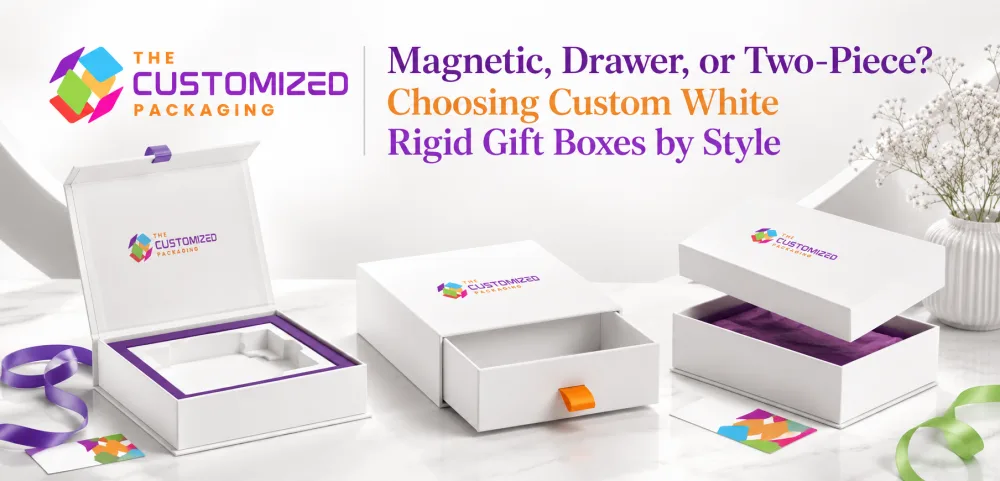

Custom White Rigid Gift Boxes: How to Build One Packaging System Across Products and Campaigns
A white rigid box does not need to be redesigned for every product launch or gifting campaign. Learn how one master structure can support multiple products through interchangeable inserts, sleeves, ribbons, cards and controlled branding changes.
 Published June 28, 2026
Updated September 03, 2026
14 min read
Published June 28, 2026
Updated September 03, 2026
14 min read
White rigid packaging has one advantage that goes far beyond appearance: it can act as a neutral foundation for many different products and campaigns.
A beauty brand may use the same white box for skincare sets, influencer kits and holiday launches. A corporate gifting program may keep one outer structure while changing the contents, ribbon and message. A jewelry brand may use the same exterior across several collections while changing only the insert.
That makes custom white rigid gift boxes especially useful when a brand wants packaging consistency without creating a completely new box for every SKU or occasion.
The goal is not to force every product into one package.
It is to identify which products can genuinely share the same structure and then use inserts, sleeves, interior colors, cards and other changeable elements to create the right presentation for each version.
Start With the Products That Actually Share Dimensions
Before creating a master box, group products by physical compatibility.
Compare:
-
Product length
-
Product width
-
Product height
-
Packed weight
-
Insert requirements
-
Number of items
-
Opening orientation
Products do not need to be identical.
They only need to fit the same outer structure without looking undersized, becoming compressed or requiring excessive filler.
For example, one white rigid box may work for:
-
Skincare jar + serum set
-
Candle + matches gift set
-
Wallet + card holder
-
Jewelry collection
-
Small corporate kit
But that does not mean all five should automatically share one box.
Test the actual packed arrangements first.
Separate the Master Box From the Product-Specific Interior
A scalable white rigid packaging system usually has two layers.
The Master Structure
This is the part that remains stable:
-
Exterior dimensions
-
Box style
-
White exterior
-
Main logo placement
-
Core typography
-
Lid or closure
-
General opening experience
The Changeable Interior
This can adapt according to the product:
-
Insert
-
Divider
-
Product platform
-
Interior color
-
Printed card
-
Sleeve
-
Ribbon
-
Product label
-
Campaign message
This approach lets custom white rigid gift boxes remain recognizable while the contents change.
White Works Well as a Shared Exterior
White provides a visually neutral foundation.
That makes it easier to introduce different:
-
Product colors
-
Brand accents
-
Campaign artwork
-
Interior trays
-
Ribbons
-
Seasonal elements
without changing the complete outer package.
For example:
Core box: white exterior + black logo
Skincare version: blush insert
Men's grooming version: charcoal insert
Holiday version: burgundy sleeve
Corporate version: navy ribbon
The package family remains consistent because the outer structure and main branding stay the same.
Keep the Permanent Branding Simple
The more products a box needs to support, the more careful you should be about permanent exterior artwork.
A shared box should usually avoid product-specific information that could make it unusable for another SKU.
Strong permanent elements may include:
-
Company logo
-
Brand mark
-
Core color
-
Website
-
Subtle pattern
-
General brand message
Be cautious about permanently printing:
-
Product name
-
Seasonal date
-
Limited-time campaign
-
Specific recipient
-
Short-lived promotional offer
Those elements can be added through changeable components instead.
Use Inserts to Adapt One Box to Different Products
The insert is often the most important variable component.
One outer box can sometimes support several product layouts simply by changing the insert.
For example:
Insert A: fragrance bottle
Insert B: candle jar
Insert C: jewelry set
Insert D: corporate accessories
The outer white rigid box remains the same.
Only the interior configuration changes.
This can make packaging easier to coordinate across a product line while still giving each item a deliberate fit.
Do Not Use One Insert for Products That Need Different Support
Standardizing the exterior does not mean standardizing everything.
A glass bottle may need different support from:
-
Apparel
-
Jewelry
-
Cosmetics
-
Electronics
Trying to make one universal insert work across very different products can reduce protection and presentation quality.
Keep the shared element where it makes sense:
outer structure
and allow the interior to change where the product requires it.
Use Interior Color to Differentiate Product Families
A white exterior can remain consistent while the inside communicates the specific collection.
For example:
| Collection | Exterior | Interior |
|---|---|---|
| Skincare | White | Soft beige |
| Fragrance | White | Black |
| Jewelry | White | Deep green |
| Holiday | White | Burgundy |
| Corporate | White | Navy |
This creates a strong reveal when the box opens without requiring several completely different outer cartons.
Interior color can come from:
-
Printed tray
-
Colored insert
-
Tissue
-
Paper lining
-
Card
-
Ribbon
The product itself should guide the final choice.
Sleeves Are Useful for Seasonal Campaigns
A removable sleeve can completely change the appearance of a standard white rigid box.
That makes sleeves useful for:
-
Christmas
-
Valentine's Day
-
Mother's Day
-
Product launches
-
Corporate events
-
Limited editions
The permanent box can remain relatively timeless.
The sleeve carries the temporary campaign artwork.
Once the campaign ends, the underlying box specification can still be used for other programs.
Keep Seasonal Artwork Outside the Master Box When Possible
If a campaign lasts only a few weeks, printing the entire message permanently onto a large quantity of boxes can create leftover inventory.
A flexible system can keep:
Box: evergreen branding
while changing:
Sleeve / card / ribbon / label: seasonal branding
This gives brands more room to adjust future campaigns without discarding otherwise usable boxes.
Ribbons Can Change the Character Without Changing the Box
A ribbon is a simple way to adapt the same white box to different uses.
For example:
-
Black ribbon for luxury retail
-
Gold ribbon for holiday gifting
-
Blush ribbon for bridal events
-
Navy ribbon for corporate programs
-
Printed ribbon for a launch campaign
The main structure stays the same.
The color and presentation change.
This can be especially useful for gift programs where the box needs to look different without requiring another structural production run.
Cards Can Carry the Product-Specific Message
A printed card allows more flexibility than putting every message directly onto the box.
Cards can include:
-
Product information
-
Campaign story
-
Recipient message
-
Instructions
-
QR code
-
Launch details
-
Seasonal greeting
They can sit:
-
On top of the product
-
Inside the lid
-
In a dedicated slot
-
Under a ribbon
-
Inside an insert pocket
This lets one box support multiple uses while keeping the customer-facing information relevant.
Use One White Box Across Several SKUs Only When Fit Still Looks Intentional
A shared structure works best when products have reasonably compatible dimensions.
If one product fills 90% of the box while another fills only 35%, the second version may look oversized.
That creates unnecessary empty space and can weaken the presentation.
Test each intended product physically.
Ask:
-
Does it look centered?
-
Is there excessive unused space?
-
Does the insert become unusually large?
-
Is the product easy to remove?
-
Does the package still feel proportional?
If the answer is no, create another master size instead of forcing the product into the wrong box.
Build Two or Three Master Sizes Instead of One Universal Box
Many brands can achieve better consistency with a small family of standard rigid boxes.
For example:
Small: jewelry, cosmetics, accessories
Medium: candles, skincare sets, fragrance
Large: corporate gifts, multi-product kits
The exact groups depend on the products.
This approach can provide consistency without creating a separate structure for every SKU.
Give Each Master Structure a Packaging Code
Once several box sizes exist, assign internal codes.
For example:
WR-01 — small white rigid box
WR-02 — medium white rigid box
WR-03 — large white rigid box
Then track the insert separately:
IN-A — jewelry insert
IN-B — candle insert
IN-C — skincare insert
This helps teams distinguish between the permanent box specification and the product-specific interior.
Create a Box-to-Product Matrix
A simple matrix can prevent packaging mistakes.
| Product | Box | Insert | Variable Component |
|---|---|---|---|
| Serum set | WR-01 | IN-S1 | Skincare card |
| Candle | WR-02 | IN-C1 | Fragrance sleeve |
| Watch | WR-01 | IN-W1 | Black interior |
| Holiday kit | WR-03 | IN-H1 | Seasonal ribbon |
| Corporate kit | WR-03 | IN-COR | Personalized card |
This becomes particularly useful when several departments or fulfillment teams use the same packaging inventory.
Use White Packaging Across Product Launches
New launches often need packaging quickly.
If the brand already has an approved white rigid structure, a new product may only require:
-
New insert
-
New sleeve
-
Updated card
-
Different interior print
rather than starting the entire structural development process from the beginning.
That can make campaign planning more consistent.
The structure should still be checked with the actual new product before production.
Influencer Kits Can Use the Same Master Box as Retail Gift Sets
An influencer kit may contain more storytelling material than the standard retail product.
That does not always require a new outer box.
A shared rigid structure might use:
Retail version: product + simple insert
Influencer version: product + campaign card + QR code + secondary sample
The interior changes while the main white exterior remains recognizable.
Only use this approach if the additional products still fit safely and comfortably.
Corporate Gifting Benefits From a Neutral Base
Corporate gifting programs often involve different recipients, events and messages.
A white rigid box can provide a stable foundation while changing:
-
Company ribbon
-
Personalized card
-
Event sleeve
-
Interior insert
-
Recipient name
-
Campaign color
This can be useful when the same gift-box structure is used throughout the year for:
-
Employee onboarding
-
Client appreciation
-
Conferences
-
Executive gifts
-
Holiday programs
The packaging remains consistent without making every event look identical.
Personalized Programs Need Variable Elements
If every recipient needs a different name or message, do not automatically make every outer box a unique printed version.
Depending on the campaign, personalization can be added through:
-
Printed sleeve
-
Name card
-
Label
-
Gift tag
-
Interior message
-
Variable printed band
This preserves the reusable master structure while still creating an individual experience.
Keep Product-Specific Barcodes Off Shared Boxes
If one master box serves several SKUs, product-specific barcodes or inventory codes should be handled carefully.
A barcode permanently printed on the outer box may make the package usable for only one product.
Instead, product-specific identification may be applied through an appropriate:
-
Label
-
Sleeve
-
Insert
-
Removable sticker
-
Secondary carton
The correct method depends on retail and operational requirements.
The goal is to avoid turning a flexible shared box into dedicated inventory by accident.
Plan Photography Around the Shared Structure
One white rigid packaging system can make product photography more consistent.
If every product uses the same:
-
Box color
-
Logo position
-
Opening angle
-
General proportions
the product line can be photographed using a repeatable visual style.
The variable interior or product color then becomes the main point of difference.
This can create a cleaner collection page while still making each product recognizable.
White Makes Small Differences More Visible
When several boxes share one white exterior, inconsistencies become easier to notice.
Compare samples for:
-
White shade
-
Logo position
-
Corner finish
-
Edge coverage
-
Lid alignment
-
Surface marks
-
Interior color
The boxes should look like part of the same family when placed next to one another.
A slight shade difference may be difficult to notice by itself but obvious when two production batches sit side by side.
Keep an Approved Reference Sample
For repeat programs, keep one approved finished box as the reference.
That sample can help future orders maintain consistency in:
-
White tone
-
Logo placement
-
Finish
-
Lid fit
-
Interior layout
-
Overall appearance
Photos are useful, but a physical reference can make subtle differences easier to compare.
This is especially helpful when the same packaging is reordered across multiple campaigns.
Test Changeable Components Together
A sleeve may look correct by itself but become too tight once placed around the finished rigid box.
A new insert may raise the product too high.
A thick card may interfere with the lid.
A new ribbon may cover the logo.
Every variable component should be tested as part of the complete package.
For custom white rigid gift boxes, the final approval should include:
box + insert + product + sleeve/ribbon/card + closure
not isolated components.
Know When to Stop Standardizing
A shared system is useful only while the products remain compatible.
Create another box structure when:
-
Product dimensions change significantly
-
Product weight increases substantially
-
New contents need much more depth
-
Glass or fragile products need stronger support
-
Presentation looks noticeably oversized
-
The opening experience needs to change
-
A different shipping configuration is required
Packaging consistency should never come at the expense of fit or product protection.
Custom White Rigid Packaging System Checklist
Before using custom white rigid gift boxes across several products or campaigns, confirm:
-
Products have compatible outer dimensions
-
Packed weights are suitable for the shared structure
-
One master box specification is documented
-
Product-specific inserts are identified
-
Exterior branding remains evergreen
-
Temporary campaign details stay variable
-
Seasonal artwork uses suitable sleeves, cards or other components
-
Interior colors follow a planned system
-
Barcodes and SKU information are handled correctly
-
Each product version still looks proportional
-
Changeable components fit without affecting closure
-
Master box sizes are clearly coded
-
Product-to-box assignments are documented
-
Repeat-order reference samples are retained
-
Several finished versions still look like one brand family
A flexible packaging system should make your product line easier to manage, not harder.
Frequently Asked Questions About Custom White Rigid Gift Boxes
Can one white rigid gift box be used for several products?
Yes, when the products have compatible dimensions, weight and protection requirements. Different inserts can adapt the same outer structure to individual products.
Why are white rigid boxes useful for multiple product lines?
A white exterior provides a neutral visual foundation that can work with different product colors, interior trays, sleeves, ribbons and campaign artwork while maintaining a consistent brand appearance.
Can one rigid box use several different inserts?
Yes. A shared outer box can use product-specific paperboard, molded pulp, foam, EVA, corrugated or other appropriate inserts depending on the item.
How can seasonal packaging use the same white box?
Keep the core box relatively evergreen and introduce seasonal design through removable sleeves, ribbons, cards, labels or interior components.
Should every SKU have its own printed rigid box?
Not always. If several products can share one structure, product-specific information may be added through sleeves, labels, inserts or other variable components instead of producing a completely separate box for every SKU.
Can white rigid boxes be used for corporate gifting?
Yes. A shared white box can be adapted for employee, client, conference and holiday programs using different ribbons, inserts, messages and personalized cards.
Can white rigid gift boxes use different interior colors?
Yes. Changing the insert, tray, lining or interior print is one way to distinguish collections while keeping the exterior consistent.
When should a product get a separate box size?
A separate structure is usually appropriate when the product no longer fits proportionally, requires different protection, has significantly different dimensions or weight, or needs a different opening experience.
How should repeat white rigid packaging be kept consistent?
Document the box specification, keep an approved physical reference sample where practical, and compare repeat production for white shade, branding position, fit and surface quality.
Should all interchangeable components be sampled?
Yes. Test the final box with the actual insert, product, card, sleeve, ribbon and other components to confirm fit and closure before production.
Build a Packaging Family Instead of a Collection of Unrelated Boxes
The biggest advantage of custom white rigid gift boxes is not simply that white looks clean.
It is that a neutral rigid structure can become a stable foundation for many different products and campaigns.
Keep the outer dimensions, white exterior and core branding consistent where the products allow it. Then adapt the interior, sleeve, ribbon, card or product-specific information according to the SKU or campaign.
Some brands may need one master structure.
Others may need two or three sizes.
The goal is not to make every product fit one box. It is to create the smallest practical family of packaging structures that can support the product range without compromising fit or presentation.
The Customized Packaging develops custom white rigid gift boxes around your products, dimensions, insert requirements and campaign needs. Share your product range and intended uses to develop a coordinated rigid-box system that can remain consistent across multiple collections.