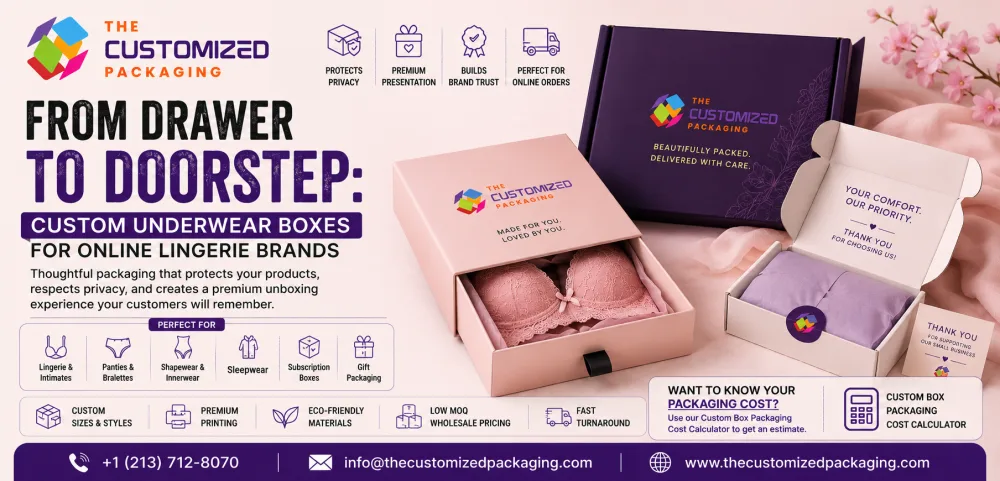

Custom Underwear Boxes: How to Size Packaging for Briefs, Boxers, Lingerie and Multipacks
A medium boxer brief, padded bra and three-pack of panties can require very different packaging even when they belong to the same apparel collection. Learn how the final garment fold, fabric bulk, waistband, cups and pack quantity determine the right underwear box dimensions.
 Published June 09, 2026
Updated September 03, 2026
17 min read
Published June 09, 2026
Updated September 03, 2026
17 min read
Underwear is soft, flexible and easy to fold, which can make packaging dimensions seem straightforward.
In practice, that flexibility is exactly what makes sizing difficult.
A pair of briefs can be folded tightly or loosely. Boxer briefs gain thickness around the waistband. A padded bra cannot be compressed in the same way as an unstructured bralette. A three-pack may need almost three times the depth of a single garment—or considerably less if the products are arranged differently.
That is why custom underwear boxes should be sized around a standardized final garment fold rather than the garment’s labeled size alone.
Before selecting the box dimensions, decide how the product will be folded, how much natural thickness it should retain and how many garments will go into each package.
Once that packing method is consistent, the box can be designed around the real product instead of an estimated size.
Start With the Garment Exactly as It Will Be Packed
Do not measure underwear while it is unfolded on a table.
Prepare it exactly as the customer will receive it.
That may include:
-
Final garment fold
-
Waistband orientation
-
Tissue wrap
-
Paper band
-
Product card
-
Size label
-
Inner pouch or bag
-
Support card
-
Additional garments in a multipack
Then measure the complete package.
For custom underwear packaging, the useful dimensions are the final:
folded length × folded width × natural packed depth
These measurements are much more useful than waist size, garment size or flat manufacturing dimensions.
Standardize the Fold Before You Standardize the Box
If different employees fold the same garment differently, one custom box size will never fit consistently.
Create a repeatable folding method before approving the packaging.
For example, a boxer brief might be folded by:
-
Laying the garment flat
-
Folding both sides inward
-
Folding the lower section upward
-
Positioning the waistband at the front
-
Keeping the final rectangle within an approved width
The exact fold depends on the product.
The important point is that the packing team uses approximately the same method every time.
A box can only be accurately sized around a consistent packed shape.
Measure the Fold Without Excessive Compression
Soft garments are easy to squeeze while measuring.
That can produce a misleading box depth.
Place the folded product naturally on a flat surface and allow the fabric to settle.
Measure the thickness without pressing heavily downward.
The packaging should control the fold without unnecessarily compressing the garment.
This is especially important for:
-
Padded underwear
-
Heavy cotton
-
Thermal fabrics
-
Ribbed materials
-
Thick waistbands
-
Lace
-
Shapewear
-
Multi-layer garments
A box that technically closes only because the garment has been heavily compressed may be too shallow for regular packing.
Waistbands Often Determine the Final Depth
The fabric body of boxer briefs or briefs may be relatively thin, but the elastic waistband can create a much thicker section when folded.
If several waistband layers stack on top of one another, the final pack depth can increase quickly.
Before sizing the box, look at where the waistband sits within the fold.
Possible approaches include:
-
Waistband facing forward
-
Waistband folded behind
-
Waistband positioned across the top
-
Garments alternated within a multipack
Changing that orientation can change the final thickness of the pack.
The goal is to create a consistent presentation without forcing a thick elastic section into a box that was measured from the thinner fabric body.
Boxer Briefs Need More Depth Than Their Flat Shape Suggests
Boxer briefs contain more fabric than standard briefs.
Longer leg panels and substantial waistbands can create additional bulk once folded.
When testing custom underwear boxes for boxer briefs, check:
-
Folded leg thickness
-
Waistband position
-
Front pouch
-
Seams
-
Fabric weight
-
Single vs multipack quantity
A lightweight performance boxer brief can compress differently from a heavyweight cotton style even when both are labeled the same size.
The box should be based on the actual finished product.
Briefs and Panties Can Often Use Shallower Packaging
Standard briefs, bikinis, thongs and similar lightweight products usually create less packed depth.
That can make them suitable for relatively shallow folding cartons or sleeves.
However, do not assume every women’s underwear style can use one identical package.
Differences may come from:
-
Lace
-
Decorative trims
-
Thick elastic
-
High-waisted designs
-
Seamless construction
-
Multiple layers
-
Attached accessories
Measure representative products before standardizing the box.
High-Waisted Underwear Changes the Fold
High-waisted briefs contain more fabric vertically.
If folded using the same method as a lower-rise style, the finished package may become thicker or longer.
A better option may be to change the folding pattern while keeping the final exterior dimensions consistent.
For example, the garment may use an additional horizontal fold so the finished footprint matches the standard box.
The important consideration is whether that extra fold creates undesirable bulk or visible creasing.
Test the actual garment before deciding that one fold works for every rise.
Bras Need a Completely Different Sizing Approach
A bra should not automatically be treated like folded briefs.
Structured cups create three-dimensional volume.
Underwire, molded padding and hardware can also be affected by excessive compression.
For bras, measure:
-
Cup projection
-
Band fold
-
Strap arrangement
-
Underwire width
-
Fastener position
-
Padding thickness
The final box needs to accommodate the bra without flattening the cups unnecessarily.
This may require a wider or deeper structure than packaging used for panties from the same collection.
Molded Cups Should Keep Their Shape
Padded and molded bras require particular care.
If the packaging forces one cup flat or folds the cup sharply, the garment may not return to its intended presentation immediately after opening.
A better packed arrangement may nest the cups where the garment construction allows it or use a box deep enough to preserve the shape.
Test the garment after it has remained packed for a realistic period.
Open the box and check whether:
-
Cups retain their form
-
Fabric shows pressure marks
-
Straps remain organized
-
Hardware has pressed into another surface
The packaging should be judged by how the garment looks after removal, not only how efficiently it fits inside the closed box.
Bralettes Can Often Pack Flatter
Unstructured bralettes generally create less rigid volume than molded bras.
They may be folded more similarly to soft apparel, depending on their fabric and construction.
However, delicate lace, decorative straps and elastic still need to be arranged carefully.
Avoid trapping straps underneath heavy folds or allowing metal adjusters to press against delicate fabric.
The final packed arrangement should look intentional when the customer opens the box.
Lingerie Sets Need a Planned Arrangement
A coordinated lingerie set may contain:
-
Bra
-
Panty
-
Garter
-
Stockings
-
Accessory
-
Product card
Do not simply stack everything until it fits.
Decide which product should be seen first.
A common layout may place the bra as the main visual element with the matching panty folded beneath or beside it.
Another set may use separated compartments.
The arrangement determines the required box dimensions.
For custom lingerie boxes, product presentation and physical fit should be planned together.
Shapewear Has High Compression but Should Not Be Measured Fully Compressed
Shapewear is designed to stretch and compress during wear.
That does not mean it should be packed under maximum compression.
Control briefs, shaping shorts and bodysuits can rebound strongly after folding.
If the box is too shallow, the garment may push upward against the lid or flap.
Measure the shapewear in its intended retail fold and allow its natural packed thickness.
Then test whether the box stays closed without excessive pressure.
Bodysuits Need More Fold Planning
Bodysuits have longer garment dimensions and often include snaps, hooks or shaped panels.
One fold may position hardware directly against delicate fabric.
Another may create excessive thickness in one section.
Test several folding arrangements before choosing the final pack dimensions.
The preferred fold should:
-
Keep hardware away from vulnerable fabric
-
Maintain a clean front presentation
-
Avoid unnecessary creases
-
Fit consistently across sizes
Once the fold is approved, document it for production packing.
Multipacks Should Be Sized as One Product
A three-pack of underwear is not simply one garment multiplied by three.
The final dimensions depend on how the products are arranged.
Possible multipack layouts include:
-
Stacked directly
-
Alternated waistbands
-
Individually banded then stacked
-
Side-by-side
-
Layered in separate sections
-
Rolled
-
Divided
Different arrangements produce different depth and width.
Build the full multipack first, then measure it as one packaged unit.
Alternate Thick Areas in a Multipack
If every waistband is stacked in exactly the same location, one edge of a three-pack can become much thicker than the other.
Alternating the garment orientation may distribute the bulk more evenly.
For example:
Garment 1: waistband toward front
Garment 2: waistband toward rear
Garment 3: waistband toward front
The exact pattern depends on the garment.
The objective is to create a more balanced pack rather than a wedge-shaped stack.
Multipack Depth Should Be Tested Under Normal Packing Pressure
A stack of three products can expand after it is released.
Measure it in the condition it will actually occupy inside the box.
If a paper band or inner wrap provides gentle control, include that in the test.
Do not squeeze the multipack tightly by hand and measure the compressed depth unless the final packaging genuinely maintains that pressure.
The box should close consistently without forcing the contents.
Decide Whether One Box Can Cover Several Garment Sizes
An underwear brand may offer XS through XXL or beyond.
Creating a separate box for every apparel size can become unnecessarily complicated.
The first question should be:
How much do the final folded dimensions actually change?
Garments can vary significantly when worn while still folding into very similar packaged footprints.
If XS, S, M and L all fit one approved box without looking loose or compressed, they may be able to share a packaging size.
Larger garments may require a second size group.
Test before deciding.
Build Size Groups From Folded Dimensions
A practical packaging system might use:
Box A: XS–L
Box B: XL–3XL
This is only an example.
The correct grouping comes from your actual garments.
Measure representative products at the smallest and largest size in each proposed group.
Then check:
-
Folded length
-
Folded width
-
Packed depth
-
Closure
-
Product removal
-
Overall presentation
If both extremes work well, the intermediate sizes are usually easier to accommodate.
Test the Smallest Product for Excess Empty Space
Packaging is not only about whether the largest garment fits.
A box large enough for XXL may make an XS product look lost inside.
Excess space can allow the garment to:
-
Slide
-
Rotate
-
Lose its fold
-
Look poorly presented
If the smallest product looks significantly undersized, another size grouping may be justified.
A shallow paper band, support card or tissue wrap may help with minor differences, but it should not be used to compensate for a badly oversized box.
Test the Largest Product for Compression
At the other end of the range, the largest garment should not require force.
Watch for:
-
Bulging side panels
-
Lid or tuck flap lifting
-
Sleeve becoming difficult to slide
-
Garment edges catching
-
Fabric becoming excessively compressed
If the largest SKU only fits when packed unusually tightly, it does not truly fit that box size.
Move it into a larger packaging group.
Standardize Around the Finished Fold, Not Clothing Size Labels
Size labels vary between brands.
A “Medium” from one collection may have a different amount of fabric from a Medium in another.
Therefore, custom underwear box sizing should never use labels such as S, M or L as structural measurements.
Use the real packed dimensions.
The apparel size is important for customer identification.
The folded dimensions are what determine packaging fit.
Fabric Weight Changes Packaging Depth
Two boxer briefs with identical patterns can pack differently if one uses lightweight microfiber and the other uses thick cotton.
Fabric characteristics that affect package thickness include:
-
GSM or fabric weight
-
Ribbing
-
Brushing
-
Padding
-
Multiple layers
-
Reinforcement panels
-
Waistband thickness
When a brand introduces a new material collection, do not assume the existing box automatically remains appropriate.
Run a fresh fit check.
Seams and Hardware Create Local Thickness
The overall fabric may be thin, but concentrated areas can create pressure points.
Examples include:
-
Waistband seams
-
Hooks
-
Snaps
-
Adjusters
-
Underwire
-
Decorative rings
-
Labels
-
Thick hems
Arrange the fold so hard components do not press unnecessarily into delicate surfaces.
A box that is slightly deeper but protects the garment presentation may be better than an ultra-tight pack.
Use Fold Support Only When It Solves a Real Problem
Soft apparel may benefit from simple supports such as:
-
Paperboard folding card
-
Waistband card
-
Paper band
-
Tissue wrap
-
Shallow tray
These components can help maintain shape and alignment.
But a complicated rigid insert is rarely necessary simply because an underwear product is premium.
The support should match the garment.
For most soft products, keeping the fold neat is more important than locking the product into a precision-cut cavity.
Window Packaging Needs a Consistent Fold
If a retail underwear box uses a window, the product must appear in the same location every time.
That requires a controlled fold.
Decide what the window should reveal:
-
Waistband
-
Fabric pattern
-
Color
-
Logo
-
Texture
-
Product style
Then position the garment accordingly.
A window designed around a perfectly arranged sample will fail if normal packing places the waistband two inches lower.
Test multiple packed units before approving the window position.
Keep Size Identification Easy to Find
Retail customers often need to compare:
-
Size
-
Style
-
Color
-
Pack quantity
-
Fit
Keep those identifiers in predictable locations.
For example, every box might place:
size: upper-right corner
color: lower front
quantity: beside product name
The exact layout is a branding decision.
Consistency is the important part.
Customers should not need to rotate every SKU to find the size.
Multipacks Need Clear Quantity Identification
A customer should immediately know whether the box contains:
-
One pair
-
Two-pack
-
Three-pack
-
Five-pack
Do not rely only on package depth to communicate quantity.
The quantity should be clearly identified as part of the product information.
This becomes particularly important when single and multipack versions use similar artwork.
Keep Product Information Separate From Box-Sizing Decisions
The same physical box can sometimes support several artwork versions.
For example:
Box A structure
may be used for:
-
Black boxer brief
-
Navy boxer brief
-
Grey boxer brief
-
Several sizes
while the printed SKU, size and color information changes.
That allows brands to standardize the physical packaging system without making every product look identical.
The structural box and artwork version should be managed as separate specifications.
Create a Garment-to-Box Matrix
Once the size system is approved, document it.
For example:
| Product | Fold | Pack Quantity | Box |
|---|---|---|---|
| Men's boxer brief XS–L | Standard waistband-forward | 1 | UB-01 |
| Men's boxer brief XL–3XL | Standard waistband-forward | 1 | UB-02 |
| Men's boxer brief XS–L | Alternating stack | 3 | UB-03 |
| Women's brief XS–XL | Flat compact fold | 1 | UB-04 |
| Soft bralette | Cup-preserving fold | 1 | UB-05 |
Your actual system may be simpler.
The purpose is to prevent staff from guessing which box goes with which garment.
Document the Folding Method Too
A packaging specification is incomplete if it only lists box dimensions.
Record:
-
Fold direction
-
Finished garment orientation
-
Waistband position
-
Product card location
-
Tissue or band
-
Multipack arrangement
Photos can be particularly useful for fulfillment teams.
A repeatable fold keeps the packaging system working as intended.
Sample the Box With Several Real Garments
Do not approve custom underwear boxes using paper or foam blocks that merely imitate dimensions.
Use the actual garments.
Test representative extremes:
-
Smallest size
-
Largest size
-
Thickest fabric
-
Thinnest fabric
-
Single pack
-
Multipack
-
Most structured garment
Then evaluate how each one looks after removal from the box.
The garment should remain presentable, not merely fit.
Leave a Packed Sample Closed Before Final Approval
A fit may look fine immediately after packing but behave differently after several hours or days.
For products with elastic, molded cups or compressive fabrics, leave representative samples packed for a realistic period.
Then open them and inspect:
-
Fold retention
-
Creases
-
Cup shape
-
Pressure marks
-
Waistband deformation
-
Hardware position
This gives you a better understanding of the actual customer experience.
Run a Packing-Line Test
Ask the people who normally prepare orders to pack several units consecutively.
Observe whether the dimensions work in normal operations.
Look for repeated problems such as:
-
Fold varies too much
-
Product catches on the opening
-
Box is difficult to close
-
Multipack expands
-
Staff use excessive pressure
-
Size versions are easily confused
A good packaging system should be repeatable during normal production, not only during a carefully staged prototype.
Custom Underwear Box Sizing Checklist
Before approving custom underwear boxes, confirm:
-
Final garment fold is standardized
-
Folded length is measured
-
Folded width is measured
-
Natural packed depth is measured
-
Waistband thickness is included
-
Fabric bulk is considered
-
Cups and underwire are protected where applicable
-
Hardware does not create harmful pressure points
-
Single and multipack configurations are measured separately
-
Smallest size is tested
-
Largest size is tested
-
Size groups are based on actual folded dimensions
-
Window position matches the production fold where applicable
-
Product quantity is clearly identified
-
Box closes without excessive compression
-
Product removes easily
-
Garment remains presentable after unpacking
-
Fulfillment staff can reproduce the fold consistently
The right dimensions come from the packed garment—not from the clothing size printed on its label.
Frequently Asked Questions About Custom Underwear Boxes
How do I measure underwear for a custom box?
Fold the garment exactly as it will be packed, including any tissue, support card or inner wrap. Measure the finished folded length, width and natural depth without heavily compressing the fabric.
Can different underwear sizes use the same box?
Often they can. Several apparel sizes may fold to very similar dimensions. Test the smallest and largest garments in the proposed size group before standardizing them into one box.
Do boxer briefs need deeper boxes than briefs?
Often yes because boxer briefs typically contain more fabric and can have thicker stacked waistbands. The actual depth depends on fabric weight, folding method and pack quantity.
How should bras be measured for packaging?
Measure the bra in its intended packed arrangement, including cup projection, band fold, straps, underwire and padding. Molded cups should not be unnecessarily flattened simply to reduce box depth.
Can one box be used for single underwear and multipacks?
Sometimes, but only when the finished packed dimensions remain compatible. A multipack generally requires a separate fit test because stacking several waistbands and fabric layers changes the depth.
How do you stop underwear from moving inside a box?
Start with a correctly sized box and consistent fold. Paper bands, tissue, folding cards or shallow supports can provide additional control where needed without overengineering the package.
Should shapewear be compressed inside its packaging?
It may naturally compress to some degree, but the package should not rely on extreme compression just to close. Measure shapewear in its intended retail fold and test how the garment looks after being unpacked.
Can window underwear boxes work across several sizes?
Yes, if the approved folding method places the visible product area in approximately the same position. Test several sizes to confirm that the waistband, fabric or other intended feature remains aligned with the window.
Do different fabrics need different box sizes?
They can. Heavy cotton, thermal fabrics, padded materials and thick elastic may create greater packed depth than lightweight microfiber or seamless fabrics, even when garment dimensions are otherwise similar.
Should I sample custom underwear boxes with actual garments?
Yes. Real garments reveal fabric bulk, elastic rebound, folds, cups, hardware and size variation that cannot be accurately represented by a simple dimensional placeholder.
Size the Box Around the Fold Customers Will Actually Receive
The best custom underwear boxes begin with the garment after it has been prepared for packing.
Standardize the fold.
Measure its natural dimensions.
Account for waistband thickness, fabric bulk, structured cups and multipack quantity.
Then determine which products can reasonably share one packaging size and which need another.
That creates a cleaner system than ordering a different box for every apparel size—or forcing an entire product range into one oversized carton.
The Customized Packaging develops custom underwear boxes around your finished garment folds, size range, pack quantities and retail or presentation requirements. Share representative products or folded measurements from your collection to develop a practical packaging-size system before production.