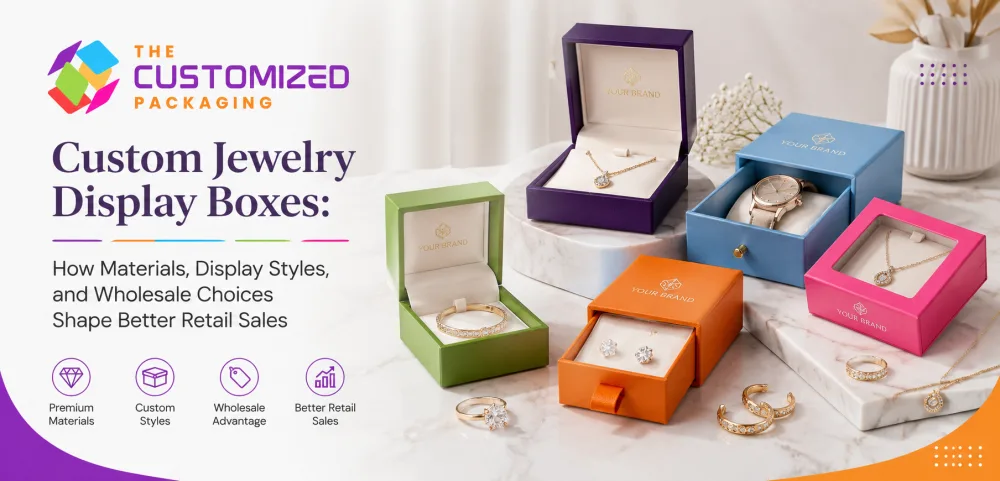
How to Choose Custom Jewelry Display Boxes for Better Retail Presentation
A jewelry display box should frame the product rather than compete with it. Learn how jewelry type, display angle, insert height, color contrast and retail presentation work together to showcase rings, earrings, necklaces, bracelets and watches.
 Published June 29, 2026
Updated August 31, 2026
13 min read
Published June 29, 2026
Updated August 31, 2026
13 min read
Jewelry packaging has an unusual job. It needs to protect a small product while making that product feel visually important.
A ring can disappear inside an oversized box. A necklace can lose its shape if the chain moves. Earrings can look uneven when their spacing is wrong, and a watch can rotate on a poorly fitted cushion.
Effective custom jewelry display boxes solve these problems by designing the presentation around the jewelry itself.
The box, insert, viewing angle, interior color and opening style should work together to place attention where it belongs: on the product.
What Is a Jewelry Display Box?
A jewelry display box is packaging designed to hold a piece of jewelry in a deliberate viewing position rather than simply contain it.
The distinction matters.
Ordinary packaging can keep a product enclosed. Jewelry display packaging should also control how a ring, necklace, bracelet, pair of earrings or watch appears when the box is opened or presented.
That often means considering:
-
Where the product sits inside the box
-
Which part of the jewelry faces the customer
-
How high or low the item sits in the insert
-
How much empty space surrounds it
-
Whether chains, posts or straps remain controlled
-
How the interior color contrasts with the jewelry
The best structure depends on what is being displayed.
Start With the Jewelry, Not the Box
Choosing a box style first can lead to compromises later.
Instead, begin by looking at the physical jewelry and deciding how it should appear when a customer sees it.
A delicate pendant and a large watch may both fit inside a square box, but they should not use the same internal presentation.
| Jewelry Type | Main Display Goal | Common Presentation Challenge |
|---|---|---|
| Ring | Keep the setting upright and visible | Ring sits too low or rotates |
| Stud earrings | Keep the pair aligned | Uneven spacing |
| Drop earrings | Show full length without tangling | Drops overlap or twist |
| Necklace | Keep the pendant centered | Excess chain becomes visible |
| Bracelet | Preserve shape and focal point | Bracelet moves or collapses |
| Watch | Support the strap and face | Watch rotates on cushion |
| Jewelry set | Create visual relationships between pieces | Layout feels crowded |
Defining the display goal first makes it easier to choose the box dimensions and internal support.
Position Rings Around the Setting
For a ring, the focal point is usually the stone, setting or decorative top.
The insert should hold the band securely while allowing the important part of the ring to remain visible.
If the ring sits too deeply in the slot, the setting can appear smaller. If the slot is too loose, the ring may lean to one side and lose the centered presentation associated with fine jewelry.
The amount of empty space matters too.
A compact presentation can make a single ring feel intentionally framed. An unnecessarily large interior can make the same piece appear visually lost.
For bridal or paired rings, spacing should show that the pieces belong together without allowing one ring to dominate the other.
Keep Earrings Balanced as a Pair
Earrings are viewed differently from most jewelry because customers naturally compare the left and right pieces.
A successful earring display box therefore depends heavily on alignment.
Studs should sit at the same height and distance from the center. Hoops need enough clearance to maintain their shape, while drop earrings need vertical space so the lower sections do not overlap.
The insert should also accommodate the parts customers do not immediately see.
Posts, hooks and backings need sufficient space behind or beneath the visible display surface. If that clearance is overlooked, the earrings may tilt forward or prevent the insert from sitting correctly.
Center Necklaces Without Showing Excess Chain
A necklace usually has one primary visual feature: the pendant, stone, charm or central design.
The display should guide attention toward that point.
Necklace inserts can use upper attachment points to control the chain while excess length is directed behind or beneath the display surface.
The goal is to avoid a loose pile of chain appearing around the pendant.
For longer necklaces, the proportions of the insert become especially important. If the display area is too short, the chain may need to bend unnaturally. If it is too wide, the necklace can lose its intended shape.
A well-designed necklace display box should make the piece look arranged rather than stored.
Support Bracelets According to Their Shape
Bracelets require different presentation strategies depending on their construction.
Fine chain bracelets can be displayed flat and secured near both ends. Bangles and cuffs often look better when their curved shape remains visible. Tennis bracelets may need several support points to maintain an even line.
The focal detail should also influence positioning.
If a bracelet includes a central charm, stone or engraved plate, that feature should remain correctly oriented when the box is opened.
The insert should control the bracelet without stretching delicate chains or forcing rigid pieces into an unnatural shape.
Design Watch Packaging Around the Complete Watch
A watch is heavier and more three-dimensional than most jewelry.
The cushion or holder should support the strap while keeping the watch face centered and easy to view.
A cushion that is too large can place unnecessary tension on the strap or closure. One that is too small can allow the watch to rotate during handling.
Case thickness also matters.
The watch face needs enough clearance from the lid so that the product does not contact the inside of the box when closed.
For watches supplied with extra straps, tools, cards or accessories, these items should be positioned separately so they support the presentation rather than crowd the watch itself.
Use Insert Height to Control Visual Importance
Insert design is not only about keeping jewelry in place.
The height of the display surface affects how the product appears inside the box.
If an item sits too low, the surrounding walls can visually dominate it. Raising the product slightly can make the jewelry easier to see and create a stronger presentation when the lid opens.
However, the jewelry should not be raised so high that it contacts the lid.
The correct height depends on the product thickness, box depth, opening angle and viewing position.
This is one reason testing the actual jewelry inside a structural sample is valuable before production.
Choose Interior Colors That Help the Jewelry Stand Out
Interior color changes how customers perceive the jewelry.
Dark backgrounds can create strong contrast with silver, diamonds, pearls and lighter stones. Cream, beige and warm neutral interiors can produce a softer presentation for gold and bridal jewelry.
The right choice depends on the collection rather than a universal rule.
For example, a black insert may create dramatic contrast for polished silver but provide less separation from black stones or dark watch straps.
A jewelry brand with several metal finishes should evaluate its interior color against all major products rather than only the hero item.
Think About Photography as Well as In-Person Display
The interior may also appear in ecommerce product photography, social media images and promotional content.
Colors and textures that look attractive in person should still allow the jewelry to remain visible under photography lighting.
The product should remain the visual focus in both environments.
Match the Opening Style to the Viewing Experience
How a jewelry box opens changes how the product is revealed.
A two-piece lid-and-base box creates a complete reveal when the lid is removed.
A hinged box keeps the lid connected and can present jewelry immediately at a controlled viewing angle.
A drawer structure introduces the product gradually as the tray slides outward.
The decision should reflect the intended experience rather than choosing a structure only because it appears premium.
For counter presentation, the open box should remain stable and allow the jewelry to be viewed comfortably. For gifting, the opening sequence may play a larger role in the experience.
Control Empty Space Around the Product
Empty space can make jewelry feel refined when it is intentional.
Too much empty space, however, can make a small piece look insignificant.
The relationship between the product and surrounding interior should therefore be considered during sizing.
A single pair of earrings generally needs less visual area than a necklace set. A watch needs enough room for the complete strap and cushion, while a small ring can benefit from compact framing.
The box should feel designed around the product rather than selected from the closest available standard size.
Design Matching Jewelry Sets as One Composition
Multi-piece collections create a different challenge.
A necklace, earrings and ring should not look like three unrelated items placed into separate cavities.
Their positions should form one visual composition.
The main piece can receive slightly more space or a stronger central position, while secondary items support it.
Spacing should remain consistent enough to communicate that the pieces form a set without making the interior feel crowded.
A customer should be able to understand the relationship between the pieces immediately after opening the box.
Consider the Customer's Viewing Angle
Packaging may be viewed from several positions depending on where the jewelry is sold.
A customer looking down into an open box at a retail counter sees the product differently from someone opening the same box at home.
For boxes designed to remain open during presentation, the viewing angle should help the jewelry remain visible rather than allowing the lid or box wall to obscure it.
This is particularly important for engagement rings, premium watches, necklaces and coordinated gift sets where the first reveal forms part of the purchase experience.
Design for Repeated Retail Handling
Display packaging may be opened more than once before the product is sold.
Customers and store staff can remove the jewelry, return it to the insert and open the package again for another customer.
The presentation system should tolerate this repeated use.
Ring slots should continue to hold the product upright. Earring cards should remain aligned. Necklace attachment points should be easy for store staff to reset, and watch cushions should allow the product to be removed without unnecessary effort.
Packaging that looks attractive only on the first opening may become difficult to use in an active retail environment.
Keep the Brand Present Without Competing With the Jewelry
Jewelry is usually the visual focal point, so branding should support rather than overpower it.
The exterior of the box can establish brand recognition before opening. Inside, a smaller logo or restrained brand element can complete the presentation while leaving visual space around the jewelry.
This is particularly useful for fine jewelry, bridal collections and watches, where excessive graphics may compete with the details customers are trying to examine.
The strongest branding does not always mean the largest logo.
It means the packaging remains recognizable while the product still receives the most attention.
Create a Consistent System Across the Collection
A jewelry brand may sell rings, necklaces, earrings, bracelets and watches in different box dimensions.
They do not need to look unrelated.
Consistent exterior materials, logo placement, interior colors, typography and opening details can create a recognizable packaging family even when the structures differ.
For example, a ring box can remain compact while a necklace box becomes longer and a watch box deeper. Shared visual elements make them feel like part of the same brand.
This approach also makes new product launches easier because future packaging can follow an established design language.
Test the Jewelry Inside the Actual Box
A digital rendering cannot completely show how jewelry will sit inside a physical insert.
Before approving the final packaging, test the intended product inside the sample.
Jewelry Display Box Checklist
-
Make sure the jewelry remains centered
-
Check that rings stay upright
-
Confirm earrings remain level as a pair
-
Make sure necklace chains stay controlled
-
Check that bracelet focal points remain visible
-
Confirm watch cushions fit without straining the strap
-
Make sure the product does not touch the closed lid
-
Test how easily the jewelry can be removed
-
View the product from the customer's normal angle
-
Compare the interior color against the jewelry
-
Open and close the sample several times
-
Test matching boxes together as a collection
These checks help identify presentation problems before they become part of a full production run.
Frequently Asked Questions About Jewelry Display Boxes
What is the difference between a jewelry box and a jewelry display box?
A jewelry box can simply store or protect the item. A jewelry display box also controls how the piece is positioned and viewed, using the interior layout to keep the jewelry centered, organized and visually presented.
What type of insert works best for jewelry?
The best insert depends on the jewelry. Rings need secure slots or holders, earrings need aligned attachment points, necklaces need chain control, bracelets need support based on their shape, and watches usually need a fitted cushion or platform.
How much space should be around jewelry inside the box?
There should be enough space to frame the item without making it look lost. The ideal amount depends on the jewelry size, display position and type of presentation.
Why does insert color matter in jewelry packaging?
The interior creates the immediate background around the product. Good contrast can make metal finishes, gemstones and details easier to see while supporting the brand's overall presentation.
Can one jewelry packaging design work across an entire collection?
Yes. Different products may require different dimensions and inserts, but consistent colors, materials, branding and design details can create one recognizable packaging family.
Should jewelry packaging be tested with the actual product?
Yes. Using the real jewelry in a physical sample helps confirm fit, viewing angle, product stability, removal, lid clearance and overall presentation before production.
Make the Jewelry the Focus of the Box
The most effective custom jewelry display boxes are designed from the product outward.
A ring needs the correct viewing angle. Earrings need balance. Necklaces need chain control. Bracelets need support that respects their shape, while watches need a stable presentation built around the case and strap.
Once those functional details are resolved, the box structure, interior treatment and branding can work around them.
That creates packaging that does more than hold jewelry. It frames the product, keeps the presentation organized and helps each piece look the way it was intended to be seen.
The Customized Packaging develops custom jewelry display boxes around your jewelry dimensions, presentation requirements, insert layout and brand identity. Share your product specifications and artwork to create packaging designed around the jewelry inside.