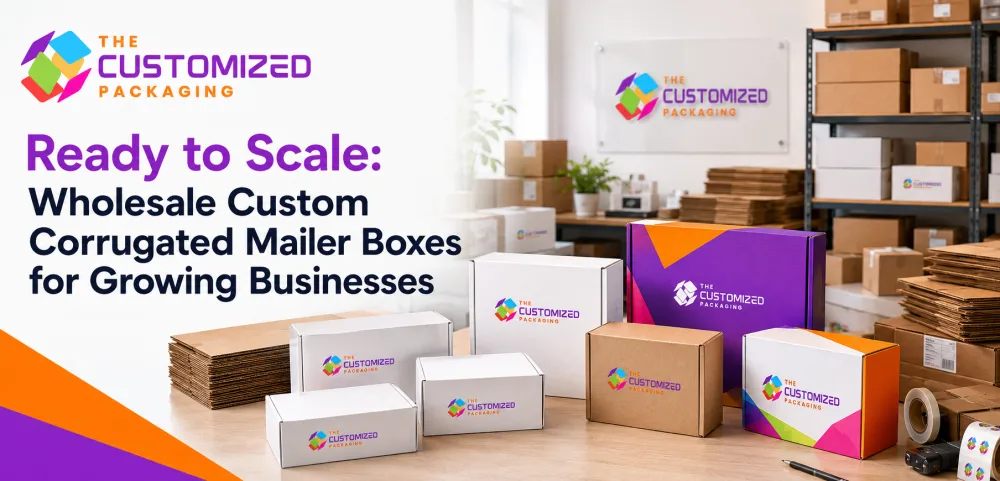

How to Choose Custom Corrugated Boxes for Product Fit and Shipping
Choosing corrugated packaging involves more than picking a box size. Learn how product weight, dimensions, flute, wall construction, box style, inserts and shipping conditions work together before you order custom corrugated boxes.
 Published June 18, 2026
Updated August 20, 2026
14 min read
Published June 18, 2026
Updated August 20, 2026
14 min read
The right custom corrugated box is not simply the thickest carton or the smallest box that can hold the product.
Corrugated packaging performs best when its dimensions, flute, wall construction, structural style and internal support are selected around what the packed product will experience.
A lightweight ecommerce order may work well in a compact corrugated mailer. Heavy manufactured components may require a stronger shipping carton. Glass bottles may need dividers, while a retail product may require a thinner corrugated structure with a smoother printing surface.
A practical specification process is:
Packed product → Shipping environment → Required strength → Box style → Internal fit → Printing → Physical test
Understanding those relationships makes it easier to select packaging without adding unnecessary material or leaving the product under-protected.
What Are Custom Corrugated Boxes?
Custom corrugated boxes are made from corrugated board that is cut, scored, folded and converted into a structure developed around a specific packaging requirement.
Corrugated board commonly combines flat liner sheets with a fluted paper medium between them.
The fluted layer creates the characteristic wave-shaped structure inside the board.
That construction helps corrugated packaging provide rigidity and cushioning while remaining relatively lightweight compared with a solid material of similar thickness.
Corrugated packaging can be produced as:
- Shipping cartons
- Mailer boxes
- Product boxes
- Subscription boxes
- Display packaging
- Telescope boxes
- Trays
- Die-cut cartons
- Heavy-duty shipping containers
The right structure depends on what the box is expected to do.
Start With the Packaging Job
Before selecting flute or board strength, determine the role of the package.
Ask:
Is it shipping one product directly to a customer?
Is it carrying several retail cartons to a distributor?
Will it sit on a store shelf?
Does it need to open like a presentation box?
Will it be stacked in a warehouse?
Is the product fragile, heavy or irregularly shaped?
These questions affect the corrugated specification.
A box designed primarily for ecommerce presentation may prioritize compact dimensions, convenient opening and printable surfaces.
A distribution carton may prioritize stacking, packing efficiency and sealing.
A retail display may need clean die-cut openings and stable product access.
Do not begin with the box style merely because it looks familiar.
Begin with the job the package must perform.
Measure the Complete Packed Product
Accurate dimensions are one of the most important parts of custom corrugated packaging.
Measure everything that will actually go inside the box.
Include:
- Product
- Primary packaging
- Inserts
- Dividers
- Protective wrap
- Accessories
- Manuals
- Product cards
- Cables
- Other components
Also record the complete packed weight.
A box designed around the bare product may become too small once the insert and accessories are added.
On the other hand, adding excessive clearance can allow movement and increase the amount of void fill required.
The target is controlled space, not simply empty space.
Understand Internal and External Dimensions
For product fit, internal dimensions are usually the most important measurements.
A common box format is:
Length × Width × Depth
Length normally describes the longer opening dimension, width the shorter opening dimension, and depth the distance from the opening to the opposite panel.
Corrugated board has thickness, so internal and external measurements are not identical.
That difference becomes more noticeable with:
- Larger flutes
- Double-wall construction
- Triple-wall construction
- Very small boxes
When requesting packaging around a product, state whether the dimensions you are providing are product dimensions, desired internal box dimensions or existing external box dimensions.
That simple clarification can prevent major sizing errors.
Choose the Wall Construction Around the Load
Corrugated board can use different numbers of fluted layers.
Single-Wall Corrugated
Single-wall board uses one fluted medium between two liners.
It works for many:
- Ecommerce shipments
- Retail products
- Apparel orders
- Books
- Cosmetics
- Small electronics
- Subscription products
- General shipping applications
It is often a practical starting point when the packed product and shipping conditions do not require a heavier construction.
Double-Wall Corrugated
Double-wall board uses two fluted layers with additional linerboard.
It may be appropriate for:
- Heavier products
- Larger cartons
- Demanding stacking
- Industrial products
- Bottles
- Tools
- Equipment
- Longer distribution routes
The extra material increases structural capability but also affects weight, cost and storage.
Do not specify double wall merely because it sounds safer.
Triple-Wall Corrugated
Triple-wall construction is used for significantly more demanding packaging applications.
Possible uses include:
- Very heavy equipment
- Industrial parts
- Machinery
- Bulk products
- Large export-style packaging
At this level, the complete packaging system should be engineered around the weight distribution, palletization, handling equipment and transportation conditions.
Choose the Flute Based on Performance
Different corrugated flute types create different combinations of thickness, cushioning, folding characteristics and print surface.
A useful general comparison is:
| Flute | General Character | Typical Direction |
|---|---|---|
| A flute | Larger profile with strong cushioning | Protective and specialty shipping |
| B flute | Firm board with good resistance to handling | Shipping, partitions and displays |
| C flute | Balanced general-purpose profile | Shipping and ecommerce cartons |
| E flute | Thin profile with cleaner folds and printing surface | Mailers and customer-facing packaging |
| F flute | Very thin corrugated profile | Small retail-style corrugated cartons |
These are practical starting points rather than automatic specifications.
Flute profiles can vary between manufacturers, and the finished performance also depends on liner and medium properties, wall construction, dimensions and box design.
A thicker flute is not automatically better.
The goal is to select the board that provides the required performance for the actual product.
Do Not Judge Corrugated Strength by Thickness Alone
Two corrugated boards of similar thickness may not perform the same way.
Corrugated box strength can also be influenced by:
- Board grade
- Liner quality
- Medium quality
- Flute orientation
- Wall construction
- Box dimensions
- Moisture conditions
- Manufacturing quality
- Product weight
- Stacking pattern
This is why specifications such as ECT or burst strength may be considered for shipping applications.
Edge Crush Test
ECT evaluates the edgewise compression resistance of corrugated board.
It becomes particularly relevant when boxes need to support loads during stacking.
Burst Strength
Burst testing evaluates the pressure required to rupture the board.
It describes a different characteristic from edge compression.
One measurement does not automatically replace the other for every packaging situation.
Your packaging supplier should evaluate the intended use of the box rather than recommending material solely from a familiar test number.
Match the Box Style to the Packing Process
The structural design affects packing, sealing, storage and customer use.
| Corrugated Style | Useful For | Main Consideration |
|---|---|---|
| Regular slotted carton | Shipping and distribution | Efficient flat storage and sealing |
| Corrugated mailer | Ecommerce and subscriptions | Opening experience and product fit |
| Die-cut product box | Product-specific packaging | Customized internal geometry |
| Display box | Retail merchandising | Product access and shelf stability |
| Telescope box | Large or variable-depth products | Top-to-bottom protection |
| Tray-and-lid | Products requiring easy access | Separate base and cover |
| Double-wall shipper | Heavy products | Higher structural demands |
The same product may use more than one corrugated structure during its journey.
For example:
Retail product box → Master shipping carton
or:
Branded corrugated mailer → Direct ecommerce shipment
Assign each layer a clear purpose.
Use Regular Slotted Cartons for Efficient Shipping
Regular slotted cartons are widely used because they are straightforward to manufacture, store flat, assemble and seal.
They work well for:
- Wholesale shipments
- Warehousing
- Moving several products
- Manufacturer distribution
- General ecommerce fulfillment
The flaps meet at the center and are normally secured using a suitable sealing method.
Their simplicity makes them efficient, but the inside still needs to match the product.
An RSC that is much larger than its contents may require additional void fill and allow excessive movement.
Use Corrugated Mailers When Opening Experience Matters
Corrugated mailers commonly use a hinged lid, roll-end walls and locking features.
They can suit:
- Ecommerce
- Subscription products
- Apparel
- Cosmetics
- Books
- Gifts
- Promotional kits
- Small electronics
Mailers can combine transit protection with a more deliberate customer presentation.
However, the box still needs to be selected for the packed weight and delivery conditions.
A visually impressive mailer is not a substitute for adequate board and internal support.
If your packaging operation depends heavily on packing speed, customer opening and returns, those factors should also be tested with the actual mailer structure.
Use Inserts to Control Product Movement
The outer box cannot perform every protective function by itself.
Corrugated box inserts and other internal supports can help:
- Hold products in position
- Separate several items
- Prevent product-to-product contact
- Protect corners
- Keep bottles upright
- Organize kits
- Reduce unnecessary movement
Possible solutions include:
- Corrugated partitions
- Die-cut corrugated inserts
- Folded paperboard supports
- Molded pulp
- Foam where appropriate
- Other product-specific supports
The insert should solve an identifiable packaging problem.
A thicker outer box combined with uncontrolled contents can still perform poorly.
Give Fragile Products Room for Protection
Right-sizing does not mean making the box fit tightly against every fragile product.
Glass, ceramics, delicate electronics and other vulnerable items may require clearance for cushioning or fitted support.
A practical protective system can be:
Product → Cushioning or insert → Corrugated box
The protective material needs enough space to perform its function.
For example, placing a glass jar directly against the corrugated wall may not provide the same protection as positioning it inside a fitted insert with controlled clearance.
Always evaluate the filled package rather than only the outer carton.
Consider Stacking and Storage Conditions
Boxes can experience pressure before they ever reach the customer.
Consider:
- Warehouse stacking
- Pallet height
- Product weight
- Time in storage
- Humidity
- Transportation
- Pallet overhang
- Uneven loads
Stacking requirements can influence wall construction, board specification and box dimensions.
Avoid allowing cartons to extend beyond the edge of a pallet where the unsupported sections may become more vulnerable to damage.
Very tall or heavy stacks also require greater attention to compression performance.
Design Around Ecommerce Shipping Conditions
An ecommerce package may move through several sorting, transportation and delivery stages.
The box should therefore be developed around:
- Packed weight
- Fragility
- Empty space
- Internal movement
- Shipping dimensions
- Closure
- Customer opening
- Returns where relevant
Right-sizing can reduce unnecessary package volume, but the box should still provide enough room for the required protection.
The strongest ecommerce package is not always the smallest package.
It is the one that balances product protection with efficient dimensions.
Keep Retail and Shipping Requirements Separate
Corrugated packaging can also be customer-facing in stores.
Retail packaging may prioritize:
- Smooth graphics
- Die-cut openings
- Windows
- Product access
- Shelf footprint
- Display stability
Shipping cartons may prioritize:
- Compression performance
- Sealing
- palletization
- Efficient packing
Sometimes one corrugated structure can support both jobs.
Other times, using a separate retail box and outer shipper creates better performance.
Do not assume one box must handle every stage.
Choose Printing After the Structure
Custom printed corrugated boxes can carry:
- Logo
- Brand colors
- Product information
- Handling instructions
- Barcode
- QR code
- Interior messaging
- Return guidance
Printing should be selected after the board and structure are established.
Common approaches include flexographic, digital and lithographic-based printing, depending on the artwork, quantity and desired presentation.
A simple shipping carton may only need a clear one-color logo and handling information.
A customer-facing ecommerce box may justify detailed full-color artwork.
The printing method should match the application rather than being selected only because one process sounds more premium.
Keep Operational Information Readable
Shipping labels, barcodes and handling information need practical panel space.
Avoid placing important operational areas across:
- Fold lines
- Deep scores
- Closure seams
- Large graphics
- Highly textured surfaces
If the same box will move through several warehouse systems, confirm where labels are normally applied before finalizing the artwork.
Brand design should work around the packaging operation instead of fighting it.
Approach Sustainability Through Specific Choices
Corrugated is primarily paper-based, and many corrugated formats may be compatible with established recycling streams depending on the complete construction and local collection system.
But broad claims should be based on the actual package.
Useful design choices may include:
- Right-sized dimensions
- Recycled-content board where specified
- Paper-based inserts
- Reduced unnecessary components
- Limited mixed materials
- Clear disposal information
Avoid assuming that brown kraft appearance alone proves a sustainability benefit.
Coatings, adhesives, labels, laminations, plastic components and inserts can affect the finished package.
Describe what the packaging actually contains.
Test Before Ordering in Quantity
A digital dieline can confirm dimensions and artwork.
It cannot fully confirm physical performance.
A sample allows you to check:
- Product fit
- Insert fit
- Assembly
- Closure
- Board behavior
- Product movement
- Customer opening
- Printing position
- Barcode readability
- Shipping practicality
For heavier, fragile or unusually shaped products, testing becomes even more important.
If the packaging is new, evaluate it with the real packed product rather than an empty sample.
What to Provide When Requesting Custom Corrugated Boxes
A useful corrugated-box request should include:
- Product dimensions
- Complete packed weight
- Quantity per box
- Product photographs
- Fragility concerns
- Preferred internal dimensions if known
- Shipping method
- Stacking requirements
- Preferred box style if known
- Insert requirements
- Printing requirements
- Order quantity
- Delivery destination
If you are replacing an existing box, also provide its dimensions and explain what is currently working or failing.
For example:
Too much empty space
Corners crushing
Product moving
Box difficult to assemble
Print quality insufficient
Those details make the next specification much more useful.
A Simple Corrugated Box Selection Framework
Use this sequence before placing an order:
1. Define the Product
Dimensions, weight, fragility and quantity
2. Define the Journey
Retail, ecommerce, warehouse, pallet, local delivery or distribution
3. Determine Internal Fit
Product plus inserts, cushioning and accessories
4. Select Required Board Performance
Flute, wall construction and appropriate strength
5. Select the Structure
Shipping carton, mailer, product box, display or another format
6. Add Internal Protection
Only where movement or impact requires it
7. Add Printing
Branding and operational information
8. Test the Filled Package
Confirm fit, handling, assembly and presentation
This order prevents visual decisions from taking priority over packaging performance.
Custom Corrugated Boxes From The Customized Packaging
The Customized Packaging develops custom corrugated boxes around product dimensions, packed weight, shipping requirements, presentation and order quantity.
Packaging options can include:
- Corrugated shipping boxes
- Custom mailer boxes
- Product boxes
- Subscription packaging
- Retail displays
- Die-cut boxes
- Single-wall packaging
- Double-wall cartons
- Custom inserts
- Dividers
- Custom printed boxes
Boxes can be produced in custom dimensions with logos, product information, interior printing and other compatible design options.
For the most useful recommendation, provide the complete packed product details and explain how the box will be stored, handled and shipped.
That allows the packaging specification to be built around the product rather than simply selecting a generic corrugated grade.
Frequently Asked Questions
What are custom corrugated boxes?
Custom corrugated boxes are packaging structures made from corrugated board and produced around specific dimensions, product weights, shipping needs, printing and internal protection requirements.
What is the difference between corrugated and cardboard boxes?
Corrugated board contains a fluted medium combined with liner sheets, while the term cardboard is often used for solid paperboard used in lighter folding cartons. The correct material depends on the product and packaging application.
Which corrugated flute is best for shipping?
There is no single best flute. C flute is widely associated with general shipping, while other profiles such as B, E and combinations can suit different structural, printing and product requirements. The complete box specification should determine the final choice.
Are thicker corrugated boxes always stronger?
No. Strength also depends on board grade, liners, flute profile, wall construction, box dimensions, manufacturing quality and the way the package is loaded and stacked.
When should I use double-wall corrugated boxes?
Double-wall construction can be useful for heavier products, demanding stacking or more severe distribution conditions. It should be selected according to actual performance requirements rather than used automatically.
Do custom corrugated boxes need inserts?
Not always. Inserts become useful when products need movement control, separation, cushioning or organized presentation.
Can corrugated boxes be printed in full color?
Yes. Corrugated packaging can support several printing approaches depending on the board, artwork, quantity and desired finish.
How should I measure a product for a corrugated box?
Measure the complete packed arrangement, including the product, accessories, inserts and cushioning. Internal box dimensions should allow suitable packing clearance without creating excessive empty space.
Should I order a sample before bulk production?
Yes, particularly when dimensions, structure, board, inserts or product weight are new. A physical sample allows you to test fit, assembly, closure and handling before a larger production run.
What information is needed for a custom corrugated box quote?
Provide dimensions, packed weight, product type, box style if known, inserts, printing requirements, quantity, shipping conditions and delivery destination.