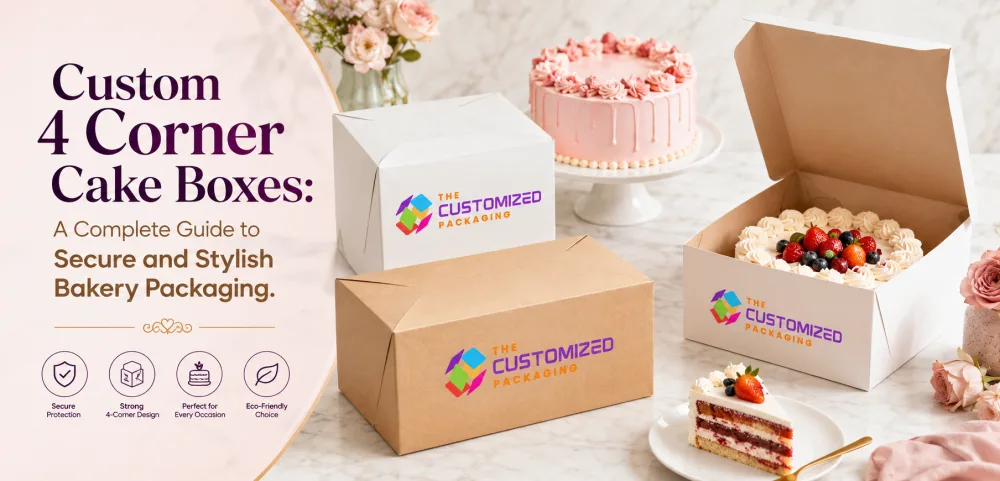
Custom 4 Corner Cake Boxes: A Practical Sizing & Selection Guide
Learn how to size custom 4 corner cake boxes around the finished cake, cake board, decoration height and packed weight. Compare paperboard and corrugated options, loading styles, inserts, windows and practical features before production.
 Published June 22, 2026
Updated August 19, 2026
14 min read
Published June 22, 2026
Updated August 19, 2026
14 min read
A decorated cake needs more than a box that looks approximately the right size.
The cake board needs a stable base, frosting needs clearance from the walls, toppers need enough vertical space, and the carton needs to remain properly formed while the product is being packed, carried and presented.
Custom 4 corner cake boxes use formed or reinforced corners to create a defined base with upright sidewalls. Depending on the design, the corners may be pre-glued or formed through locking panels during assembly.
The right four-corner box should be selected around the finished cake rather than a standard cake diameter alone.
A practical sequence is:
Cake board → Decorated cake dimensions → Packed weight → Required clearance → Box structure → Material → Sample
What Is a 4 Corner Cake Box?
A 4 corner cake box is a folding bakery carton designed so four formed corners help create the base and upright walls of the package.
Different versions can use:
- Pre-glued corners
- Locking corner panels
- Hinged lids
- Separate lids
- Front-opening panels
- Windows
- Handles
- Internal board supports
Four-corner construction can be used for individual cakes as well as selected cheesecakes, pies, pastries and dessert products when the dimensions and material suit the contents.
Its main advantage for cake packaging is the defined base and wall structure.
But four reinforced corners do not automatically make every box suitable for every cake. The overall dimensions, board specification, cake weight and way the package will be handled still matter.
Measure the Cake Board Before Choosing the Box
The cake diameter is not usually the final packaging measurement.
A decorated cake commonly sits on a board that extends beyond the product, and that board becomes the actual item resting on the bottom of the box.
Measure:
- Cake-board length or diameter
- Board thickness
- Maximum decorated cake width
- Total cake height
- Packed weight
For example, an 8-inch cake may be presented on a 10-inch board.
A box selected only from the 8-inch cake diameter would therefore be too small.
The internal base should be developed around the cake board, while the height and side clearance should account for the finished decorations.
Measure the Cake After Decorating
Cake dimensions can change significantly after decorating.
Include anything that extends beyond the basic cake shape, such as:
- Piped borders
- Rosettes
- Fondant decoration
- Chocolate pieces
- Fruit
- Flowers
- Side decorations
- Toppers
- Cake charms
A cake that begins as a simple 10-inch round can require more width once side piping and decorative elements are added.
Measure the maximum finished width rather than the undecorated sponge.
For height, measure from the bottom of the cake board to the highest point that needs to remain inside the box.
If the topper will be transported separately, it does not need to determine the box height. If it stays on the cake, include it.
Allow Practical Clearance Around the Cake
A cake should fit securely without the frosting touching the walls.
However, making the box unnecessarily large can allow the cake board to move and can make the package awkward to carry.
Think of sizing as two different requirements:
Base fit → controls the cake board
Wall and lid clearance → protects decoration
The amount of clearance depends on the product, decoration and loading method.
A simple buttercream cake may need a different setup from a wedding tier covered with delicate sugar flowers.
This is why physical testing is more reliable than applying one fixed clearance measurement to every cake.
Choose the Box Height Around the Finished Product
Vertical clearance is especially important for:
- Tall cakes
- Layered cakes
- Drip cakes
- Floral cakes
- Celebration cakes
- Sculpted cakes
- Wedding tiers
A standard-height carton may fit the board perfectly but still damage the upper decoration.
For taller products, consider:
- Extended-height sidewalls
- Removable lids
- Front-opening boxes
- Side-loading designs
- Stronger board construction
Increasing the height also changes the structural behavior of the carton.
A wide box with very tall walls may need additional material strength to prevent the panels from bowing outward.
When a Front-Opening Cake Box Makes Sense
Lowering a heavily decorated cake into a deep box can be difficult.
The board may catch a sidewall, or frosting can be damaged while the baker is trying to position the cake.
A front-opening or side-loading design allows the cake board to move horizontally into the package.
This can be particularly useful for:
- Tall cakes
- Wedding tiers
- Sculpted cakes
- Delicate side decoration
- Heavy cakes that are difficult to lower
Once the cake is positioned, the front panel and lid are secured around it.
The closure should be tested with the finished packed weight so the panel remains properly closed during normal handling.
Select Material According to the Packed Cake
The material should match the dimensions, weight and handling requirements of the finished package.
| Cake Type | Practical Starting Direction |
|---|---|
| Small lightweight cake | Folding paperboard |
| Standard birthday cake | Suitable paperboard construction |
| Tall decorated cake | Stronger paperboard or corrugated construction |
| Heavy cheesecake | Strong base with appropriate board or corrugated support |
| Large celebration cake | Reinforced paperboard or corrugated |
| Wedding cake tier | Structure matched to the individual tier weight |
| Multiple desserts | Paperboard or corrugated depending on total packed weight |
Paperboard
Paperboard can work well for many everyday cake boxes.
It provides a clean printable surface and can be supplied flat for storage before assembly.
The board specification should increase where the box becomes larger, taller or heavier.
Corrugated Board
Corrugated material can provide additional structural support for heavier cakes, larger dimensions and selected transportation applications.
The exact corrugated construction should be selected around the packed weight and box dimensions rather than assuming that every cake needs the strongest board available.
The goal is appropriate strength, not unnecessary material.
Kraft or White Cake Boxes?
Both can use four-corner construction.
The difference is largely in the material specification and visual presentation.
White Paperboard
White surfaces work well for:
- Full-color branding
- Bright bakery artwork
- Pastel designs
- Wedding packaging
- Product photography
- Detailed illustrations
Kraft
Kraft provides a natural brown appearance that works with:
- Minimal branding
- Dark printed logos
- Botanical artwork
- Rustic presentation
- Handmade bakery styles
Choose the material around both performance and artwork requirements.
A kraft appearance alone should not be used as proof that the complete package has a particular environmental benefit. If sustainability is part of the purchasing decision, review the actual fiber, recycled-content, coating and disposal specifications.
Match the Cake Board to the Box Base
The cake board carries the product's weight directly.
The outer carton and cake board therefore need to work together.
A strong cake box cannot prevent problems caused by a board that flexes under the cake.
Likewise, a strong board can still move inside an oversized carton.
Check:
- Board thickness
- Board dimensions
- Cake weight
- Box base dimensions
- Available movement
- Ease of removal
For heavy or valuable cakes, the customer should be able to support the bottom of the complete package during carrying.
Use Internal Supports When the Cake Board Needs More Control
Some cakes only need an accurately sized flat base.
Others may benefit from a simple support that keeps the cake board from sliding.
Possible approaches include:
- Raised retaining edges
- Folded paperboard supports
- Corrugated stops
- Locking tabs
- Recessed board positions
The support should control movement without making it difficult to insert or remove the cake.
Avoid adding an elaborate insert unless it solves a real problem.
For cupcakes, mini cakes or mixed desserts, fitted cavities or dividers may be more appropriate because several individual products need to remain separated.
Add a Window When Seeing the Cake Matters
A window can allow the customer to see the decorated cake without opening the box.
This can be useful for:
- Bakery counters
- Café displays
- Ready-made cakes
- Pickup orders
- Gift cakes
- Celebration desserts
Window placement should be planned around the product.
A top window can reveal the decoration above the cake, while a front window may show the height and side detailing.
Larger openings remove more board from the panel, so the remaining frame needs enough structure for the finished package.
The cake should also remain correctly positioned behind the window.
If product visibility is a major part of your packaging decision, see our guide to Window Custom 4 Corner Cake Boxes.
Be Careful With Handles on Heavy Cake Boxes
A handle can make smaller cake packages easier to carry.
But adding a handle does not automatically make a box suitable for lifting a heavy cake from the top.
The handle area, lid and sidewalls all need to work with the packed weight.
For valuable or heavy cakes, supporting the base is generally more secure than relying entirely on an integrated top handle unless the package has been developed and tested specifically for that use.
When convenience is important, evaluate the filled sample rather than deciding from the empty carton.
Plan Branding Around the Finished Structure
Custom printed cake boxes can carry bakery branding without turning every panel into an advertisement.
Useful printed elements can include:
- Bakery logo
- Brand colors
- Product name
- Website
- Social media handle
- QR code
- Customer name
- Order identification
- Storage guidance
- Cake-care instructions
Prioritize information customers actually need.
A clean lid with a recognizable logo may be more effective than filling every panel with decorative graphics.
For businesses with several cake sizes, the same artwork system can often be adapted across a coordinated family of boxes.
Use the Inside for Helpful Customer Information
The interior of the lid can be useful for information that becomes relevant after the customer opens the package.
Depending on the bakery and product, that may include:
- Thank-you message
- Carrying reminder
- Storage guidance
- Serving information
- QR code
- Reorder information
Keep instructions specific to the actual product.
If different cakes require different storage or serving conditions, use labels or another variable-information method rather than printing one generic instruction across every package.
Consider Pickup and Local Delivery During Design
Cake packaging should be planned around what happens after it leaves the decorating area.
For customer pickup, consider:
- Ease of carrying
- Vehicle placement
- Box closure
- Board movement
- Package dimensions
For bakery delivery, also consider:
- Repeated handling
- Vehicle space
- Level placement
- Route conditions
- Package stacking where appropriate
The box can control and protect the cake, but it cannot correct unsuitable transportation conditions.
A cake should remain on a stable, level surface during normal movement.
Test the finished package under realistic handling conditions before standardizing it for recurring deliveries.
Plan Food Contact According to the Actual Package
Many cakes sit on a cake board, tray or liner rather than directly against the printed outer carton.
If any part of the box, insert, liner, adhesive, coating or window will directly contact food, make that clear when the packaging is being specified.
Food-contact suitability depends on the actual component and intended use rather than the general name of the material. FDA guidance similarly evaluates packaging substances according to their intended food-contact application.
Also consider the characteristics of the bakery product.
A dry cake, oily pastry, refrigerated cheesecake and moist dessert may create different packaging conditions.
Test the Complete Filled Package
A dieline confirms dimensions.
It cannot show whether a real cake can be loaded without touching the sides or whether a tall wall will remain stable when filled.
Test the actual package with the actual cake or a realistic equivalent.
Check:
- Cake-board fit
- Side clearance
- Top clearance
- Loading
- Closure
- Base stability
- Wall strength
- Insert fit
- Window alignment
- Handle performance where used
- Product removal
For a new size or structure, physical sampling is especially valuable before placing a large production order.
Create a Coordinated Size Range for Regular Orders
Bakeries rarely sell only one cake size.
Instead of designing every carton as a completely unrelated package, consider a coordinated range.
For example:
6-inch board → Size A
8-inch board → Size B
10-inch board → Size C
12-inch board → Size D
The structure, logo position and overall artwork can remain consistent while the dimensions change.
Tall cakes may require separate height variants.
This approach can make storage, packing and reordering easier while maintaining a recognizable bakery presentation.
What to Provide When Requesting Custom 4 Corner Cake Boxes
For an accurate recommendation or quotation, provide:
- Cake-board dimensions
- Board thickness
- Maximum decorated cake width
- Total cake height
- Packed weight
- Cake type
- Preferred loading method
- Window requirement
- Handle requirement
- Insert or board-support requirement
- Printing requirements
- Quantity
- Delivery destination
Photos of the finished cakes are also useful, particularly when decorations extend beyond the basic shape.
If several cake sizes are required, provide the complete size range at the beginning.
Ordering 4 Corner Cake Boxes in Larger Quantities
Once the structure and sizes are established, recurring bakery orders can be produced in larger quantities.
Before selecting a quantity, consider:
- Monthly box usage
- Available storage
- Number of cake sizes
- Seasonal artwork
- Expected menu changes
- Assembly method
Buying more boxes may reduce the average production cost, but unused inventory also takes up storage and can become obsolete after an artwork or size change.
If you are comparing production quantities and pricing, our Wholesale Custom 4 Corner Cake Boxes Guide goes deeper into bulk-order planning.
Custom 4 Corner Cake Boxes From The Customized Packaging
The Customized Packaging develops custom 4 corner cake boxes around the finished cake, board dimensions, packed weight and presentation requirements.
Available configurations can include:
- Custom dimensions
- Paperboard construction
- Corrugated construction
- Tall cake boxes
- Front-opening designs
- Window boxes
- Board supports
- Cupcake inserts
- Logo printing
- Interior printing
- Compatible finishing options
The best starting point is the actual finished product.
Once the cake board, decoration height, packed weight and handling requirements are known, the structure can be developed around what the cake needs rather than forcing it into a generic stock size.
Frequently Asked Questions
What is a 4 corner cake box?
A four-corner cake box is a folding carton that uses four formed or reinforced corners to create a defined base and upright sidewalls. Depending on the design, the corners may be pre-glued or formed during assembly.
How do I choose the correct cake box size?
Start with the cake board rather than the cake diameter alone. Then measure the maximum decorated width and total product height so frosting, toppers and other details have sufficient clearance.
Should the cake box be the same size as the cake board?
The internal base should fit the board closely enough to control unnecessary movement while still allowing the cake to be loaded and removed comfortably. The exact clearance should be confirmed with a physical sample.
What material is best for a 4 corner cake box?
Paperboard can work well for many standard cakes, while stronger paperboard or corrugated construction may be more appropriate as the cake becomes larger, taller or heavier. The final selection should be based on the packed product.
Are 4 corner boxes suitable for tall cakes?
Yes. Four-corner structures can be produced with extended-height walls. Tall boxes need to be checked for panel stability, top clearance and ease of loading.
Is a front-opening cake box better for decorated cakes?
It can be useful for tall, heavy or delicately decorated cakes because the board can be moved horizontally into the package rather than lowered through the top.
Can 4 corner cake boxes have windows?
Yes. Windows can be added to suitable top or side panels. The window size and placement should preserve enough surrounding board for the intended structure.
Do cake boxes need inserts?
Not always. An accurately sized base may be sufficient for many cakes. Additional supports are useful when the cake board needs more movement control or when several smaller desserts need individual positions.
Should I test a cake box before ordering in bulk?
Yes, especially for a new size, tall cake, heavy product, window structure, handle or custom insert. A physical sample confirms fit and handling in ways a digital dieline cannot.