
How to Choose Custom Eye Shadow Boxes for Your Beauty Brand
Learn how to choose custom eye shadow boxes by palette size, structure, inserts, materials, printing and finishes for retail, ecommerce and premium beauty packaging.
 Published June 02, 2026
Updated September 28, 2026
10 min read
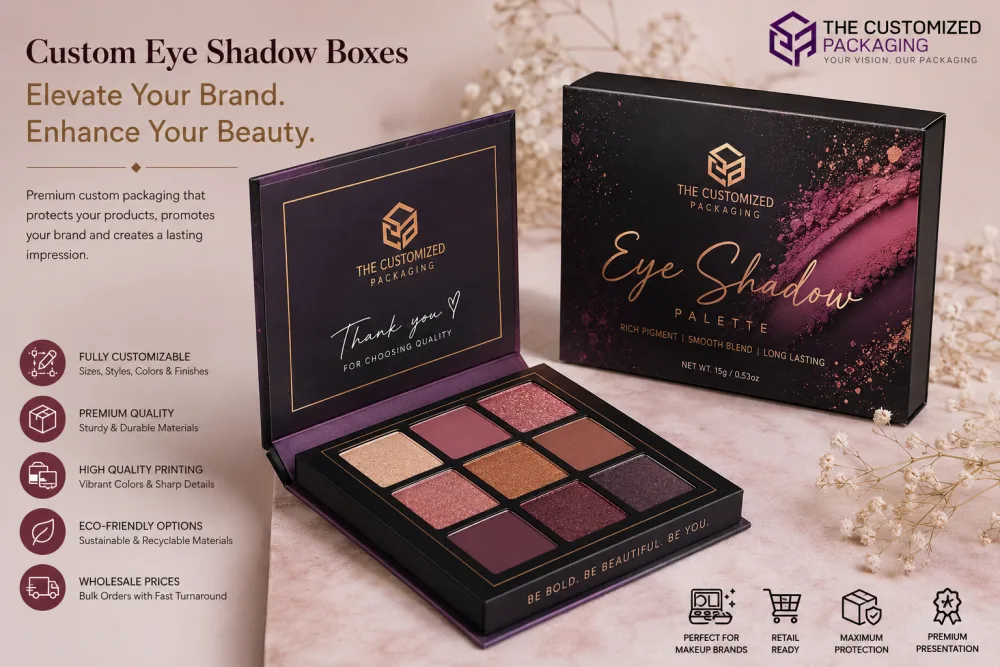
Custom eye shadow boxes are printed cartons or presentation packs built around a finished palette, compact, or pan set. The useful decisions are size, structure, retention, print, and finish — not a generic “beauty box” style. Palette width, depth, pan layout, and any mirror or applicator stack determine the dieline. Inserts keep pans from sliding; board and coating set how the pack feels in hand; print and finishing carry shade names and brand marks. Premium rigid or magnetic presentation is one option for launches and gifts. It is not a separate product family from the folding carton a retailer may need. When you are ready to configure the carton itself, use custom eye shadow boxes as the manufacturing page; this guide is for the choices that come first.
What Makes Eye Shadow Packaging Different?
Pressed powder, glitter, and cream shadows fail in different ways. A carton that works for a lipstick tube can still let a 12-pan palette rattle, crack a pan, or scuff a mirror. Start from the object, not from a catalog style name.
Record, from the production palette:
- Maximum length, width, and depth, including the closed lid and any raised logo on the compact
- Pan count and whether pans sit in one plane or a stepped tray
- Mirror thickness, hinge swing, and applicator or brush pockets
- Weight of the filled compact
- How the face of the palette should appear on shelf or in a listing photo
Fragility is a fit problem. If the compact can move noticeably inside the carton, transit impact can transfer to the palette and pans. If the carton is too tight, lids can bind or finished surfaces can mark. Those measurements belong on the brief before anyone picks a board caliper.
Choose the Box Structure Around the Palette
Structure follows how the pack is opened, stacked, and shown. A folding carton can carry a daily-driver palette. A rigid or magnetic pack is for a presentation that customers reopen. Sleeve-and-tray and gift-set layouts are only useful when the inner tray is specified with the outer wrap.
| Structure | Usually considered when | Watch for |
|---|---|---|
| Folding carton (tuck or auto-lock) | A single compact or slim palette for retail and mail | Lid height vs mirror; tuck that does not crush the first pan row |
| Rigid presentation box | A launch, PR, or counter pack that should feel substantial | Caliper vs compact weight; lid stay when the mirror is open |
| Magnetic closure | The customer will open and close the outer pack repeatedly | Magnet placement clear of pan wells and foil on the compact |
| Sleeve and tray | The inner tray holds the palette and the sleeve carries print | This is not a wraparound paper sleeve on a bar; both pieces need a dieline |
| Gift-set / multi-cavity | Palette plus brush, mini, or card in one presentation | Each cavity sized to the actual accessory, not a generic foam guess |
Do not specify magnetic or rigid “because it looks premium” if the compact already has its own closure and the outer pack is only a shipper. Use those structures when the outer box is part of the unboxing, not when a mailer will hide them.
Materials for Eye Shadow Packaging
Board is chosen after the compact sample exists. Naming a color is not a material specification.
- Folding paperboard / SBS — the usual print face for retail cartons when the compact is light and the pack is a tuck carton.
- Kraft paperboard — when the print plan and brand face call for a kraft look; confirm ink holdout and crease quality at the corners.
- Rigid board — for presentation packs, not as a default for every SKU.
- Corrugated or micro-flute — when the eye shadow carton is also doing shipping work, or when a heavier palette needs a stiffer wrap. The inner beauty carton is still not automatically the parcel.
Recycled-content fiber is listed only when mill documentation applies to the production lot. Coatings, window film, foil, and adhesives become part of the finished construction. End-of-life depends on that finished build and on local collection rules. Do not print a disposal claim until board, coating, ink, and adhesive are known.
Inserts and Product Retention
An insert helps retain the product inside the pack. It can reduce movement of the compact, keep accessories separated, and help prevent the palette, mirror or tools from contacting the outer pack during normal handling. A pretty empty carton is not retention.
- Die-cut paperboard collar or tray — common for a single compact. Cut to the closed footprint plus the approved tolerance.
- Stepped or nested tray — when pans or a second compact sit at different heights.
- Accessory channel — brush, sponge, or shade card; size the channel to the accessory, then leave a keep-out so it cannot scrape powder.
- Gift-set cavities — one well per item. Do not force a palette, mascara, and card into one undersized foam guess.
A fitted paperboard insert may be sufficient when the compact already has a rigid closed plastic or metal case. Foam or molded pulp may be considered when the geometry is irregular or the set contains components at several heights. Test the insert on the production compact, not on a 3D mock that is 1 mm smaller.
Printing and Finishing Options
Build artwork on the approved dieline. Keep barcodes, net quantity, and required copy off the glue flap, window, and scuff edges. Shade names and a pan map belong where the customer can read them — often the reverse or an inner lid — not as decoration that fights the structure.
Digital and offset printing can both support multicolor artwork; the appropriate method depends on quantity, substrate, color-control requirements and production setup. Pantone or other specified spot colors can be used when consistent brand-color matching is required. Call the ink set and the board in the same specification.
| Finish | Visual effect | Appropriate use |
|---|---|---|
| Matte or gloss lamination | Even sheen, scuff resistance depends on film and handling | Retail faces that will be picked up often |
| Soft-touch coating | Low-gloss, velvety hand-feel | Presentation packs; confirm it does not mark against a dark compact |
| Foil (gold, silver, rose gold, selected holographic) | Metallic or pigment stamp on logo or title | Keep-out from windows, magnets, and tight wrap corners |
| Spot UV | Local gloss on type or a pan graphic | Treat as an added surface in the finished-construction description |
| Embossing / debossing | Raised or pressed mark | Needs enough caliper; stay off the insert well and the magnet |
Ingredient lists, shade information and product claims should be supplied and approved by the brand before printing so the required copy can be positioned correctly on the final dieline.
Packaging Ideas by Eye Shadow Palette Type
Finish and artwork should follow the compact, not a trend list. The table is a starting direction. Two nude palettes from different brands can still need different dielines.
| Palette type | Fit notes | Design direction (not a rule) |
|---|---|---|
| Matte | Usually a flat pan plane; watch lid height if a mirror is thick | Quiet type, even coating, pan map on reverse or inner lid |
| Shimmer | Same footprint as matte unless the compact has a raised window | Controlled metallic or foil on the mark, not on every panel |
| Glitter | Loose glitter on the compact face can scuff an uncoated wrap | Review coating vs the compact; avoid a tight sleeve that grinds glitter onto type |
| Neutral / nude | Often a slim compact; easy to oversize the carton | Right-size first; use contrast so the logo still reads on a pale face |
| Multipan / pro | Heavier; hinge and pan grid need a stiffer tray or carton | Clear shade count on the face; structure before decoration |
When Premium or Luxury Packaging Makes Sense
Premium presentation is a job for a launch, a gift set, a counter display, or a kit the customer keeps. It is not a second article and not a requirement for every SKU.
Use rigid board, a magnetic lid, or a multi-cavity tray when:
- The outer pack is meant to be kept and reopened
- The set includes a palette plus tools that need separate wells
- Foil, soft-touch, or a deep emboss is part of the approved face, and the caliper can hold it
If the compact already presents well and the carton only needs to survive a case pack, a folding carton with a fitted insert is the honest specification. Putting a magnetic wrap on a mailer-hidden unit adds cost without changing what the customer sees.
Retail vs Ecommerce Considerations
Retail packaging should reserve readable areas for branding, product information, barcode and required copy while keeping critical content away from creases and closures. If a hang feature is required, include it in the structural brief before the dieline is approved. A window is optional and only if the compact face is stable behind it.
Ecommerce still uses that same carton as the product pack. It does not replace the outer shipper. Powder and mirrors need the compact locked in the insert, then a mailer or corrugated wrap sized to the closed carton. Do not treat the beauty carton as a guaranteed parcel. Transit protection for a case of palettes belongs to the outer carton and the pack-out method.
How to Brief a Packaging Supplier
Send a production compact (or maximum dimensions and weight) plus:
- Pan layout, mirror, and accessory list
- Preferred structure: folding carton, rigid, sleeve-and-tray, magnetic, or gift-set
- Board family and whether an insert is required
- Print method, colors, and any foil, spot UV, or emboss
- Artwork versions and supplied label copy
- Quantity and how units move: shelf, DTC mailer, or both
Browse adjacent beauty cartons on cosmetics packaging. For a planning range across styles and quantities, use the Custom Box Packaging Cost Calculator, then request a production quote from the approved palette sample and dieline.
Choosing the Right Eye Shadow Packaging
Measure the finished compact, lock retention with an insert, then pick structure and board for how the pack is shown and shipped. Print and finishing follow the dieline. Premium rigid or magnetic packs are for presentation jobs. Configure manufacturing options on the custom eye shadow boxes product page once the brief above is complete.
Frequently asked questions
What box style works best for eye shadow palettes?
The style that matches the compact and the opening ritual. A folding carton with a fitted insert covers most single palettes. Rigid or magnetic packs are for presentation and gift sets. Sleeve-and-tray needs both pieces specified. There is no universal “best” style.
Do eye shadow boxes need inserts?
They need retention if the compact can move. A die-cut paperboard collar is typical for a closed compact. Gift sets need a cavity per item. Skip foam unless the geometry or height stack requires it. Fit-test on the production palette.
Which finishes are commonly used for premium eye shadow packaging?
Foil on a mark, soft-touch or matte on the face, spot UV on type, and embossing or debossing when the board is thick enough. Each finish is part of the construction. They are not required on every SKU.
How should a beauty brand size an eye shadow box?
Measure the closed compact after mirrors, pans, and labels are in place. Add only the insert wall and the approved tolerance. Oversizing lets the palette slam; undersizing marks lids and foil. Send the sample with the brief.