
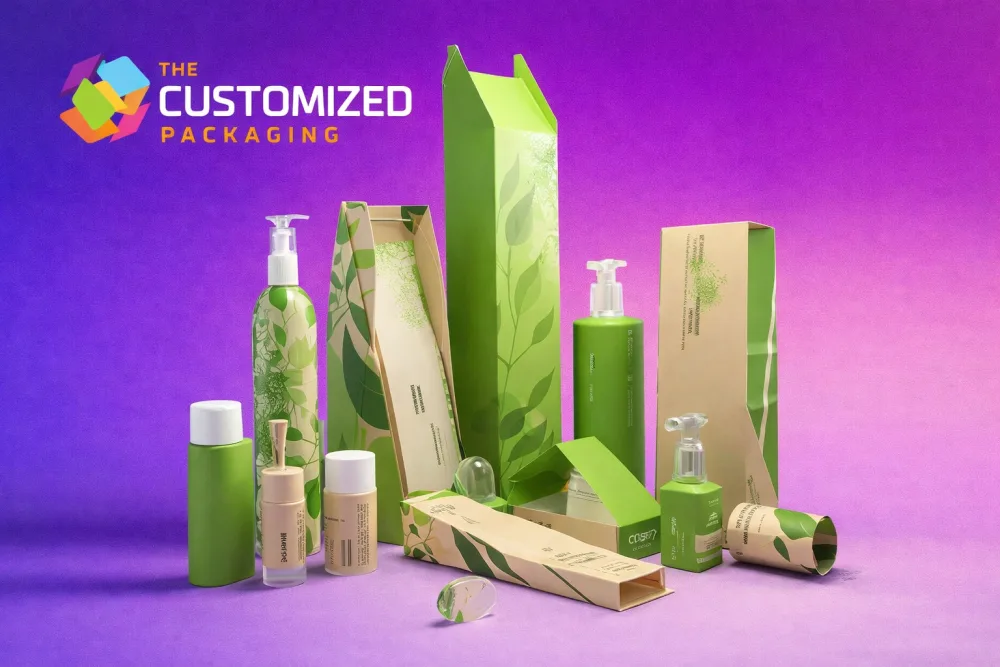
10 Cosmetic Box Design Strategies for Better Shelf Appeal
Explore 10 innovative cosmetic packaging design ideas that help beauty brands capture attention, strengthen brand identity, enhance customer experiences, and boost sales through custom cosmetic packaging solutions.
 Ammar Sheikh
Author
Ammar Sheikh
View LinkedIn profile
Published April 08, 2026
Updated July 21, 2026
20 min read
Ammar Sheikh
Author
Ammar Sheikh
View LinkedIn profile
Published April 08, 2026
Updated July 21, 2026
20 min read
Cosmetic packaging design should begin with the product rather than a color palette, decorative pattern, or finishing effect. A serum bottle, cream jar, mascara tube, lipstick, foundation bottle, and makeup compact each create different requirements for carton dimensions, inserts, label space, retail presentation, and ecommerce protection.
The most effective cosmetic packaging design ideas balance visual appeal with practical performance. A box may look attractive on a screen but fail when the pump touches the lid, the bottle moves inside the carton, required information becomes difficult to read, or the package cannot withstand normal retail and shipping conditions.
Beauty brands also need packaging that works across different sales environments. A folding carton designed for a retail shelf may need an additional corrugated mailer for online delivery. A luxury rigid box may create a premium gift experience but may not be cost-effective for a high-volume skincare line. A product-view window may help customers see the container, but it also reduces printable space and can affect the strength of the panel.
The ten cosmetic box design strategies below explain how beauty brands can turn creative ideas into practical packaging. They cover product measurements, visual hierarchy, color systems, box structures, windows, inserts, premium finishes, labeling space, ecommerce protection, and seasonal variations.
Why Cosmetic Packaging Design Matters
Cosmetic packaging often creates the first physical interaction between a beauty brand and its customer. Before a shopper tests the formula, opens the jar, or applies the product, the packaging communicates the product category, price position, audience, and overall brand personality.
A clean skincare carton can suggest simplicity and clinical precision. A brightly printed makeup box can communicate creativity and energy. A textured rigid box with a fitted insert can position a fragrance or beauty set as a premium gift. These impressions influence how customers understand the product before they experience its actual performance.
Good cosmetic packaging also supports product identification. Beauty companies may sell several cleansers, creams, serums, shades, scents, or formulas with similar containers. A clear visual system helps customers distinguish products without making every SKU look unrelated.
Packaging design should therefore support four main goals:
-
Present the product clearly
-
Communicate the brand consistently
-
Reserve space for customer-approved information
-
Protect and organize the product through its intended sales journey
The strongest cosmetic boxes achieve these goals without looking overloaded.
Cosmetic Packaging Design Strategy Comparison
| Design Strategy | Best For | Main Advantage | Main Consideration |
|---|---|---|---|
| Minimal visual hierarchy | Premium skincare and clinical beauty | Creates a clean and refined appearance | Can look generic without strong brand details |
| Product-family color system | Makeup, skincare ranges, and multiple SKUs | Helps customers identify variants quickly | Colors must maintain readable contrast |
| Product-view window | Attractive jars, bottles, and applicators | Allows customers to see the product | Reduces printable space and panel strength |
| Fitted insert | Glass bottles, jars, and gift sets | Organizes the product presentation | Must be developed around exact dimensions |
| Selective foil or embossing | Luxury cosmetics and limited editions | Highlights logos and premium details | Excessive decoration can reduce clarity |
| QR-enabled packaging | Tutorials, registration, and repeat purchases | Extends the customer journey online | Code must remain easy to scan |
| Seasonal sleeve or band | Holiday and limited-edition collections | Updates artwork without changing the core box | Adds another component |
| Corrugated ecommerce layer | Online cosmetic orders | Supports transit protection | Increases packaging volume |
| Interior printing | Unboxing messages and instructions | Uses hidden areas for communication | Adds printing coverage and cost |
| Modular packaging system | Product families and subscription programs | Supports several products with related designs | Requires careful size and artwork planning |
1. Design the Box Around the Final Cosmetic Container
The first step in custom cosmetic packaging is measuring the completed product. Packaging should not be developed only from an empty jar, unfilled bottle, or preliminary supplier drawing.
The final measurement should include every component that will remain on the product when it enters the box. These may include the cap, pump, dropper, sprayer, label, protective seal, shrink band, applicator, wrapper, and instruction leaflet.
A serum bottle may need additional clearance around a dropper bulb. A lotion bottle may require space above the pump. A mascara tube may need support along its length. A cream jar may require a base platform so it remains centered inside a taller carton.
The following measurements are normally required:
-
Maximum product length
-
Maximum product width
-
Maximum product height
-
Filled product weight
-
Cap or closure dimensions
-
Pump, dropper, or sprayer projection
-
Label thickness
-
Required product orientation
-
Insert depth
-
Finger-access space
The final box should allow the product to enter and leave without excessive force. It should not be so loose that the container moves freely, but it should not press against a pump, dropper, decorative cap, or fragile surface.
A physical filled sample is often more reliable than dimensions alone. This is particularly important for cosmetic containers with rounded shoulders, unusual caps, thick labels, or decorative components.
2. Create a Clear Front-Panel Information Hierarchy
A cosmetic box needs a visual order that helps customers understand the product quickly. Every line of text should not receive the same size, weight, and visual emphasis.
A practical front-panel hierarchy may include:
-
Brand name or logo
-
Product name
-
Product type
-
Variant, shade, scent, or formula
-
Primary customer-approved benefit
-
Net quantity or other required information
The customer should be able to identify the product without studying several panels.
For example, the brand name may appear at the top, followed by the product name in a larger type size. The product type and formula can appear underneath, while the net quantity remains clear near the bottom.
Minimal cosmetic packaging does not mean empty packaging. It means the design uses space deliberately and avoids giving every message equal importance.
Required or customer-approved information should be planned before decorative elements are finalized. Otherwise, the brand may later need to place ingredients, warnings, directions, barcodes, or batch fields over finished artwork.
A clear hierarchy is especially important for skincare brands with several similar products. A cleanser, toner, serum, moisturizer, and eye cream can share one visual system while remaining easy to distinguish.
3. Build a Consistent Product-Family Color System
Color is one of the most useful cosmetic packaging tools, but it should be applied through a controlled system rather than selecting unrelated colors for every product.
A product-family color system can use:
-
One master brand color
-
One neutral background
-
One category color
-
One formula or shade indicator
-
Consistent typography
-
Repeated logo placement
A skincare company may use white as the main background and apply different colored bands for cleansers, serums, moisturizers, and eye products. A makeup brand may use one dark base color while changing small panels or labels for individual shades.
| Cosmetic Product | Main Packaging Color | Variant Indicator | Recommended Visual Approach |
|---|---|---|---|
| Facial cleanser | White or light neutral | Blue band | Clean and refreshing |
| Vitamin serum | White or amber | Orange accent | Active and energetic |
| Moisturizer | White or cream | Green accent | Soft and balanced |
| Eye cream | White or silver | Purple accent | Refined and targeted |
| Foundation | Neutral brand color | Shade number and swatch | Easy shade identification |
| Lipstick | Dark or bold base | Color-coded end panel | Fast retail comparison |
| Mascara | Black or brand color | Formula stripe | Strong shelf recognition |
| Fragrance gift set | Premium neutral | Metallic accent | Luxury presentation |
Color should not be the only method used to distinguish products. Text labels, product names, icons, and shade numbers should remain clear for customers who may not perceive colors in the same way.
Contrast should also be tested. Pale text on a light background may look elegant in a mockup but become difficult to read when printed. Dark text, adequate spacing, and suitable font sizes normally produce better results.
4. Match the Box Structure to the Product and Buying Experience
Creative cosmetic packaging is not limited to artwork. The structure determines how customers see, open, remove, and store the product.
A folding carton works well for everyday skincare, makeup, and personal-care products. It is lightweight, printable, and practical for retail quantities.
A sleeve-and-tray box creates a more controlled reveal. It can suit serum collections, beauty tools, gift sets, and limited editions.
A rigid two-piece box provides a more substantial presentation for fragrances, luxury skincare, bridal cosmetics, and premium gift programs.
A drawer box can organize multiple products while creating a gradual opening experience. It is often useful for influencer kits, subscription collections, and cosmetic gift sets.
A corrugated mailer is more suitable when the primary need is ecommerce delivery. It can contain individual cosmetic cartons, tissue, inserts, printed cards, and promotional materials.
Cosmetic Box Structure Comparison
| Packaging Structure | Suitable Cosmetic Products | Presentation Level | Shipping Requirement |
|---|---|---|---|
| Folding carton | Serum, cream, mascara, lipstick, foundation | Standard to premium retail | Usually needs an outer shipper |
| Sleeve-and-tray box | Skincare sets, tools, luxury samples | Premium | Usually needs an outer shipper |
| Drawer box | Gift sets, subscription products, PR kits | Premium unboxing | Protective outer packaging recommended |
| Two-piece rigid box | Fragrances, luxury cosmetics, bridal sets | High-end gifting | Corrugated outer carton required |
| Magnetic rigid box | Influencer kits and limited editions | Luxury presentation | Corrugated outer carton required |
| Window carton | Attractive jars, bottles, and tools | Product-focused retail | Outer protection depends on route |
| Corrugated mailer | Ecommerce and subscriptions | Branded delivery | Can serve as an outer package when tested |
| Display carton | Retail counters and product launches | High visibility | Used mainly for retail display |
The selected structure should match the price level of the product. An expensive rigid box may not be appropriate for a low-cost everyday item, while a basic folding carton may not provide the presentation expected from a luxury gift set.
5. Use Product-View Windows Selectively
A window can help customers see a cosmetic jar, bottle, applicator, shade, texture, or gift-set arrangement before opening the box.
Windows can be especially useful for:
-
Makeup tools
-
Lip products
-
Nail polish
-
Fragrance bottles
-
Cosmetic jars
-
Product sets
-
Color-focused items
-
Decorative primary containers
A window should not be added only because it looks creative. It reduces the available printing area and may weaken the surrounding panel when placed too close to folds, glue seams, or locking tabs.
The product must also remain aligned behind the opening. A beautiful container can look poorly presented when it rotates or drops below the window during handling.
Window options may include:
-
Open die-cut window
-
Transparent-film window
-
Small product-detail window
-
Full-width front window
-
Side-panel window
-
Logo-shaped opening
-
Custom product-shaped cutout
Transparent film introduces another material and may affect local recycling acceptance. An open window avoids film but provides less coverage from dust and handling.
The window should be developed together with the product insert. The insert keeps the product positioned while the window creates visibility.
6. Engineer the Insert Around the Filled Product
An insert can improve presentation by keeping the product centered and separating multiple items. It may also reduce unnecessary movement when the complete package is designed correctly.
Different cosmetic products require different insert features.
A serum bottle may need a base well and neck support. A cream jar may sit on a raised platform. A mascara tube may use a long channel. A makeup tool set may require several shaped openings. A fragrance bottle may need support around the base and shoulders.
Insert options can include:
-
Folded paperboard
-
Corrugated board
-
Molded pulp
-
Foam
-
Paper bands
-
Divider grids
-
Product platforms
-
Neck collars
-
Side supports
-
Accessory pockets
Paperboard inserts are suitable for many retail cosmetic products and can be printed with instructions or product names. Molded pulp may support shaped cavities while maintaining a paper-based presentation. Foam may suit selected fragile or premium products, but it adds another material and should not be recommended automatically.
The insert should provide enough finger access for the customer to remove the product. A perfectly fitted cavity can become frustrating when there is no notch, ribbon, tab, or access gap.
The final product, insert, retail carton, and ecommerce package should be evaluated together.
7. Use Premium Finishes to Create Visual Hierarchy
Foil stamping, embossing, debossing, spot UV, matte coating, gloss coating, and textured paper can make cosmetic packaging more distinctive. However, combining every finish does not automatically create a premium design.
A stronger approach is to select one primary tactile treatment and one secondary visual accent.
Examples include:
-
Matte box with a gloss logo
-
Textured paper with simple foil stamping
-
White rigid box with blind embossing
-
Dark carton with metallic product name
-
Soft-touch surface with spot UV pattern
-
Uncoated paper with a debossed logo
Foil can highlight the brand name, product line, or limited-edition message. Embossing can add dimension to a logo. Spot UV can create contrast between matte and glossy surfaces.
Finishes should remain clear of:
-
Barcodes
-
QR codes
-
Small legal text
-
Fold lines
-
Glue areas
-
Batch fields
-
Deeply scored corners
-
Transparent window attachment areas
Highly reflective foil can make small text difficult to read or photograph. Deep embossing may distort nearby information. A printed prototype should be approved when several finishes are combined.
8. Reserve Space for Labels, Codes, and Customer-Approved Information
Cosmetic packaging must balance creative branding with the information supplied by the responsible cosmetic company.
The required content may differ by product and market, but common information areas may include:
-
Product name
-
Product identity
-
Net quantity
-
Ingredients
-
Directions
-
Warnings
-
Responsible-business details
-
Country information
-
Barcode
-
SKU
-
Batch or lot field
-
Shade name
-
QR code
-
Date coding
-
Recycling instructions
-
Customer-service details
This information should be considered during the first artwork stage, not added after the design has been completed.
The front, back, side, top, bottom, and interior panels should each have a clear purpose.
A practical panel plan may be:
| Box Panel | Recommended Content |
|---|---|
| Front | Brand, product name, product type, variant, net quantity |
| Back | Product explanation, directions, warnings, customer-approved claims |
| Side 1 | Ingredients and responsible-business information |
| Side 2 | Barcode, SKU, QR code, batch field, recycling guidance |
| Top | Logo, shade, scent, formula, or collection identifier |
| Bottom | Technical codes and supplier-approved production fields |
| Interior | Brand story, instructions, message, tutorial link |
QR codes should remain on a flat and high-contrast area. Avoid placing them over foil, heavy texture, folds, or deeply embossed sections.
Barcodes also need sufficient contrast and clear surrounding space.
9. Design Retail and Ecommerce Packaging as Separate Layers
One of the most common cosmetic packaging mistakes is treating the retail box as the complete shipping package.
A folding carton can present the product on a shelf, but it may not provide enough protection for courier handling. A rigid gift box may create a luxury unboxing experience, but its corners and decorative surfaces may be damaged without an outer corrugated package.
A complete ecommerce system may include:
Primary cosmetic container
→ Retail carton
→ Product insert
→ Tissue or protective wrap
→ Corrugated mailer or shipping carton
The retail carton communicates the brand and product details. The insert organizes the product. The corrugated outer package supports delivery.
Fragile glass jars and bottles may also need:
-
Movement control
-
Corner protection
-
Bottle separation
-
Surface protection
-
Void reduction
-
Leak-response components where appropriate
-
Appropriate shipping labels
The shipping package should be developed around the actual filled weight and route.
A cosmetic box should not be described as damage-proof, leakproof, or shipping-ready without testing the complete packed system.
10. Create Seasonal Designs Without Rebuilding the Entire Package
Seasonal and limited-edition packaging can create excitement, but producing a completely new box structure for every campaign can increase cost, storage requirements, and approval time.
Brands can update an existing approved structure through:
-
Printed sleeves
-
Belly bands
-
Labels
-
Product cards
-
Interior messages
-
Gift tags
-
Ribbons
-
Foil color changes
-
Seasonal patterns
-
Limited-edition stickers
A skincare brand can retain the same folding carton while adding a holiday sleeve. A cosmetics company can use one rigid gift-box structure with different inserts and artwork for spring, holiday, bridal, or influencer collections.
This approach allows the brand to maintain structural consistency while creating visual variety.
The new seasonal component should still leave required information visible. A sleeve should not cover a barcode, warning, ingredient panel, or shade identifier unless the same information appears correctly on the sleeve.
Cosmetic Packaging Materials and Their Design Impact
The material affects printing, texture, strength, fold quality, cost, and presentation.
| Material | Visual Character | Best Applications | Design Considerations |
|---|---|---|---|
| SBS paperboard | Smooth and clean | Skincare, makeup, fragrances | Supports detailed printing |
| White kraft | Natural but bright | Clean beauty and retail products | Surface may be less smooth |
| Natural kraft | Organic and earthy | Soap, personal care, natural brands | Colors print differently on brown stock |
| Corrugated board | Strong and practical | Ecommerce and subscriptions | Flute can affect fine printing |
| Rigid board | Premium and substantial | Gift sets and luxury cosmetics | Usually requires wrapping paper |
| Textured specialty paper | Tactile and decorative | Luxury skincare and fragrance | Fine details may lose clarity |
| Molded pulp | Formed and paper-based | Inserts and product holders | Surface is less suitable for fine printing |
| Transparent film | Product visibility | Windows and clear sections | Adds another material component |
The material should be selected according to the product weight, structure, printing, finishes, order quantity, and sales environment.
A natural kraft appearance should not automatically be described as recycled, biodegradable, or environmentally superior. Environmental claims should reflect the actual material specification and complete packaging construction.
Cosmetic Packaging Design for Different Product Types
Serum Packaging Design
Serum boxes should account for bottle height, dropper size, glass weight, and label placement.
A folded paperboard insert or bottle collar can keep the serum upright. The front panel should communicate the product name and primary formula, while the side panels can hold ingredients, directions, and customer-approved information.
Cream and Moisturizer Box Design
Cream jars are often wider and heavier than serum bottles.
The carton may require a stronger base, greater board thickness, and a fitted platform. A top window can reveal the lid artwork, while a sleeve-and-tray box can create a more premium presentation.
Mascara and Eyeliner Packaging Design
Long cosmetic tubes need narrow cartons with sufficient closure clearance.
The design can use vertical typography, strong color coding, and formula identifiers. A hang tab may be added for peg display, while a window can reveal the applicator or tube when structurally suitable.
Foundation Packaging Design
Foundation products often need clear shade identification.
The shade name and number should appear in predictable positions across every SKU. A small window may reveal the bottle or formula color, but the product must remain aligned.
Glass foundation bottles may require a base insert and protective ecommerce layer.
Lipstick Packaging Design
Lipstick cartons can use bold colors, metallic accents, and end-panel shade identifiers.
The design should help customers locate the correct shade quickly. The box should also provide enough clearance for decorative caps and unusual tube shapes.
Cosmetic Gift-Set Design
Gift sets need organized product arrangements.
The insert should separate jars, tubes, bottles, tools, and accessories. The opening sequence should help the customer understand the collection without removing every product.
Rigid, drawer, and sleeve-and-tray structures are common for premium beauty gift sets.
Common Cosmetic Packaging Design Mistakes
One common mistake is designing the box before receiving the final product measurements. This can produce incorrect dimensions, poor insert fit, and inadequate closure clearance.
Another mistake is using too many design features at once. Bold patterns, foil, embossing, windows, ribbons, several fonts, and multiple colors can compete with each other.
Small text is another frequent problem. A design may look clean on a large monitor but become difficult to read when printed on a compact serum or mascara carton.
Brands may also forget ecommerce requirements. A retail carton can arrive damaged when it moves inside an oversized shipping package.
Other common mistakes include:
-
Placing QR codes over reflective foil
-
Positioning barcodes across folds
-
Using windows without securing the product
-
Selecting inserts without finger access
-
Making unsupported environmental claims
-
Using the same design for products with different dimensions
-
Covering important information with seasonal sleeves
-
Assuming every premium finish works on every material
-
Using several unrelated typefaces
-
Choosing low-contrast color combinations
A structural and printed sample can identify many of these issues before full production.
How to Plan a Cosmetic Packaging Design Project
A structured development process helps reduce revisions and production risks.
Step 1: Define the Product
Confirm the cosmetic type, primary container, filled weight, dimensions, closure, label, and sales environment.
Step 2: Select the Packaging Layer
Determine whether the project needs a retail carton, rigid gift box, ecommerce mailer, display package, subscription box, or several layers.
Step 3: Choose the Structure
Select a folding carton, sleeve-and-tray, drawer box, rigid box, window carton, or corrugated mailer based on the product and customer experience.
Step 4: Develop the Insert
Decide whether the product needs a platform, neck support, side restraint, divider, molded cavity, or no insert.
Step 5: Plan the Information
Reserve areas for branding, product identification, ingredients, directions, warnings, barcodes, QR codes, and production fields.
Step 6: Build the Visual System
Choose typography, colors, image style, patterns, and finishing based on the brand and product family.
Step 7: Review the Dieline
Check folds, glue flaps, closures, windows, inserts, artwork orientation, and code placement.
Step 8: Approve Proofs and Samples
Review a digital proof and structural sample. Use a printed prototype for complex finishes, windows, or color-sensitive projects.
Step 9: Test the Complete Packaging
Test the filled product, insert, retail carton, and ecommerce outer package together.
Step 10: Approve Final Production
Confirm dimensions, material, printing, finishes, quantity, packing method, and delivery requirements.
Sustainable Cosmetic Packaging Design Without Vague Claims
Beauty brands increasingly want paper-based or reduced-plastic packaging, but sustainability should be discussed through specific design decisions.
Possible options may include:
-
Right-sized dimensions
-
Paperboard inserts
-
Molded-pulp inserts
-
Removal of unnecessary plastic windows
-
Reduced lamination
-
Documented recycled-content paper
-
Lower printing coverage
-
One-material structures
-
Reusable rigid gift boxes
-
Reduced packaging layers where suitable
The recyclability of a cosmetic box depends on the complete construction. Lamination, foil, transparent films, magnets, foam, adhesives, labels, and mixed-material inserts may affect local acceptance.
Instead of saying a box is “100% eco-friendly,” describe the actual feature:
-
Made with an identified recycled-content paper
-
Designed without a plastic window
-
Uses a folded paperboard insert
-
Produced without lamination
-
Right-sized to reduce unused space
Specific claims are more useful and credible than broad environmental language.
Estimate Your Cosmetic Packaging Budget
Custom cosmetic packaging prices depend on the dimensions, material, structure, insert, printing coverage, finishing, quantity, and delivery requirements.
A basic folding carton may cost less than a rigid magnetic box with a foam insert and several decorative finishes. A standard-size product may also require less structural development than an unusual jar, bottle, or applicator.
Use the Custom Box Packaging Cost Calculator to create a preliminary estimate for your project. Enter the box dimensions, material, printing, finishes, insert requirements, and order quantity.
The calculator provides an initial budgeting reference. Final pricing should be confirmed after reviewing the actual product, dieline, structural sample, artwork, and shipping requirements.
Why Choose The Customized Packaging for Cosmetic Boxes?
The Customized Packaging produces custom cosmetic boxes for skincare companies, makeup brands, beauty retailers, personal-care businesses, subscription services, ecommerce sellers, and product-launch campaigns throughout the USA.
Our packaging team can assist with product measurements, folding cartons, rigid structures, inserts, windows, dielines, printing, and finishing options.
Brands can create packaging for serum bottles, cream jars, mascara tubes, lipstick, foundation, makeup tools, beauty gift sets, and promotional collections.
The final recommendation depends on the product dimensions, filled weight, sales environment, brand presentation, quantity, and delivery method.
Final Thoughts
Creative cosmetic packaging is not created by adding every available color, finish, or structural feature. It comes from making deliberate choices around the actual container, customer journey, brand position, and distribution method.
A successful cosmetic box should help customers identify the product, read the necessary information, remove it easily, and receive it in suitable condition. Minimal layouts, bold color systems, windows, inserts, foil, QR codes, and seasonal artwork can all be effective when they solve a specific packaging need.
Before approving production, test the final filled container, structural sample, insert, artwork, barcode, QR code, retail carton, and ecommerce package together. This process turns a visual packaging concept into a practical branded experience that can support shelf presentation, customer confidence, and long-term brand consistency.